
We read your photo as:
In a class of 95 students, 38 students are in set P only, 13 students are in set Q only, and the number of students in both P and Q is x. The number of students in P is 2x + 38, and the number of stud
ScanSolve AI Answer
Answer
Step-by-step solution
3 stepsHere's how to solve the problem:
Set up the equation for .
The total number of elements in is the sum of the elements in all three regions of the Venn diagram: the elements only in P, the elements in the intersection of P and Q, and the elements only in Q.
We are given that .
Solve for .
Combine the constant terms and the terms with :
Subtract 51 from both sides:
Divide by 4:
The value of is .
Calculate .
represents the number of elements that are not in the intersection of P and Q. In the context of this problem, where is given as the total, this means the elements within but outside .
This is the sum of elements only in P and elements only in Q.Substitute the value of :
Alternatively, .
Since :The value of is .
Try one yourself
A new problem that tests the same skill.
Still stuck on this one?
Ask a follow-up, and the answer starts from this question.
More Mathematics Questions
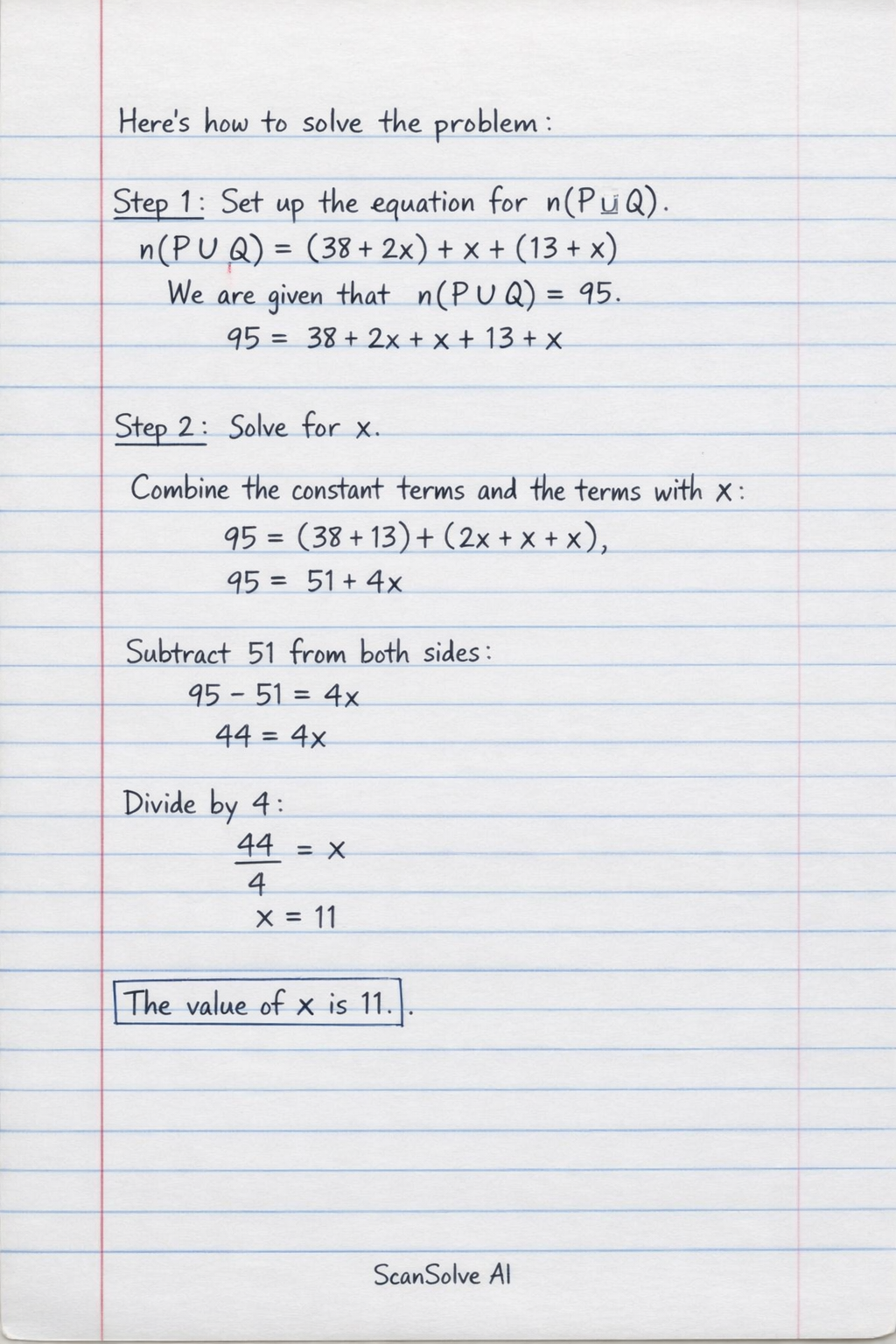
Handwritten Step-by-Step Solution
Get this as a handwritten image on WhatsApp — like a tutor wrote it for you.
Try on WhatsApp