
We read your photo as:
In a diagram RST, MN is parallel to ST. PM=5cm, RN=8cm and MS=10cm. Name the triangle similar to triangle PST, find the length of NT.
ScanSolve AI Answer
Step-by-step solution
7 stepsHere are the solutions to your questions:
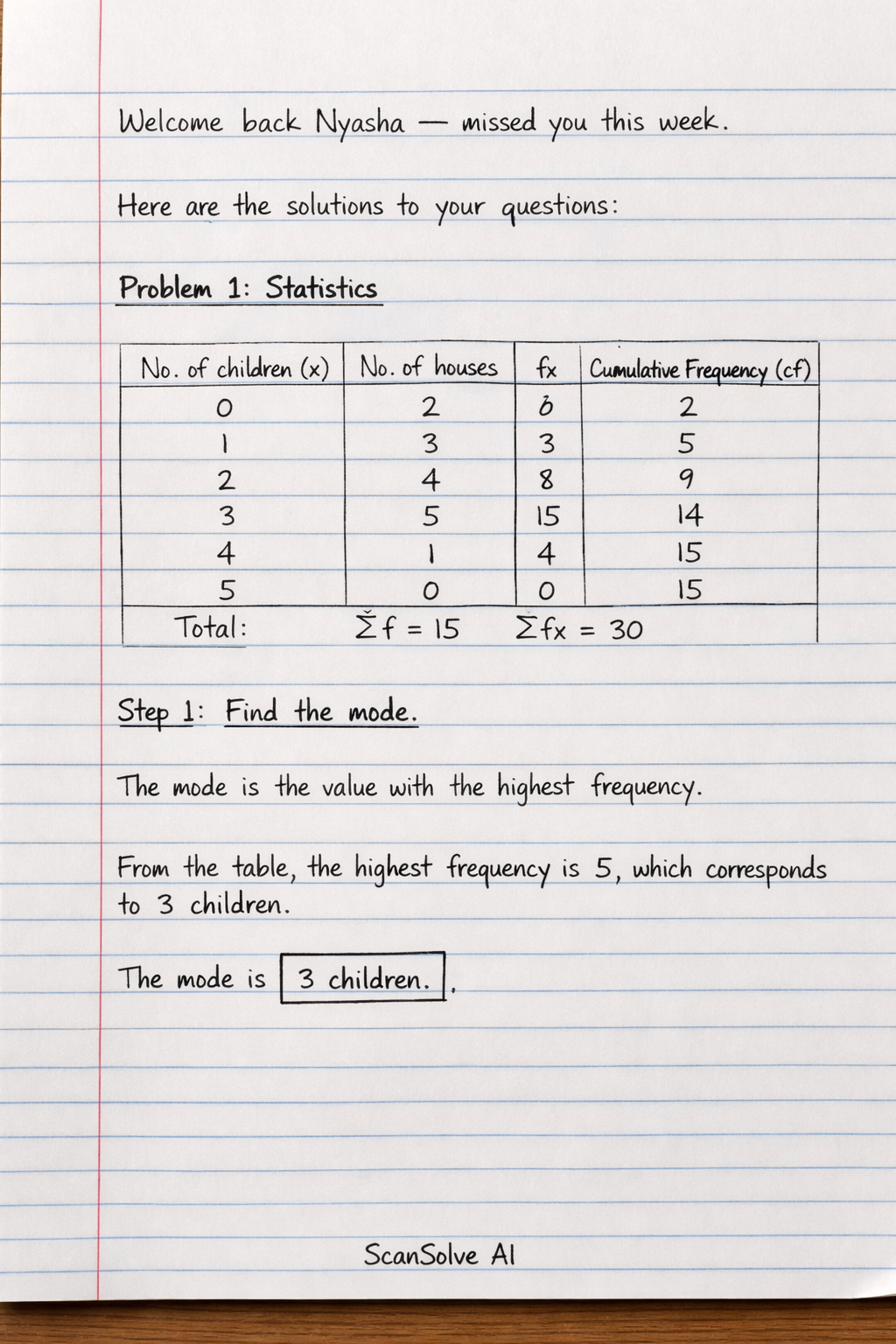
: Statistics
The table shows the number of children per house and the frequency (number of houses).
| No. of children (x) | No. of houses (f) | fx | Cumulative Frequency (cf) |
|---|---|---|---|
| 0 | 2 | 0 | 2 |
| 1 | 3 | 3 | 5 |
| 2 | 4 | 8 | 9 |
| 3 | 5 | 15 | 14 |
| 4 | 1 | 4 | 15 |
| 5 | 0 | 0 | 15 |
| Total |
Find the mode.
The mode is the value with the highest frequency. From the table, the highest frequency is 5, which corresponds to 3 children.
The mode is .Find the median.
The total number of houses is . The position of the median is , where is the total frequency.
Median position position.
Looking at the cumulative frequency, the 8th value falls in the category of 2 children (since the cumulative frequency reaches 5 at 1 child, and 9 at 2 children).
The median is .Find the mean.
The mean is calculated as .
Mean .
The mean is .: Geometry
Given the diagram with triangle PST and line segment MN parallel to ST.
Given: cm, cm.
There is a typo in the problem statement "RN = 8cm". Based on the diagram and typical similar triangle problems, we will assume 'RN' is a typo for 'PN', so cm.Name the triangle similar to triangle PST.
Since MN is parallel to ST, by the property of similar triangles, is similar to .
The triangle similar to is .Find the length of NT.
First, calculate the length of PS:
Since , the ratio of corresponding sides is equal:
Substitute the known values:
Simplify the ratio:
Solve for PT:
Now, find NT:
The length of NT is .
: Vectors
Given: and .Express as a column vector.
Using the triangle law of vector addition, .
Substitute the given column vectors and perform the addition.
The column vector for is .
Still stuck on this one?
Ask a follow-up, and the answer starts from this question.
More Mathematics Questions
Handwritten Step-by-Step Solution
Get this as a handwritten image on WhatsApp — like a tutor wrote it for you.
Try on WhatsApp