

This mathematics problem involves applying core mathematical principles and formulas. Below you will find a complete step-by-step solution with detailed explanations for each step, helping you understand not just the answer but the method behind it.
ScanSolve AI Answer
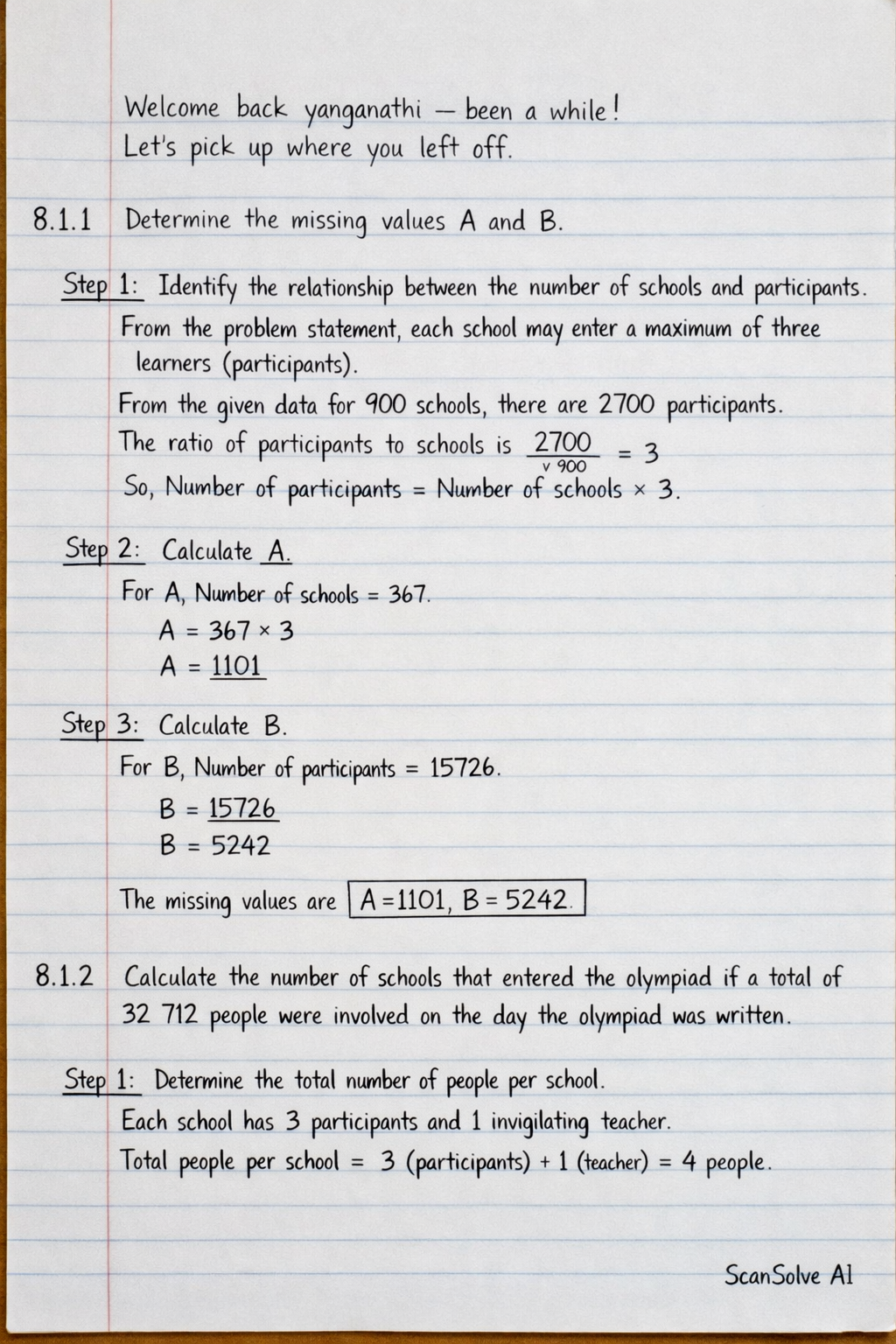
8.1.1 Determine the missing values A and B. Step 1: Identify the relationship between the number of schools and participants. From the problem statement, each school may enter a maximum of three learners (participants). From the given data for 900 schools, there are 2700 participants. The ratio of participants to schools is (2700)/(900) = 3. So, Number of participants = Number of schools × 3. Step 2: Calculate A. For A, Number of schools = 367. A = 367 × 3 A = 1101 Step 3: Calculate B. For B, Number of participants = 15726. B = (15726)/(3) B = 5242 The missing values are A = 1101, B = 5242. 8.1.2 Calculate the number of schools that entered the olympiad if a total of 32 712 people were involved on the day the olympiad was written. Step 1: Determine the total number of people per school. Each school has 3 participants and 1 invigilating teacher. Total people per school = 3 (participants) + 1 (teacher) = 4 people. Step 2: Calculate the total number of schools. Let S be the number of schools. Total people involved = 4 × S. Given total people involved = 32712. 4S = 32712 S = (32712)/(4) S = 8178 The number of schools that entered the olympiad is 8178. 8.2.1 Calculate Matuli's median percentage mark. Step 1: List Matuli's marks and order them from lowest to highest. Matuli's marks: 53, 48, 62, 80, 48, 58, 72, 48, 70, 86. Ordered marks: 48, 48, 48, 53, 58, 62, 70, 72, 80, 86. Step 2: Find the median. There are 10 marks (an even number). The median is the average of the two middle values (the 5th and 6th marks). The 5th mark is 58. The 6th mark is 62. Median = (58 + 62)/(2) Median = (120)/(2) Median = 60 Matuli's median percentage mark is 60\%. 8.2.2 Calculate Bianca's mean percentage mark. Step 1: List Bianca's marks. Bianca's marks from the table are: 36, 42, 48, 58, 60, 61, 62, 76, 86. The note states "Bianca's median percentage mark is 60%". If we order these 9 marks: 36, 42, 48, 58, 60, 61, 62, 76, 86, the 5th mark (median for 9 values) is 60, which matches the note. Thus, there are 9 marks for Bianca. Step 2: Calculate the sum of Bianca's marks. Sum = 36 + 42 + 48 + 58 + 60 + 61 + 62 + 76 + 86 Sum = 529 Step 3: Calculate the mean. Mean = Sum of marksNumber of marks Mean = (529)/(9) Mean ≈ 58.78 Bianca's mean percentage mark is 58.78\%. 8.2.3 Determine the missing value C, the lower quartile mark, if Khotso's interquartile range (IQR) is 16. Step 1: Identify Khotso's ordered marks and relevant information. Khotso's marks (already ordered as per note): 30, 47, C, 55, 60, 60, 68, 68, 70, 90. There are 10 marks. IQR = Upper quartile (Q3) - Lower quartile (Q1) = 16. Step 2: Determine the upper quartile (Q3). The upper quartile (Q3) is the median of the upper half of the data. Upper half: 60, 68, 68, 70, 90. Q3 is the 3rd value in this ordered upper half. Q3 = 68 Step 3: Determine the lower quartile (Q1) using the IQR. The lower quartile (Q1) is the median of the lower half of the data. Lower half: 30, 47, C, 55, 60. Q1 is the 3rd value in this ordered lower half, which is C. We are given IQR = 16. IQR = Q3 - Q1 16 = 68 - C C = 68 - 16 C = 52 The missing value C, which is also the lower quartile mark, is 52. 8.2.4 Bianca stated that Matuli performed better than she did in the practice tests. Give TWO possible reasons to support Bianca's statement. Here are two reasons to support Bianca's statement: • Matuli's mean percentage mark (62.5%) is higher than Bianca's mean percentage mark (58.78%). A higher mean indicates a better overall performance. • Matuli's lowest mark is 48%, while Bianca's lowest mark is 36%. This shows that Matuli avoided very low scores and maintained a higher minimum performance level. Send me the next one 📸