
We read your photo as:
In a party with guests who took Mirinda and Fanta, let k be the number of guests who took only Mirinda. If 5 guests took both Mirinda and Fanta, and the total number of guests who took Mirinda is 2k-1
ScanSolve AI Answer
Answer
Step-by-step solution
3 stepsSet up the equation for .
From the Venn diagram, the number of guests who took Mirinda, , is the sum of those who took only Mirinda and those who took both Mirinda and Fanta.
We are also given the expression for as .
Therefore, we can equate the two expressions for :Solve the equation for .
Subtract from both sides of the equation:
Add 10 to both sides of the equation:
State the value of .
The value of is 15.
We can also check the values for the regions:
Only Mirinda:
Only Fanta:
Both: 5
Neither: 7Total .
Using the given formula . This matches.The value of is .
Try one yourself
A new problem that tests the same skill.
Still stuck on this one?
Ask a follow-up, and the answer starts from this question.
More Mathematics Questions
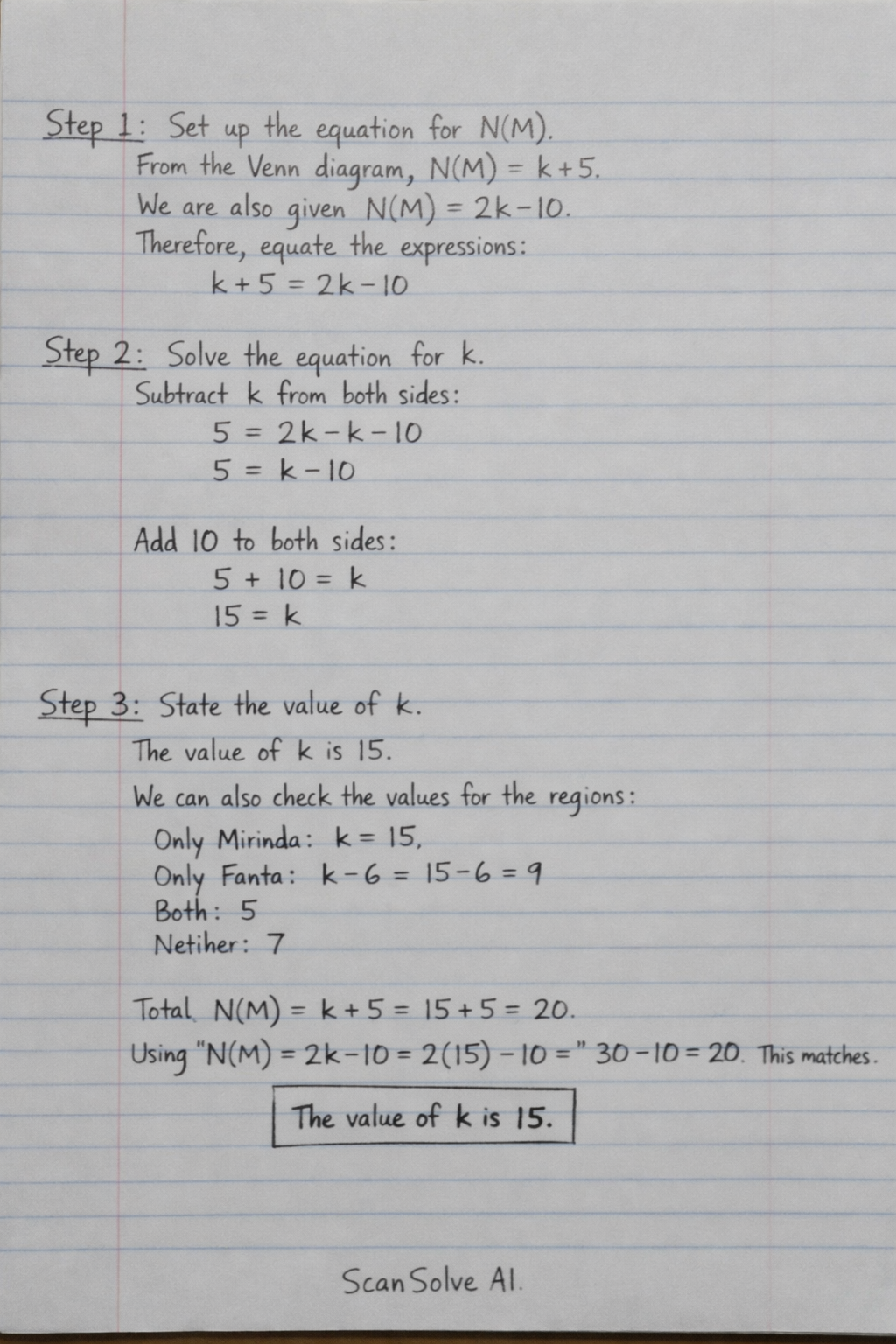
Handwritten Step-by-Step Solution
Get this as a handwritten image on WhatsApp — like a tutor wrote it for you.
Try on WhatsApp