
We read your photo as:
In ABC, A=40^, BC=12 and AB=15. Determine the other angles of the triangle. Assume that C is acute. In PQR, Q=110^, R=40^ and PQ=13. Calculate the lengths of the sides.
ScanSolve AI Answer
Answers
2 partsStep-by-step solution
5 stepsPart a· 2 steps
To determine the other angles of , we will use the Sine Rule.
Apply the Sine Rule to find angle .
The Sine Rule states that for a triangle with sides and opposite angles :
Given , (side ), and (side ). We want to find .
Since is acute, we take the principal value:
Find angle using the sum of angles in a triangle.
The sum of angles in a triangle is .
The other angles of the triangle are .
Part b
To calculate the lengths of the sides of , we will first find the missing angle and then use the Sine Rule.
Find angle using the sum of angles in a triangle.
Given and .
Apply the Sine Rule to find side .
Given . We want to find (opposite ) and (opposite ).
Apply the Sine Rule to find side .
The lengths of the sides are .
Try one yourself
A new problem that tests the same skill.
Still stuck on this one?
Ask a follow-up, and the answer starts from this question.
More Mathematics Questions
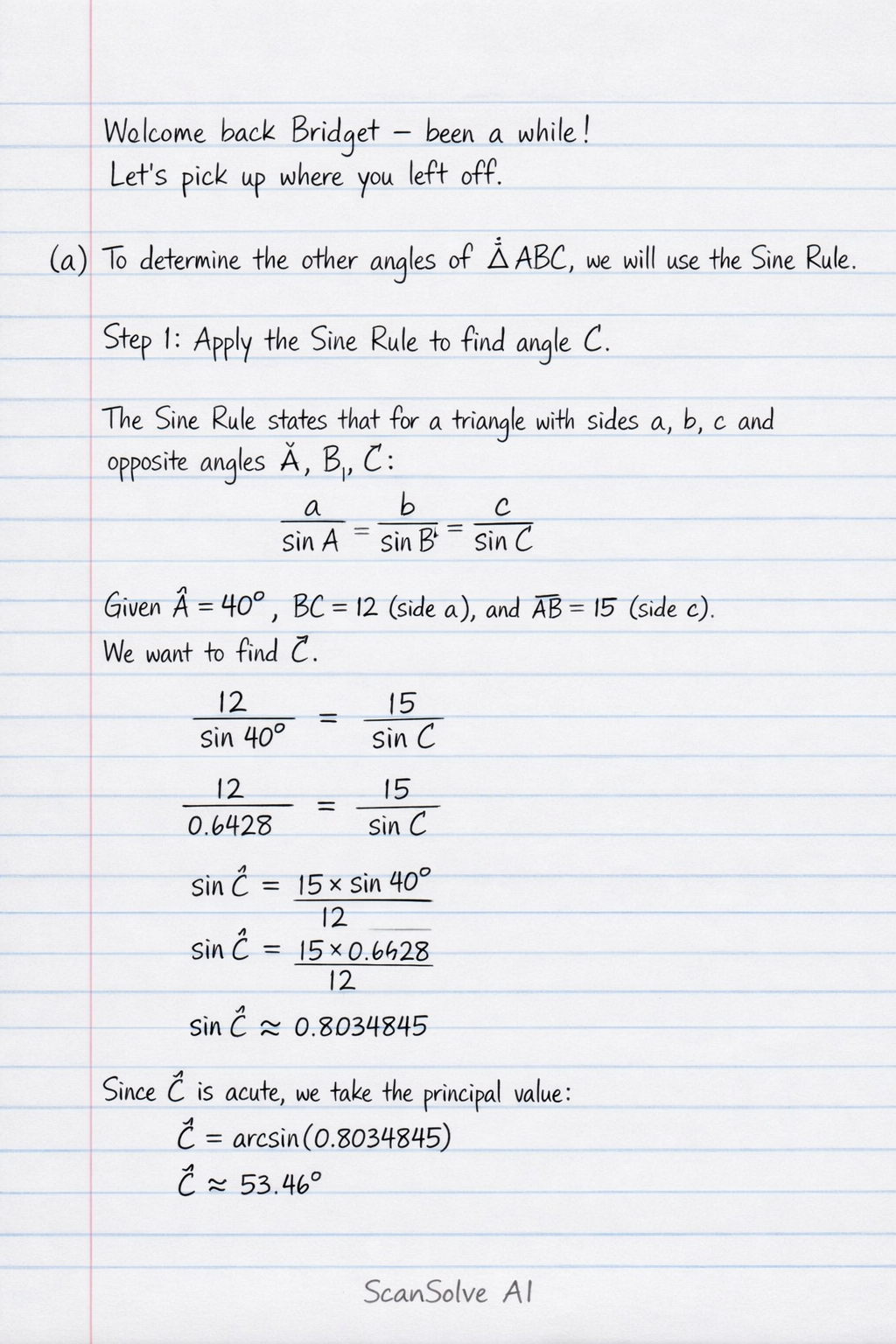
Handwritten Step-by-Step Solution
Get this as a handwritten image on WhatsApp — like a tutor wrote it for you.
Try on WhatsApp