
We read your photo as:
A) construct a triangle ABC with AB=2cm, BC=6cm and CA=6cm. b) Construct inside triangle ABC the locus which are equidistant from AB and BC call this set R. c) construct inside triangle ABC the which are equidistant from B and C. Call this set S.
ScanSolve AI Answer
Step-by-step solution
10 stepsHere are the steps for the geometric construction:
Part a· 4 steps
Construct a triangle ABC with AB = 2 cm, BC = 6 cm, and CA = 6 cm.
Draw a line segment.
Draw a line segment AB of length 2 cm.
Draw the first arc.
With A as the center, open your compass to 6 cm and draw an arc.
Draw the second arc.
With B as the center, open your compass to 6 cm and draw another arc. This arc should intersect the first arc.
Locate point C and complete the triangle.
Label the intersection point of the two arcs as C. Draw line segments AC and BC to complete .
Part b· 3 steps
Construct inside the locus which are equidistant from AB and BC. Call this set R.
Identify the locus.
The locus of points equidistant from two intersecting lines (AB and BC) is the angle bisector of the angle formed by these lines, which is .
Bisect .
Place the compass at point B and draw an arc that intersects both line segment AB and line segment BC. From each of these intersection points, draw another arc such that they intersect inside .
Draw the angle bisector.
Draw a straight line from point B through the intersection point of the two arcs you just drew. This line is the angle bisector of , and it represents set R.
The locus is the angle bisector of .
Part c· 3 steps
Construct inside the which are equidistant from B and C. Call this set S.
Identify the locus.
The locus of points equidistant from two fixed points (B and C) is the perpendicular bisector of the line segment connecting those two points, which is BC.
Construct the perpendicular bisector of BC.
Place the compass at point B and open it to more than half the length of BC. Draw an arc above and an arc below line segment BC. With the same compass setting, place the compass at point C and draw two more arcs that intersect the previous arcs above and below BC.
Draw the perpendicular bisector.
Draw a straight line connecting the two points where the arcs intersect. This line is the perpendicular bisector of BC, and it represents set S.
The locus is the perpendicular bisector of line segment BC.
Still stuck on this one?
Ask a follow-up, and the answer starts from this question.
More Mathematics Questions
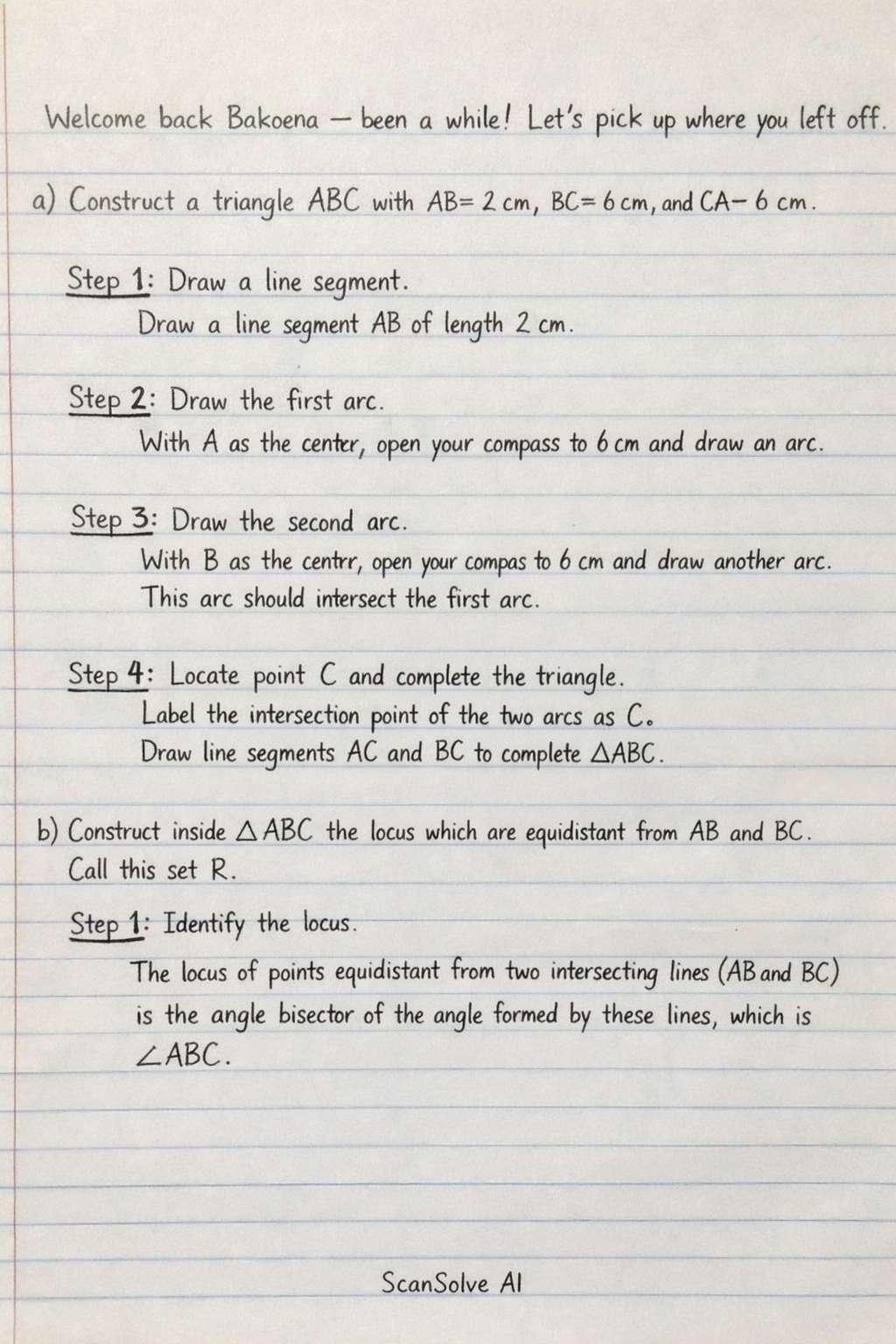
Handwritten Step-by-Step Solution
Get this as a handwritten image on WhatsApp — like a tutor wrote it for you.
Try on WhatsApp