
We read your photo as:
Construct triangle PQR where PQ = 7.5 cm, PR = 9 cm, and angle QPR = 135 degrees. Then construct the locus of points equidistant from P and Q (L1) and the locus of points equidistant from P and R (L2)
ScanSolve AI Answer
Step-by-step solution
18 stepsHere are the steps to construct the figure and find the required loci and measurements:
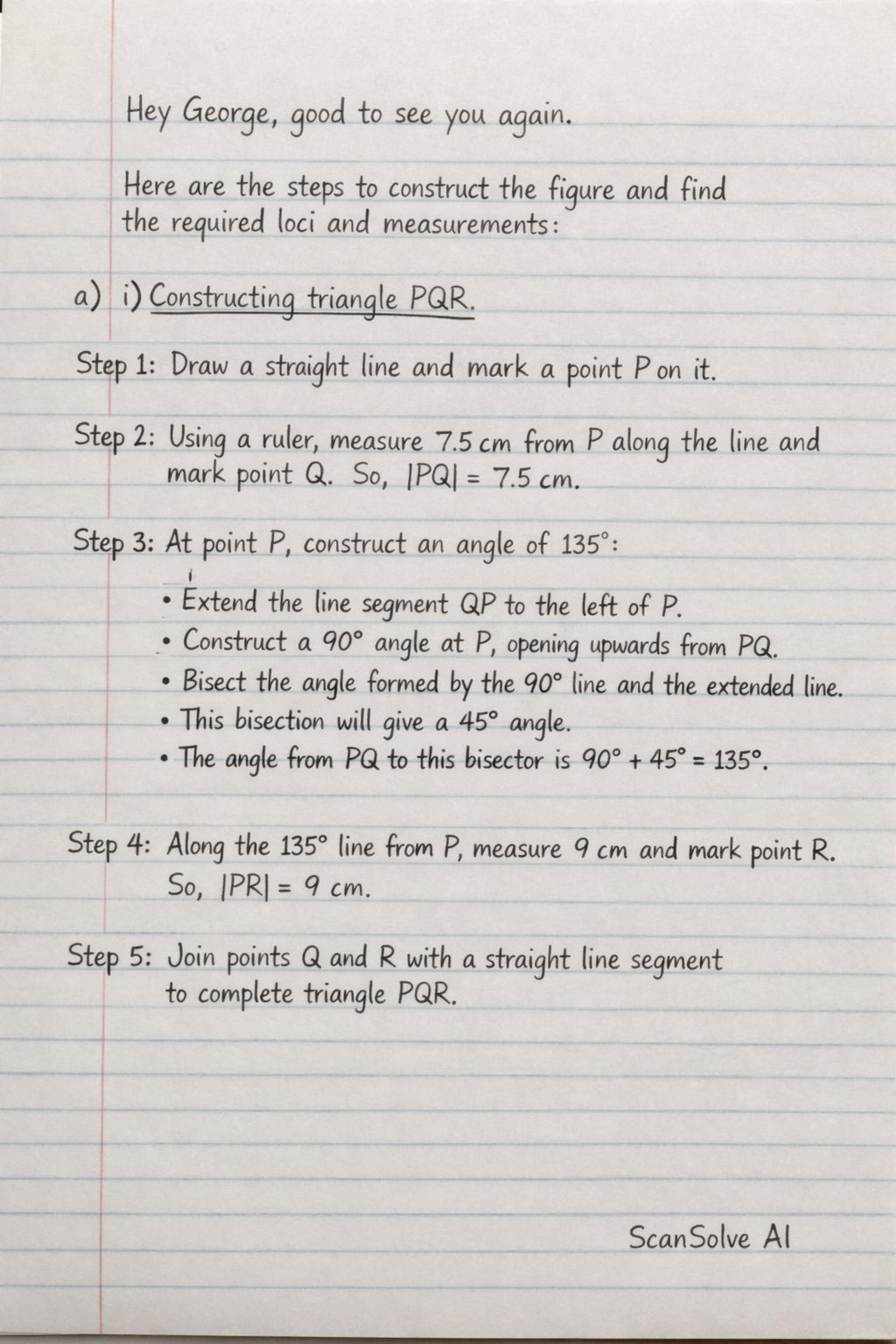
a) i) Constructing triangle PQR
Draw a straight line and mark a point P on it.
Using a ruler, measure from P along the line and mark point Q.
So, .
At point P, construct an angle of .
- Extend the line segment QP to the left of P.
- Construct a angle at P, opening upwards from PQ.
- Bisect the angle formed by the line and the extended line (to the left of P). This bisection will give a angle. The angle from PQ to this bisector will be .
Along the line from P, measure and mark point R.
So, .
Join points Q and R with a straight line segment to complete triangle PQR.
a) ii) Constructing Locus
Place the compass needle at P and open it to a radius greater than half the length of PQ.
Draw an arc above and below the line segment PQ.
Without changing the compass radius, place the needle at Q and draw another arc that intersects the first two arcs at two points.
Draw a straight line connecting these two intersection points.
This line is , the locus of points equidistant from P and Q.
a) iii) Constructing Locus
Place the compass needle at Q and open it to a radius greater than half the length of QR.
Draw an arc above and below the line segment QR.
Without changing the compass radius, place the needle at R and draw another arc that intersects the first two arcs at two points.
Draw a straight line connecting these two intersection points.
This line is , the locus of points equidistant from Q and R.
b) Locating point S
Identify the point where the lines and intersect.
Mark this intersection point as S.
c) Joining SR
Draw a straight line segment connecting point S to point R.
d) Measuring and
Using a protractor, measure the angle (the angle at R formed by lines SR and RQ).
Using a protractor, measure the angle (the angle at Q formed by lines PQ and QR).
Since this is a construction problem, the final angle measurements depend on the accuracy of your physical drawing. You will need to measure these angles from your constructed diagram.
Still stuck on this one?
Ask a follow-up, and the answer starts from this question.
More Mathematics Questions
Handwritten Step-by-Step Solution
Get this as a handwritten image on WhatsApp — like a tutor wrote it for you.
Try on WhatsApp