
We read your photo as:
Construct a triangle P.Q.R such that P.Q=6cm and angle P.Q.R = 70 degrees. ii. Construct perpendicular by setter of PQ and PR and let the inter section of the mediators be O. iii. Draw a circle with O as center and PO as radius.
Mathematics
ScanSolve AI Answer
Step-by-step solution
2 stepsOkay, Ella, let's tackle the measurement part of your construction.
Measure the length of
- Place a ruler along the line segment on your constructed triangle.
- Read the length from the ruler.
Based on the given dimensions, the theoretical length of can be calculated using the Law of Cosines:
Your measured value should be close to this.
Measure the angles of
- The angle is given in the problem as .
- To measure : Place the center of your protractor at point and align the baseline with . Read the angle where crosses the protractor scale.
- To measure : Place the center of your protractor at point and align the baseline with . Read the angle where crosses the protractor scale.
Based on the given dimensions, the theoretical values for the other angles are:
Using the Law of Sines:Then, using the sum of angles in a triangle:
Your measured values for and should be close to these.
Was this helpful?
Still stuck on this one?
Ask a follow-up, and the answer starts from this question.
Got a different question?Ask your own question
More Mathematics Questions
QConstruct a triangle PQR such that PQ=6cm and angle PQR=70 degrees. Construct the perpendicular…QUsing ruler and a pair of compasses only, construct a triangle PQR such that PQ = 6cm and angle PQR…QConstruct triangle PQR with PR=8cm, PQ=6cm, angle P=90 degrees. Construct triangle ABC with…QConstruct triangle PQR where PQ = 7.5 cm, PR = 9 cm, and angle QPR = 135 degrees. Then construct the…QConstruct triangle PQR in which PQ = 8cm, angle QPR = 50° and angle PQR = 70°. Measure and write the…
Browse by topic:Geometry
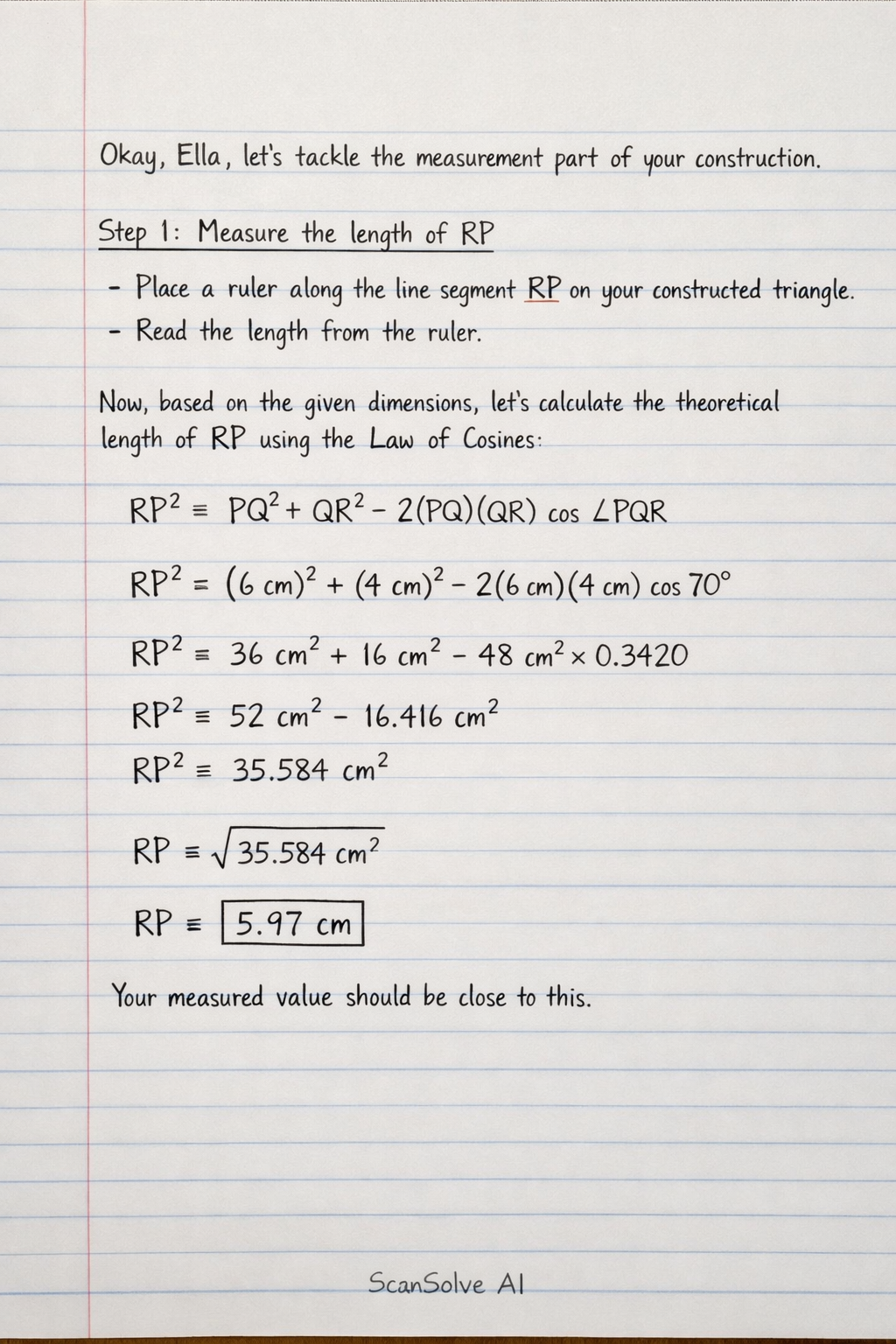
Handwritten Step-by-Step Solution
Get this as a handwritten image on WhatsApp — like a tutor wrote it for you.
Try on WhatsApp