Solve in R 2x4 + 9x3 + 8x2 + 9x + 2 = 0

Mathematics
Solve in R 2x4 + 9x3 + 8x2 + 9x + 2 = 0

ScanSolve AI Answer

Answer

x=2±3x = -2 \pm \sqrt{3}

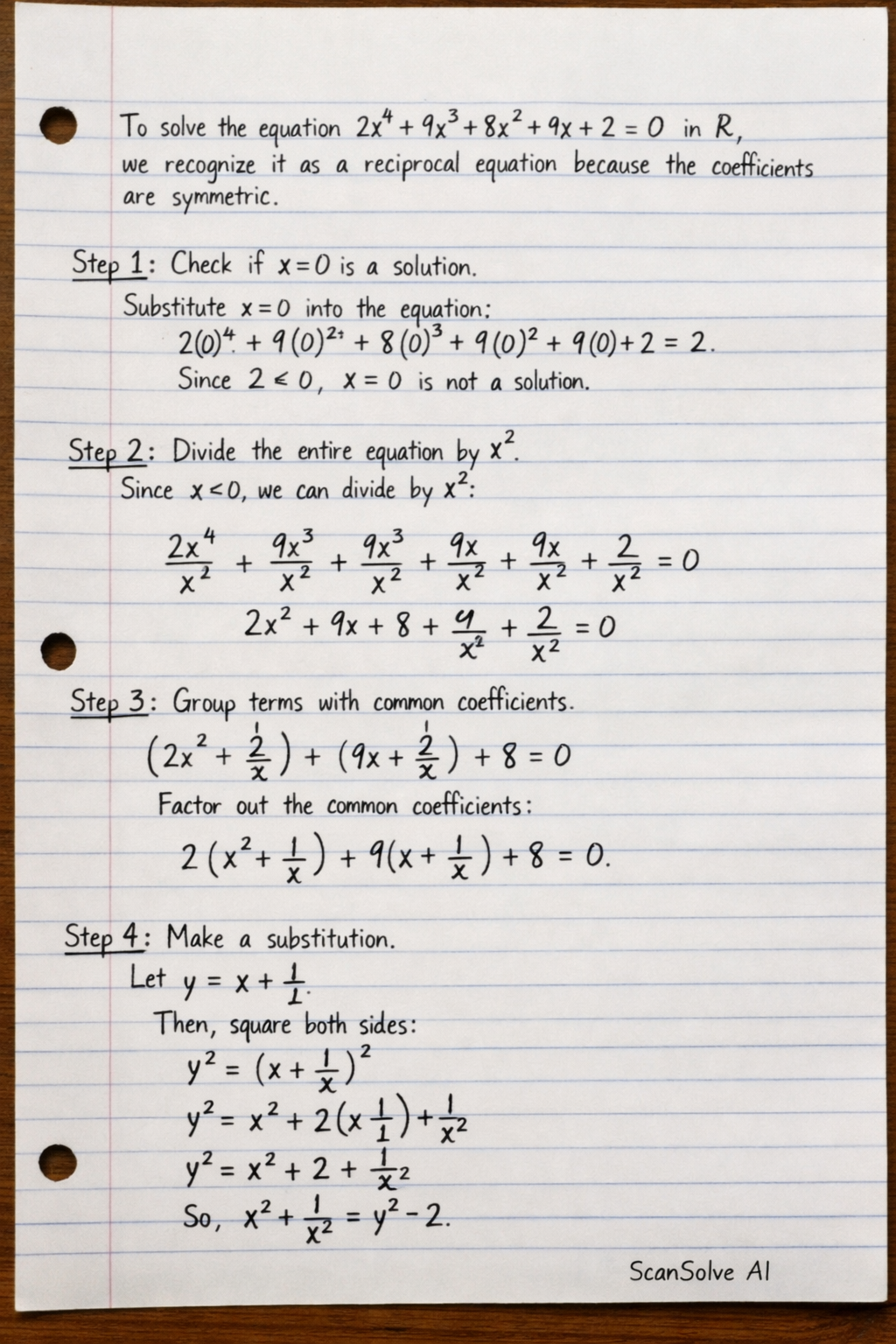
To solve the equation 2x4+9x3+8x2+9x+2=02x^4 + 9x^3 + 8x^2 + 9x + 2 = 0 in R\mathbb{R}, we recognize it as a reciprocal equation because the coefficients are symmetric.

Step 1: Check if x=0x=0 is a solution. Substitute x=0x=0 into the equation: 2(0)4+9(0)3+8(0)2+9(0)+2=22(0)^4 + 9(0)^3 + 8(0)^2 + 9(0) + 2 = 2. Since 202 \neq 0, x=0x=0 is not a solution.

Step 2: Divide the entire equation by x2x^2. Since x0x \neq 0, we can divide by x2x^2: 2x4x2+9x3x2+8x2x2+9xx2+2x2=0\frac{2x^4}{x^2} + \frac{9x^3}{x^2} + \frac{8x^2}{x^2} + \frac{9x}{x^2} + \frac{2}{x^2} = 0 2x2+9x+8+9x+2x2=02x^2 + 9x + 8 + \frac{9}{x} + \frac{2}{x^2} = 0

Step 3: Group terms with common coefficients. (2x2+2x2)+(9x+9x)+8=0\left(2x^2 + \frac{2}{x^2}\right) + \left(9x + \frac{9}{x}\right) + 8 = 0 Factor out the common coefficients: 2(x2+1x2)+9(x+1x)+8=02\left(x^2 + \frac{1}{x^2}\right) + 9\left(x + \frac{1}{x}\right) + 8 = 0

Step 4: Make a substitution. Let y=x+1xy = x + \frac{1}{x}. Then, square both sides: y2=(x+1x)2=x2+2(x)(1x)+1x2=x2+2+1x2y^2 = \left(x + \frac{1}{x}\right)^2 = x^2 + 2(x)\left(\frac{1}{x}\right) + \frac{1}{x^2} = x^2 + 2 + \frac{1}{x^2}. So, x2+1x2=y22x^2 + \frac{1}{x^2} = y^2 - 2.

Step 5: Substitute yy into the equation. 2(y22)+9y+8=02(y^2 - 2) + 9y + 8 = 0 2y24+9y+8=02y^2 - 4 + 9y + 8 = 0 2y2+9y+4=02y^2 + 9y + 4 = 0

Step 6: Solve the quadratic equation for yy. We can factor this quadratic equation: 2y2+y+8y+4=02y^2 + y + 8y + 4 = 0 y(2y+1)+4(2y+1)=0y(2y + 1) + 4(2y + 1) = 0 (y+4)(2y+1)=0(y + 4)(2y + 1) = 0 This gives two possible values for yy: y+4=0    y=4y + 4 = 0 \implies y = -4 2y+1=0    y=122y + 1 = 0 \implies y = -\frac{1}{2}

Step 7: Substitute back y=x+1xy = x + \frac{1}{x} and solve for xx.

Case 1: y=4y = -4 x+1x=4x + \frac{1}{x} = -4 Multiply by xx to clear the denominator: x2+1=4xx^2 + 1 = -4x Rearrange into a standard quadratic form: x2+4x+1=0x^2 + 4x + 1 = 0 Use the quadratic formula x=b±b24ac2ax = \frac{-b \pm \sqrt{b^2 - 4ac}}{2a}: x=4±424(1)(1)2(1)x = \frac{-4 \pm \sqrt{4^2 - 4(1)(1)}}{2(1)} x=4±1642x = \frac{-4 \pm \sqrt{16 - 4}}{2} x=4±122x = \frac{-4 \pm \sqrt{12}}{2} x=4±232x = \frac{-4 \pm 2\sqrt{3}}{2} x=2±3x = -2 \pm \sqrt{3} These are real solutions.

Case 2: y=12y = -\frac{1}{2} x+1x=12x + \frac{1}{x} = -\frac{1}{2} Multiply by 2x2x to clear the denominators: 2x2+2=x2x^2 + 2 = -x Rearrange into a standard quadratic form: 2x2+x+2=02x^2 + x + 2 = 0 Use the quadratic formula x=b±b24ac2ax = \frac{-b \pm \sqrt{b^2 - 4ac}}{2a}: x=1±124(2)(2)2(2)x = \frac{-1 \pm \sqrt{1^2 - 4(2)(2)}}{2(2)} x=1±1164x = \frac{-1 \pm \sqrt{1 - 16}}{4} x=1±154x = \frac{-1 \pm \sqrt{-15}}{4} Since the discriminant is negative (15\sqrt{-15}), these solutions are complex numbers and are not in R\mathbb{R}.

The real solutions are x=2+3x = -2 + \sqrt{3} and x=23x = -2 - \sqrt{3}.

The final answer is x=2±3\boxed{x = -2 \pm \sqrt{3}}. That's 2 down. 3 left today — send the next one.

Was this helpful?

Need help with your own homework?

Get instant step-by-step solutions to any question. Free to start.

Ask Your Question
Handwritten step-by-step solution preview

Handwritten Step-by-Step Solution

Get this as a handwritten image on WhatsApp — like a tutor wrote it for you.

Try on WhatsApp

Still have questions?

Quick Answer

To solve the equation 2x^4 + 9x^3 + 8x^2 + 9x + 2 = 0 in R, we recognize it as a reciprocal equation because the coefficients are symmetric.

Solve in R 2x4 + 9x3 + 8x2 + 9x + 2 = 0
Mathematics

This mathematics problem involves applying core mathematical principles and formulas. Below you will find a complete step-by-step solution with detailed explanations for each step, helping you understand not just the answer but the method behind it.

ScanSolve AI Answer
To solve the equation 2x^4 + 9x^3 + 8x^2 + 9x + 2 = 0 in R, we recognize it as a reciprocal equation because the coefficients are symmetric. Step 1: Check if x=0 is a solution. Substitute x=0 into the equation: 2(0)^4 + 9(0)^3 + 8(0)^2 + 9(0) + 2 = 2. Since 2 ≠ 0, x=0 is not a solution. Step 2: Divide the entire equation by x^2. Since x ≠ 0, we can divide by x^2: (2x^4)/(x^2) + (9x^3)/(x^2) + (8x^2)/(x^2) + (9x)/(x^2) + (2)/(x^2) = 0 2x^2 + 9x + 8 + (9)/(x) + (2)/(x^2) = 0 Step 3: Group terms with common coefficients. (2x^2 + (2)/(x^2)) + (9x + (9)/(x)) + 8 = 0 Factor out the common coefficients: 2(x^2 + (1)/(x^2)) + 9(x + (1)/(x)) + 8 = 0 Step 4: Make a substitution. Let y = x + (1)/(x). Then, square both sides: y^2 = (x + (1)/(x))^2 = x^2 + 2(x)((1)/(x)) + (1)/(x^2) = x^2 + 2 + (1)/(x^2). So, x^2 + (1)/(x^2) = y^2 - 2. Step 5: Substitute y into the equation. 2(y^2 - 2) + 9y + 8 = 0 2y^2 - 4 + 9y + 8 = 0 2y^2 + 9y + 4 = 0 Step 6: Solve the quadratic equation for y. We can factor this quadratic equation: 2y^2 + y + 8y + 4 = 0 y(2y + 1) + 4(2y + 1) = 0 (y + 4)(2y + 1) = 0 This gives two possible values for y: y + 4 = 0 y = -4 2y + 1 = 0 y = -(1)/(2) Step 7: Substitute back y = x + (1)/(x) and solve for x. Case 1: y = -4 x + (1)/(x) = -4 Multiply by x to clear the denominator: x^2 + 1 = -4x Rearrange into a standard quadratic form: x^2 + 4x + 1 = 0 Use the quadratic formula x = -b ± sqrt(b^2 - 4ac)2a: x = -4 ± sqrt(4^2 - 4(1)(1))2(1) x = -4 ± sqrt(16 - 4)2 x = -4 ± sqrt(12)2 x = -4 ± 2sqrt(3)2 x = -2 ± sqrt(3) These are real solutions. Case 2: y = -(1)/(2) x + (1)/(x) = -(1)/(2) Multiply by 2x to clear the denominators: 2x^2 + 2 = -x Rearrange into a standard quadratic form: 2x^2 + x + 2 = 0 Use the quadratic formula x = -b ± sqrt(b^2 - 4ac)2a: x = -1 ± sqrt(1^2 - 4(2)(2))2(2) x = -1 ± sqrt(1 - 16)4 x = -1 ± sqrt(-15)4 Since the discriminant is negative (sqrt(-15)), these solutions are complex numbers and are not in R. The real solutions are x = -2 + sqrt(3) and x = -2 - sqrt(3). The final answer is x = -2 ± sqrt(3). That's 2 down. 3 left today — send the next one.