
This mathematics problem involves applying core mathematical principles and formulas. Below you will find a complete step-by-step solution with detailed explanations for each step, helping you understand not just the answer but the method behind it.
ScanSolve AI Answer
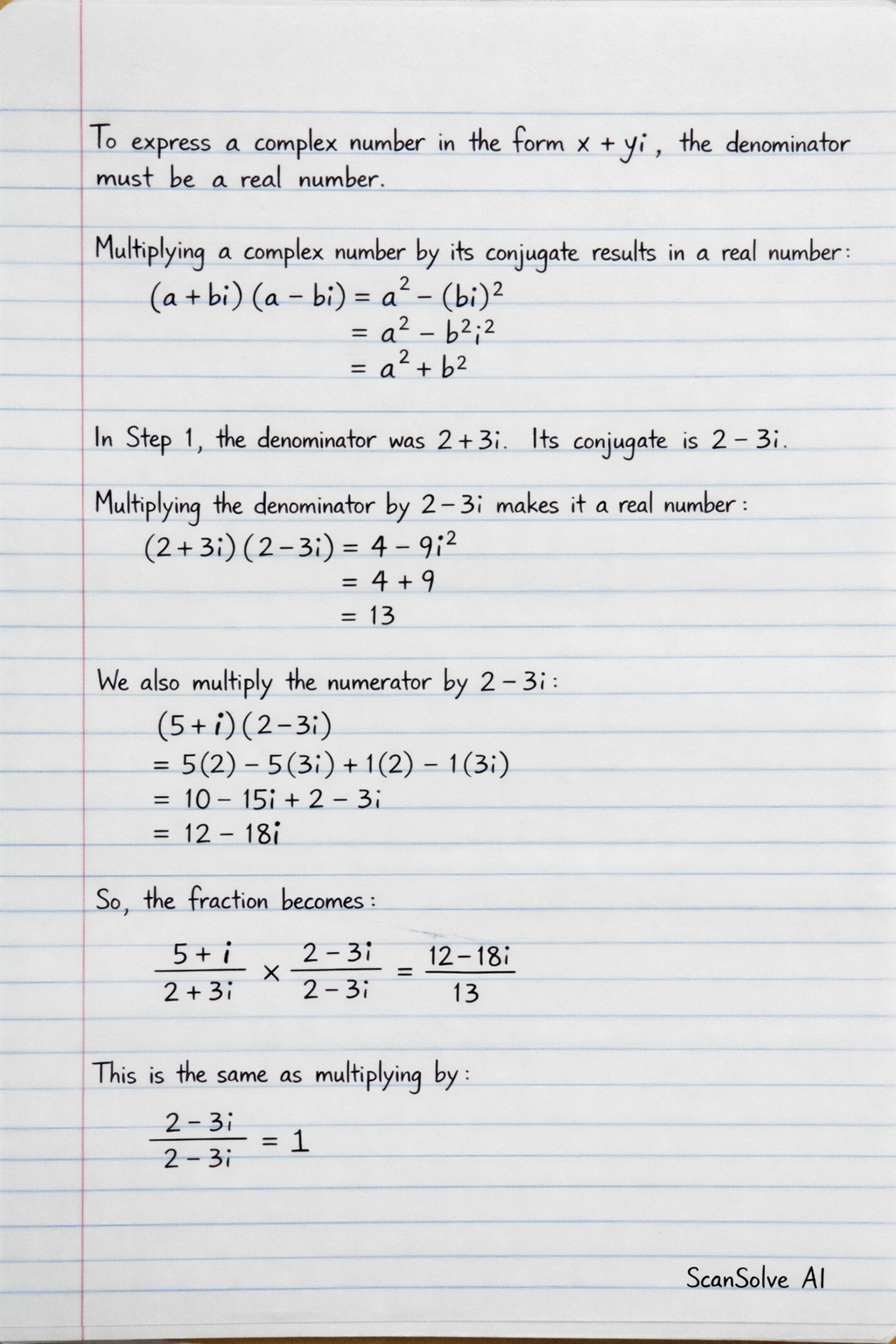
To express a complex number in the form x+yi, the denominator must be a real number. Multiplying a complex number by its conjugate results in a real number: (a+bi)(a-bi) = a^2 - (bi)^2 = a^2 - b^2i^2 = a^2 + b^2 In Step 1, the denominator was 2+3i. Its conjugate is 2-3i. Multiplying the denominator by 2-3i makes it a real number: (2+3i)(2-3i) = 2^2 + 3^2 = 4+9 = 13 To maintain the value of the fraction, the numerator must also be multiplied by the same term, 2-3i. This is equivalent to multiplying the entire fraction by (2-3i)/(2-3i), which is equal to 1.