In the diagram below, B1=beta, B2=alpha, AB=y units, BD=DC=x units and AC BC. (1) Show that D=180^-2alpha. (2) Prove that y=(x 2alpha)/( alpha beta). (3) If x=150 m, alpha=30^ and beta=70^, calculate y.
|Mathematics
In the diagram below, B1=beta, B2=alpha, AB=y units, BD=DC=x units and AC BC. (1) Show that D=180^-2alpha. (2) Prove that y=(x 2alpha)/( alpha beta). (3) If x=150 m, alpha=30^ and beta=70^, calculate y.
ScanSolve AI Answer
Answer
759.64 m
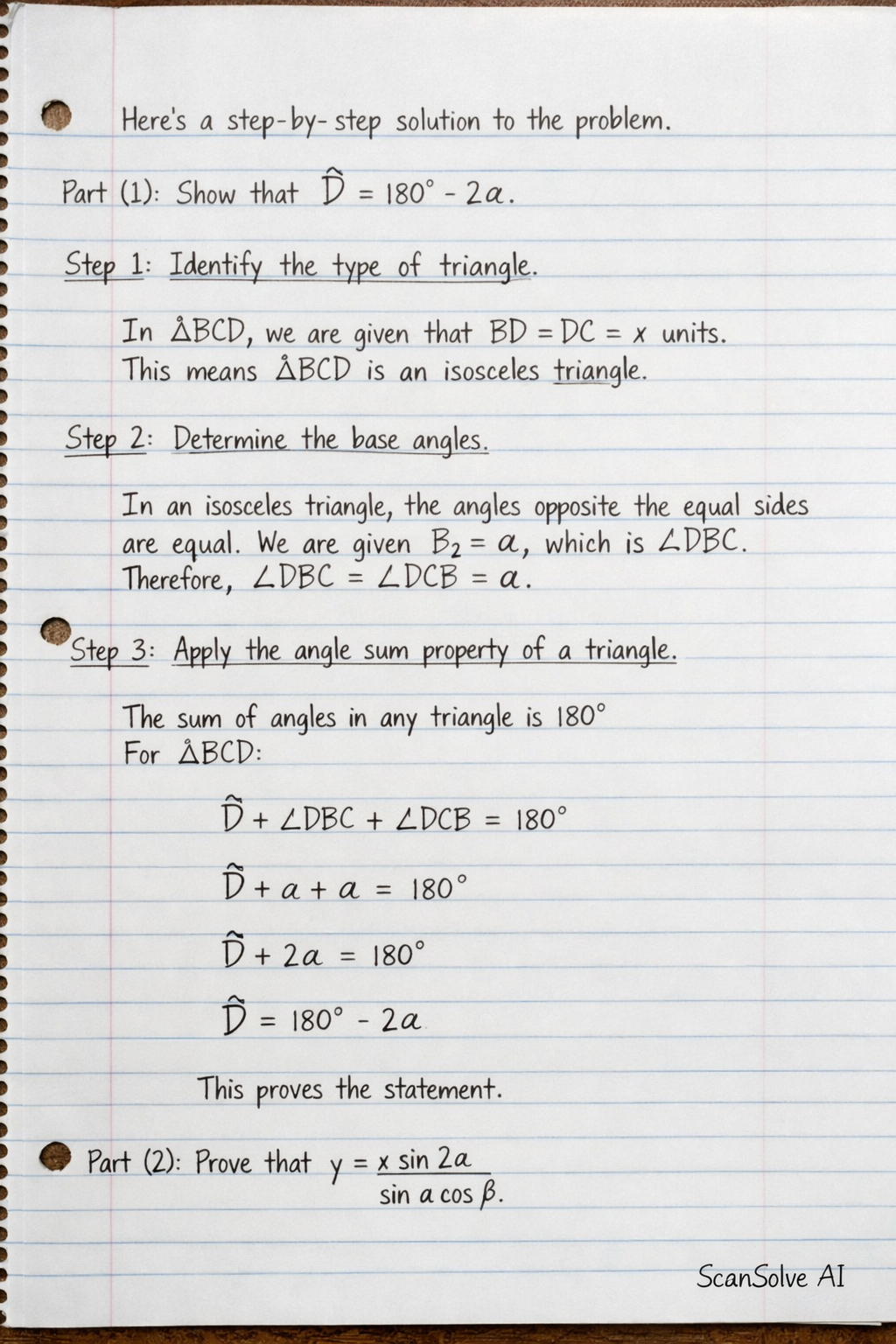
Here's a step-by-step solution to the problem.
Part (1): Show that D^=180∘−2α.
Step 1: Identify the type of triangle.
In △BCD, we are given that BD=DC=x units. This means △BCD is an isosceles triangle.
Step 2: Determine the base angles.
In an isosceles triangle, the angles opposite the equal sides are equal. We are given B^2=α, which is ∠DBC. Therefore, ∠DBC=∠DCB=α.
Step 3: Apply the angle sum property of a triangle.
The sum of angles in any triangle is 180∘. For △BCD:
D^+∠DBC+∠DCB=180∘
Substitute the known angles:
D^+α+α=180∘D^+2α=180∘
Rearrange to solve for D^:
D^=180∘−2α
This proves the statement.
Part (2): Prove that y=sinαcosβxsin2α.
Step 1: Use the Sine Rule in △BCD.
In △BCD, we have sides BD=x, DC=x, and angles ∠DBC=α, ∠DCB=α, and D^=180∘−2α.
Applying the Sine Rule:
sinD^BC=sin∠DBCDC
Substitute the known values:
sin(180∘−2α)BC=sinαx
Using the identity sin(180∘−θ)=sinθ:
sin2αBC=sinαx
Solve for BC:
BC=sinαxsin2α
Step 2: Use trigonometry in △ABC.
We are given that AC⊥BC, so △ABC is a right-angled triangle at C.
We have B^1=β, which is ∠ABC. The hypotenuse is AB=y.
In a right-angled triangle, cos(angle)=hypotenuseadjacent.
cosβ=ABBC
Substitute AB=y:
cosβ=yBC
Solve for y:
y=cosβBC
Step 3: Substitute the expression for BC into the equation for y.
Substitute BC=sinαxsin2α into y=cosβBC:
y=cosβsinαxsin2αy=sinαcosβxsin2α
This proves the statement.
Part (3): If x=150 m, α=30∘ and β=70∘, calculate y.
Step 1: Use the formula derived in Part (2).
y=sinαcosβxsin2α
Step 2: Substitute the given values.
Given x=150 m, α=30∘, β=70∘.
y=sin30∘cos70∘150sin(2×30∘)y=sin30∘cos70∘150sin60∘
Step 3: Calculate the trigonometric values and simplify.
sin60∘=23sin30∘=21cos70∘≈0.34202
Substitute these values:
y=21×cos70∘150×23y=0.5cos70∘753y=cos70∘1503
Using a calculator:
y≈0.3420201150×1.7320508y≈0.3420201259.80762y≈759.639m
Rounding to two decimal places:
y≈759.64m
The value of y is 759.64m.
Send me the next one 📸
Was this helpful?
Need help with your own homework?
Get instant step-by-step solutions to any question. Free to start.
Here's a step-by-step solution to the problem. Part (1): Show that D = 180^ - 2.
In the diagram below, B1=beta, B2=alpha, AB=y units, BD=DC=x units and AC BC. (1) Show that D=180^-2alpha. (2) Prove that y=(x 2alpha)/( alpha beta). (3) If x=150 m, alpha=30^ and beta=70^, calculate y.
This mathematics problem involves applying core mathematical principles and formulas. Below you will find a complete step-by-step solution with detailed explanations for each step, helping you understand not just the answer but the method behind it.
ScanSolve AI Answer
Here's a step-by-step solution to the problem. Part (1): Show that D = 180^ - 2. Step 1: Identify the type of triangle. In BCD, we are given that BD = DC = x units. This means BCD is an isosceles triangle. Step 2: Determine the base angles. In an isosceles triangle, the angles opposite the equal sides are equal. We are given B_2 = , which is DBC. Therefore, DBC = DCB = . Step 3: Apply the angle sum property of a triangle. The sum of angles in any triangle is 180^. For BCD: D + DBC + DCB = 180^ Substitute the known angles: D + + = 180^ D + 2 = 180^ Rearrange to solve for D: D = 180^ - 2 This proves the statement. Part (2): Prove that y = (x 2)/( ). Step 1: Use the Sine Rule in BCD. In BCD, we have sides BD=x, DC=x, and angles DBC=, DCB=, and D=180^ - 2. Applying the Sine Rule: (BC)/( D) = (DC)/( DBC) Substitute the known values: (BC)/((180^ - 2)) = (x)/( ) Using the identity (180^ - ) = : (BC)/( 2) = (x)/( ) Solve for BC: BC = (x 2)/( ) Step 2: Use trigonometry in ABC. We are given that AC BC, so ABC is a right-angled triangle at C. We have B_1 = , which is ABC. The hypotenuse is AB = y. In a right-angled triangle, (angle) = adjacenthypotenuse. = (BC)/(AB) Substitute AB = y: = (BC)/(y) Solve for y: y = (BC)/( ) Step 3: Substitute the expression for BC into the equation for y. Substitute BC = (x 2)/( ) into y = (BC)/( ): y = (x 2)/( ) y = (x 2)/( ) This proves the statement. Part (3): If x = 150 m, = 30^ and = 70^, calculate y. Step 1: Use the formula derived in Part (2). y = (x 2)/( ) Step 2: Substitute the given values. Given x = 150 m, = 30^, = 70^. y = (150 (2 × 30^))/( 30^ 70^) y = (150 60^)/( 30^ 70^) Step 3: Calculate the trigonometric values and simplify. 60^ = sqrt(3)2 30^ = (1)/(2) 70^ ≈ 0.34202 Substitute these values: y = 150 × sqrt(3)2(1)/(2) × 70^ y = 75sqrt(3)0.5 70^ y = 150sqrt(3) 70^ Using a calculator: y ≈ (150 × 1.7320508)/(0.3420201) y ≈ (259.80762)/(0.3420201) y ≈ 759.639 m Rounding to two decimal places: y ≈ 759.64 m The value of y is 759.64 m. Send me the next one 📸