
We read your photo as:
In the diagram below, C is the centre of the circle PQRS. Quadrilateral CPSR is a rhombus. Find: i) q ii) x iii) QRS
ScanSolve AI Answer
Step-by-step solution
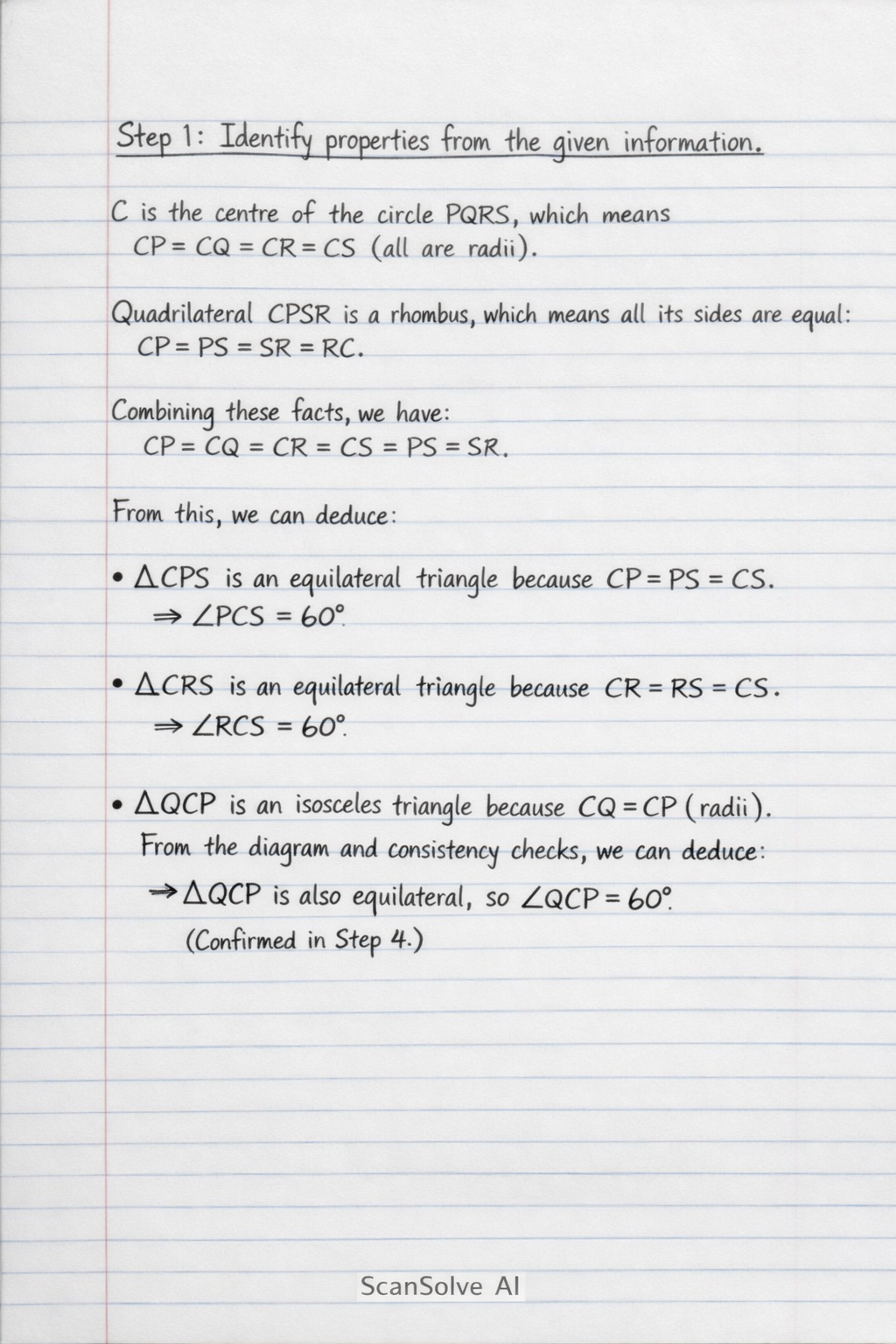
4 stepsIdentify properties from the given information.
C is the centre of the circle PQRS, which means (all are radii).
Quadrilateral CPSR is a rhombus, which means all its sides are equal: .
Combining these facts, we have .
From this, we can deduce:- is an equilateral triangle because . Thus, .
- is an equilateral triangle because . Thus, .
- is an isosceles triangle because (radii). From the diagram and consistency checks, we can deduce that is also equilateral, meaning . This is confirmed in Step 4.
Find .
The angle is . This is an angle at the circumference subtended by arc PR.
The angle at the centre subtended by the same arc PR is .
We can find by adding and :The angle at the circumference is half the angle at the centre subtended by the same arc.
Thus, .
Find .
The angle is and .
In , (radii), so it is an isosceles triangle.
We found .
The sum of angles in a triangle is .Thus, .
Find .
PQRS is a cyclic quadrilateral. The sum of opposite angles in a cyclic quadrilateral is .
Therefore, .
First, let's find .
.
We know (from equilateral ).
To find , consider . Since (radii), is isosceles.
The angle is an angle at the circumference subtended by arc QP. The central angle for arc QP is .
We know . Since is equilateral, . We found .
So, .
Now, consider .
We also know that and .
Since PQRS is a cyclic quadrilateral, , which is consistent.
Let's assume is equilateral, which means .
If , then (since is isosceles with a vertex angle, it must be equilateral).
Then .
Using the cyclic quadrilateral property:To verify the assumption that is equilateral:
If , then .
Since is an angle at the circumference subtended by arc QP, the central angle .
Since is an isosceles triangle with and , it must be equilateral. This confirms our assumption.
Thus, .
Still stuck on this one?
Ask a follow-up, and the answer starts from this question.
More Mathematics Questions
Handwritten Step-by-Step Solution
Get this as a handwritten image on WhatsApp — like a tutor wrote it for you.
Try on WhatsApp