
We read your photo as:
lim sqrt(1-t) + sqrt(1+t) t 0 lim (2t2 + 3t + 1)/(t2 - 1) t infinity
Mathematics
ScanSolve AI Answer
Answer
2
Step-by-step solution
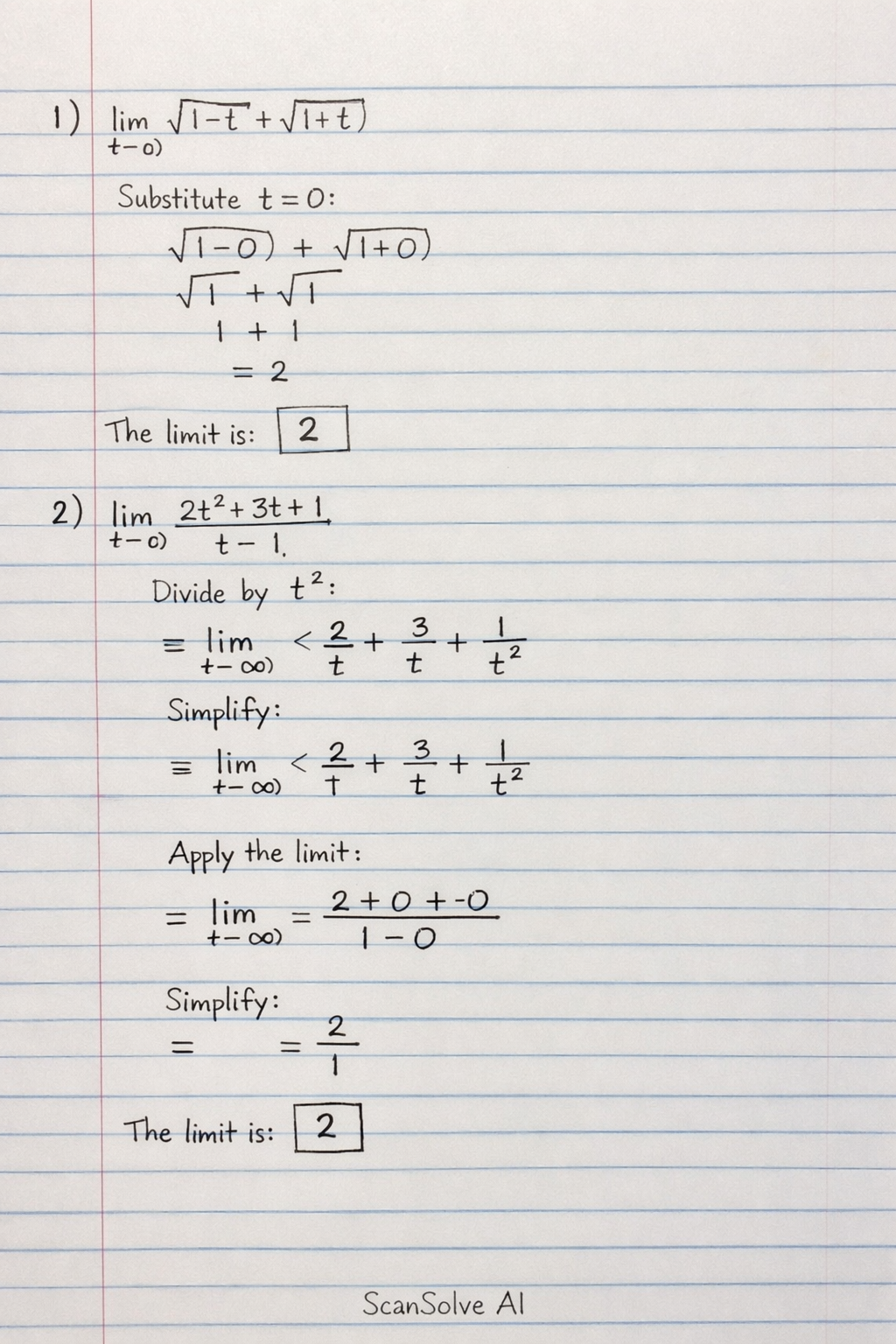
6 stepsHere are the solutions to your limit problems.
1.) To evaluate the limit, substitute into the expression.
Substitute into the function.
Simplify the expression.
The limit is:
2.) To evaluate the limit as , divide every term in the numerator and denominator by the highest power of in the denominator, which is .
Divide all terms by .
Simplify the terms.
Apply the limit property for .
Simplify the result.
Was this helpful?
Try one yourself
A new problem that tests the same skill.
Still stuck on this one?
Ask a follow-up, and the answer starts from this question.
Got a different question?Ask your own question
More Mathematics Questions
Qlim t->inf (2t2 + 3t + 1) / (t2 - 1)QEvaluate the limit: lim x->inf (sqrt(x2+2x+3) - sqrt(x2+3)) / (1 - cos(sin⁻¹(tan(1/x))))QEvaluate the limit: lim (t->0) (10^t - 2^t - 5^t + 1) / (t * tan(t))QEvaluate the limit: lim (t->0) x / (3 - sqrt(x+9))QFind the integral integral_sqrt(2)2 (1)/(t3 sqrt(t2-1)) dt using trigonometric substitution.
Browse by topic:Calculus
Handwritten Step-by-Step Solution
Get this as a handwritten image on WhatsApp — like a tutor wrote it for you.
Try on WhatsApp