
We read your photo as:
In the diagram below, F is due east of E, and angle EFG=40°. Calculate the bearing of (a) F from G (b) E from G
ScanSolve AI Answer
Step-by-step solution
3 stepsHere's how to calculate the bearings:
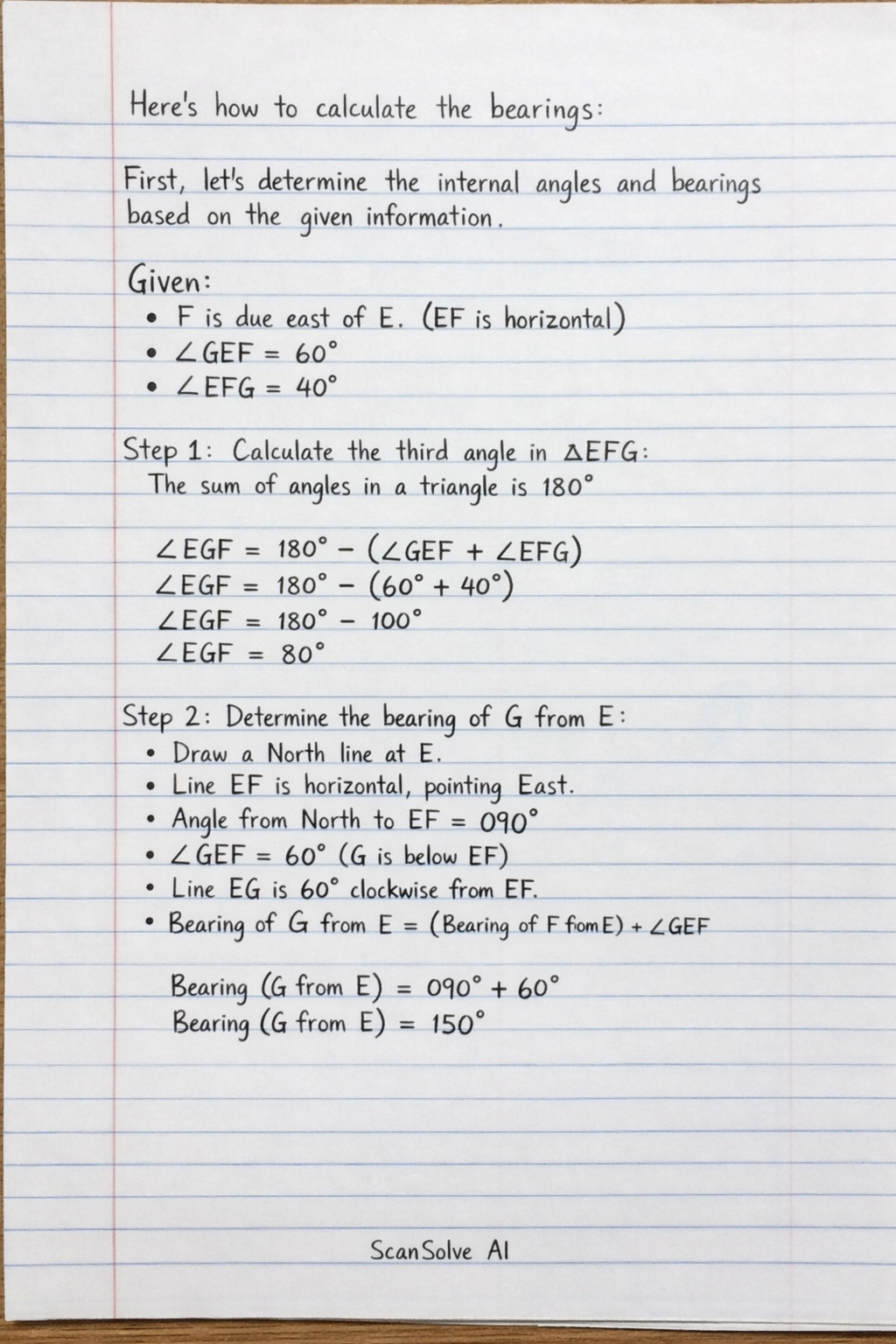
First, let's determine the internal angles and bearings based on the given information.
- Given:
- F is due east of E. This means the line EF is horizontal.
- Angle GEF = .
- Angle EFG = .
Calculate the third angle in triangle EFG.
The sum of angles in a triangle is .
Determine the bearing of G from E.
- Draw a North line at E.
- Since F is due east of E, the line EF points East. The angle from North at E, clockwise to EF is .
- From the diagram, G is below the line EF. Angle GEF is .
- Therefore, the line EG is clockwise from the line EF.
- Bearing of G from E = (Bearing of F from E) +
Determine the bearing of G from F.
- Draw a North line at F.
- Since E is due west of F, the line FE points West. The angle from North at F, clockwise to FE is .
- From the diagram, G is below the line EF. Angle EFG is .
- Therefore, the line FG is clockwise from the line FE.
- Bearing of G from F = (Bearing of E from F) +
a) Calculate the bearing of F from G.
To find the bearing of F from G, we use the back bearing from G from F.
If the bearing of A from B is :- If , the bearing of B from A is .
- If , the bearing of B from A is .
We have Bearing (G from F) = .
Since , the bearing of F from G is .This can also be found by drawing a North line at G and using parallel lines. The angle from North at F to FG is . The angle from North at G to GF (alternate interior angle with the angle from the South line at F to FG) is .
b) Calculate the bearing of E from G.
To find the bearing of E from G, we use the back bearing from G from E.
We have Bearing (G from E) = .
Since , the bearing of E from G is .Final Answers:
a) The bearing of F from G is
b) The bearing of E from G is
Still stuck on this one?
Ask a follow-up, and the answer starts from this question.
More Mathematics Questions
Handwritten Step-by-Step Solution
Get this as a handwritten image on WhatsApp — like a tutor wrote it for you.
Try on WhatsApp