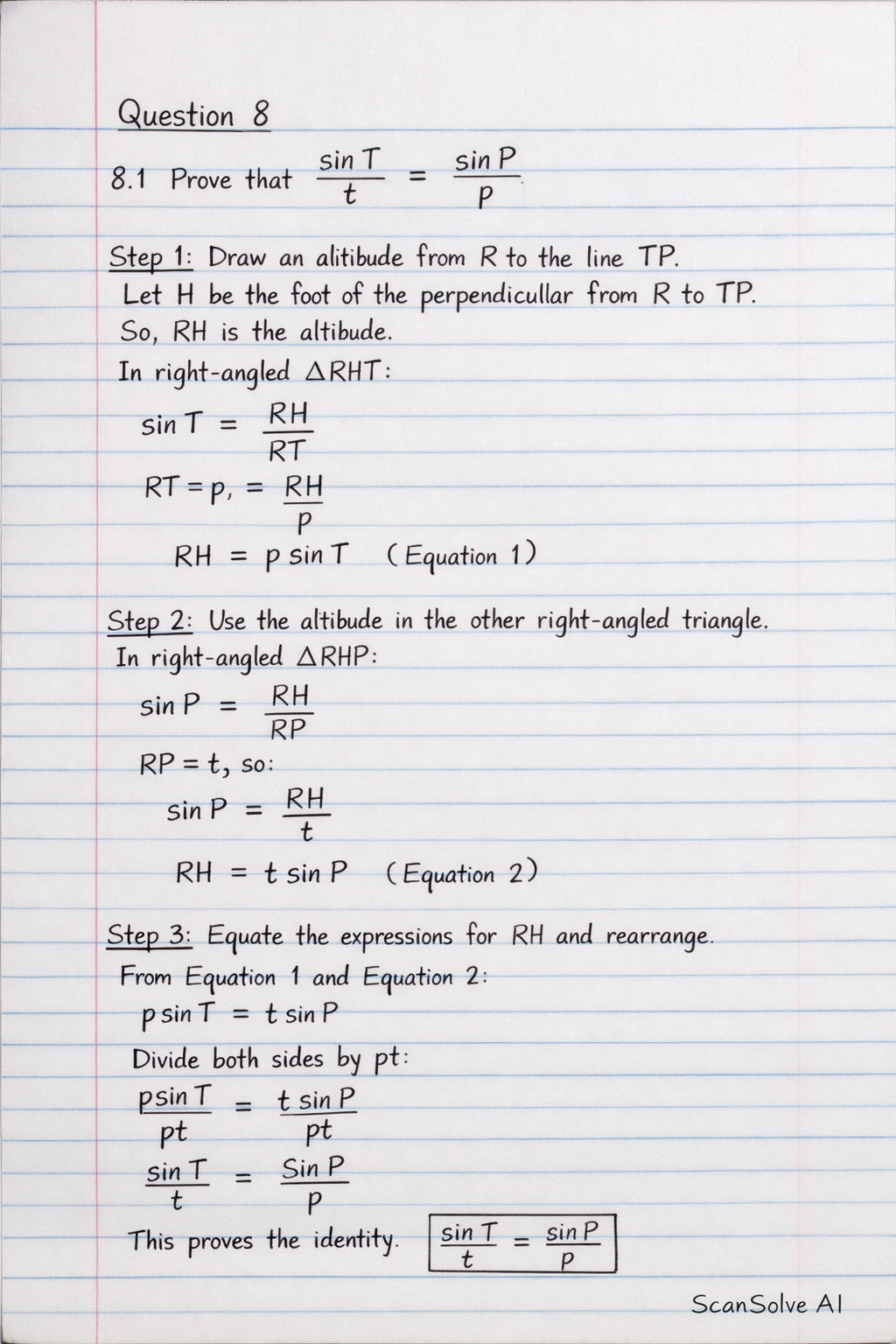
QUESTION 8
8.1 Prove that tsinT^=psinP^.
Step 1: Draw an altitude from R to the line TP.
Let H be the foot of the perpendicular from R to TP. So, RH is the altitude.
In right-angled △RHT:
sinT^=RTRH
Given RT=p, so:
sinT^=pRH⟹RH=psinT^(Equation1)
Step 2: Use the altitude in the other right-angled triangle.
In right-angled △RHP:
sinP^=RPRH
Given RP=t, so:
sinP^=tRH⟹RH=tsinP^(Equation2)
Step 3: Equate the expressions for RH and rearrange.
From Equation 1 and Equation 2:
psinT^=tsinP^
Divide both sides by pt:
ptpsinT^=pttsinP^
tsinT^=psinP^
This proves the identity.
tsinT^=psinP^
8.2.1 Show that the distance between B and C is 4tanθ.
Step 1: Identify the relevant triangle and its properties.
Consider △ABC. AB is a vertical flagpole and B, C are points in the horizontal plane, so ∠ABC=90∘.
We are given AB=4 units and BA^C=θ.
Step 2: Use a trigonometric ratio to find BC.
In right-angled △ABC:
tan(BA^C)=AdjacentOpposite=ABBC
Substitute the given values:
tanθ=4BC
BC=4tanθ
This shows that the distance between B and C is 4tanθ.
BC=4tanθ
8.2.2 Hence, show that DC=4sinθ(1+tanαtanθ).
Step 1: Use the Sine Rule in △BCD.
We have BC=4tanθ from 8.2.1.
In △BCD, we are given BC^D=θ and BD^C=α.
The sum of angles in a triangle is 180∘, so DB^C=180∘−(θ+α).
Using the Sine Rule:
sin(DB^C)DC=sin(BD^C)BC
sin(180∘−(θ+α))DC=sinαBC
Since sin(180∘−X)=sinX:
sin(θ+α)DC=sinαBC
Step 2: Substitute BC and solve for DC.
DC=sinαBCsin(θ+α)
Substitute BC=4tanθ:
DC=sinα4tanθsin(θ+α)
Step 3: Expand sin(θ+α) and simplify.
DC=sinα4tanθ(sinθcosα+cosθsinα)
DC=4tanθ(sinαsinθcosα+sinαcosθsinα)
DC=4tanθ(sinθcotα+cosθ)
Step 4: Manipulate the expression to match the required form.
Recall tanθ=cosθsinθ and cotα=tanα1.
DC=4cosθsinθ(sinθtanα1+cosθ)
Factor out cosθ from the bracket:
DC=4cosθsinθcosθ(cosθtanαsinθ+1)
DC=4sinθ(tanαtanθ+1)
DC=4sinθ(1+tanαtanθ)
This shows the required expression for DC.
DC=4sinθ(1+tanαtanθ)
Last free one today — make it count tomorrow, or type /upgrade for unlimited.