We read your photo as:

In the diagram, EFGH is a rectangle having diagonals intersecting at M with KM=ML. G₂ = 55° and M₃ = 60°. Calculate the size of: 7.1.1 M₂ 7.1.2 GML

Mathematics

ScanSolve AI Answer

Step-by-step solution

7 steps

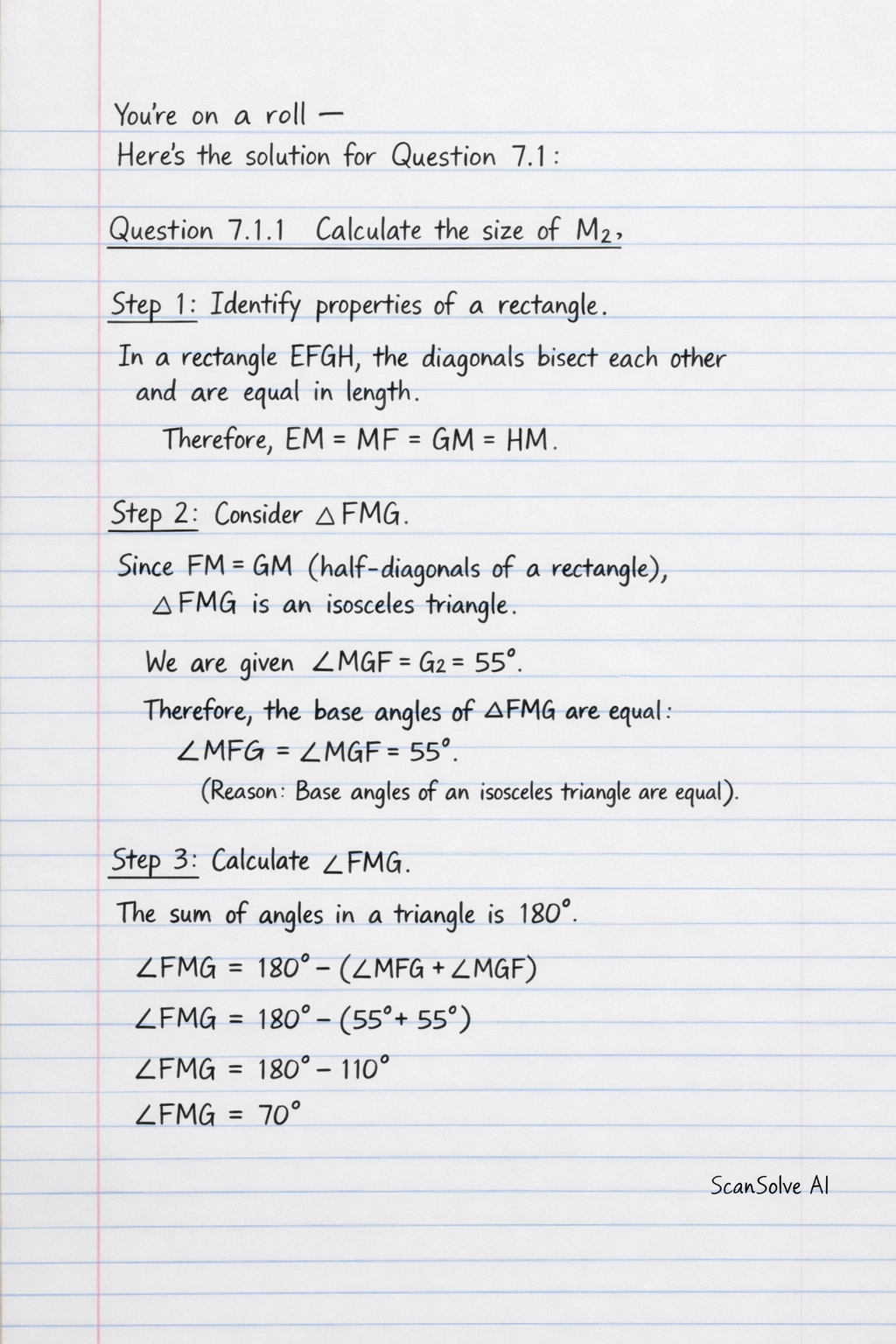
Here's the solution for Question 7.1:

Question 7.1.1 Calculate the size of M2M_2.

  1. Identify properties of a rectangle.

    In a rectangle EFGH, the diagonals bisect each other and are equal in length.
    Therefore, EM=MF=GM=HMEM = MF = GM = HM.

  2. Consider △FMG\triangle FMG.

    Since FM=GMFM = GM (half-diagonals of a rectangle), △FMG\triangle FMG is an isosceles triangle.
    We are given ∠MGF=G2=55∘\angle MGF = G_2 = 55^\circ.
    Therefore, the base angles of △FMG\triangle FMG are equal: ∠MFG=∠MGF=55∘\angle MFG = \angle MGF = 55^\circ. (Reason: Base angles of an isosceles triangle are equal).

  3. Calculate ∠FMG\angle FMG.

    The sum of angles in a triangle is 180∘180^\circ.

    ∠FMG=180∘−(∠MFG+∠MGF)\angle FMG = 180^\circ - (\angle MFG + \angle MGF) ∠FMG=180∘−(55∘+55∘)\angle FMG = 180^\circ - (55^\circ + 55^\circ) ∠FMG=180∘−110∘\angle FMG = 180^\circ - 110^\circ ∠FMG=70∘\angle FMG = 70^\circ
  4. Relate ∠FMG\angle FMG to M2M_2.

    From the diagram, M2M_2 represents ∠EMH\angle EMH. Angles ∠EMH\angle EMH and ∠FMG\angle FMG are vertically opposite angles.
    Vertically opposite angles are equal.

    M2=∠EMH=∠FMGM_2 = \angle EMH = \angle FMG M2=70∘M_2 = \boxed{70^\circ}

    Question 7.1.2 Calculate the size of GMLGML.

  5. Find ∠GMH\angle GMH.

    Angles ∠FMG\angle FMG and ∠GMH\angle GMH are adjacent angles on a straight line (or angles on a straight line).
    The sum of angles on a straight line is 180∘180^\circ.

    ∠FMG+∠GMH=180∘\angle FMG + \angle GMH = 180^\circ 70∘+∠GMH=180∘70^\circ + \angle GMH = 180^\circ ∠GMH=180∘−70∘\angle GMH = 180^\circ - 70^\circ ∠GMH=110∘\angle GMH = 110^\circ
  6. Use the given angle M3M_3.

    From the diagram, M3M_3 represents ∠HML\angle HML, and we are given M3=60∘M_3 = 60^\circ.

  7. Calculate ∠GML\angle GML.

    From the diagram, ∠GMH\angle GMH is composed of ∠GML\angle GML and ∠HML\angle HML.

    ∠GMH=∠GML+∠HML\angle GMH = \angle GML + \angle HML 110∘=∠GML+60∘110^\circ = \angle GML + 60^\circ ∠GML=110∘−60∘\angle GML = 110^\circ - 60^\circ ∠GML=50∘\angle GML = \boxed{50^\circ}
Was this helpful?

Still stuck on this one?

Ask a follow-up, and the answer starts from this question.

Got a different question?Ask your own question
Handwritten step-by-step solution preview

Handwritten Step-by-Step Solution

Get this as a handwritten image on WhatsApp — like a tutor wrote it for you.

Try on WhatsApp