We read your photo as:

In the diagram, QT ext || WU ext and QR ext || WT. Find the length of ST.

Mathematics

ScanSolve AI Answer

Answer

24 mm\text{24 mm}

Step-by-step solution

5 steps
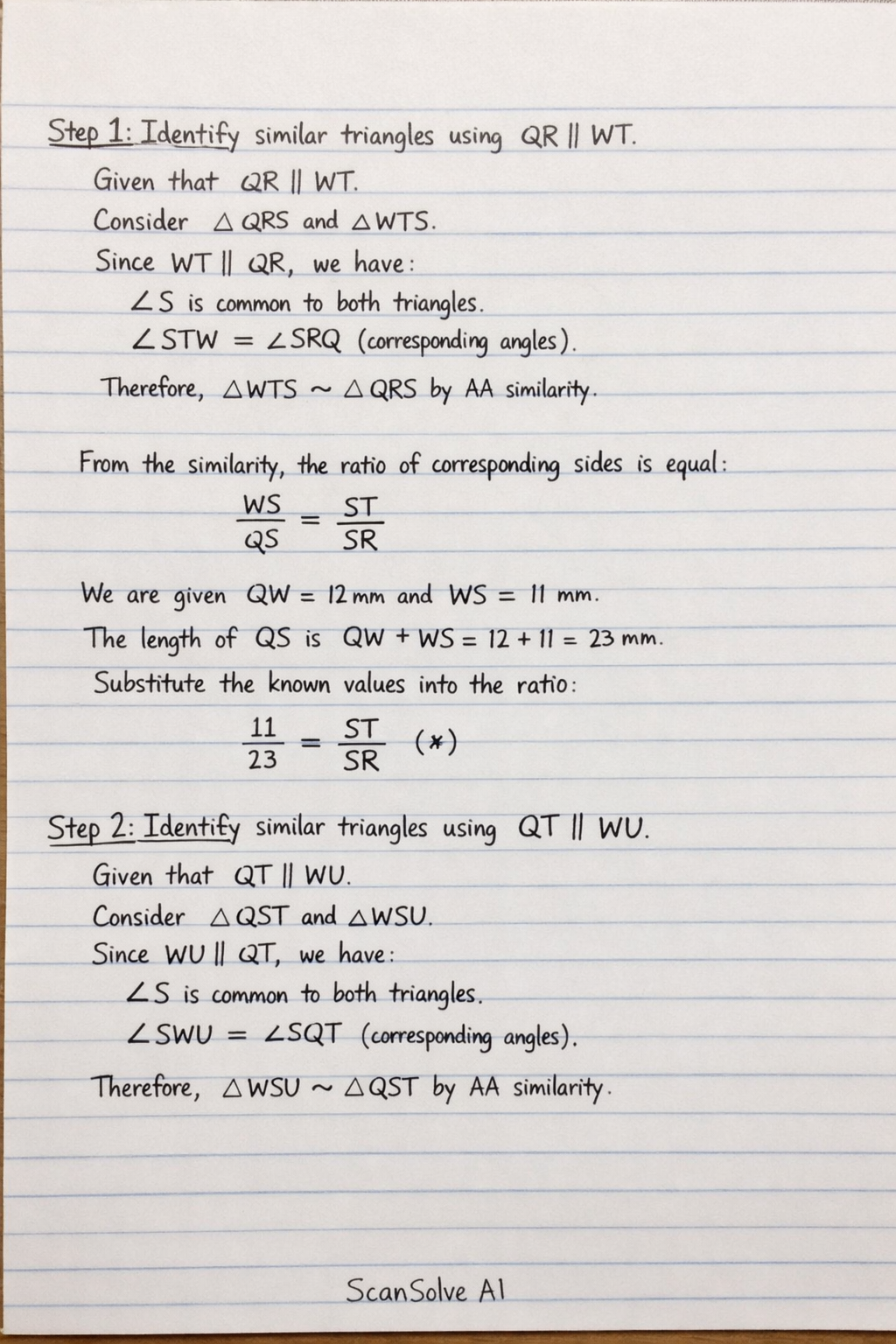
  1. Identify similar triangles using QR∥WTQR \parallel WT.

    Given that QR∥WTQR \parallel WT.
    Consider △QRS\triangle QRS and △WTS\triangle WTS.
    Since WT∥QRWT \parallel QR, we have:
    ∠S\angle S is common to both triangles.
    ∠STW=∠SRQ\angle STW = \angle SRQ (corresponding angles).
    Therefore, △WTS∼△QRS\triangle WTS \sim \triangle QRS by AA similarity.

    From the similarity, the ratio of corresponding sides is equal:

    WSQS=STSR\frac{WS}{QS} = \frac{ST}{SR}

    We are given QW=12 mmQW = 12 \text{ mm} and WS=11 mmWS = 11 \text{ mm}.
    The length of QSQS is QW+WS=12+11=23 mmQW + WS = 12 + 11 = 23 \text{ mm}.
    Substitute the known values into the ratio:

    1123=STSR(∗)\frac{11}{23} = \frac{ST}{SR} \quad (*)
  2. Identify similar triangles using QT∥WUQT \parallel WU.

    Given that QT∥WUQT \parallel WU.
    Consider △QST\triangle QST and △WSU\triangle WSU.
    Since WU∥QTWU \parallel QT, we have:
    ∠S\angle S is common to both triangles.
    ∠SWU=∠SQT\angle SWU = \angle SQT (corresponding angles).
    Therefore, △WSU∼△QST\triangle WSU \sim \triangle QST by AA similarity.

    From the similarity, the ratio of corresponding sides is equal:

    SWSQ=SUST\frac{SW}{SQ} = \frac{SU}{ST}

    We know SW=11 mmSW = 11 \text{ mm} and SQ=23 mmSQ = 23 \text{ mm}.
    Substitute these values into the ratio:

    1123=SUST\frac{11}{23} = \frac{SU}{ST}
  3. Calculate STST.

    From the ratio in Step 2, we can express SUSU in terms of STST:

    SU=1123STSU = \frac{11}{23} ST

    We are given TU=6 mmTU = 6 \text{ mm}.
    From the diagram, points S,U,TS, U, T are collinear on RSRS in that order, so ST=SU+UTST = SU + UT.
    Substitute the expression for SUSU and the value of TUTU:

    ST=1123ST+6ST = \frac{11}{23} ST + 6

    Subtract 1123ST\frac{11}{23} ST from both sides:

    ST−1123ST=6ST - \frac{11}{23} ST = 6 23ST−11ST23=6\frac{23 ST - 11 ST}{23} = 6 12ST23=6\frac{12 ST}{23} = 6

    Multiply both sides by 23 and divide by 12:

    12ST=6×2312 ST = 6 \times 23 12ST=13812 ST = 138 ST=13812ST = \frac{138}{12} ST=11.5 mmST = 11.5 \text{ mm}
  4. Calculate RSRS.

    Substitute the value of ST=11.5 mmST = 11.5 \text{ mm} into equation (∗)(*) from Step 1:

    1123=11.5SR\frac{11}{23} = \frac{11.5}{SR}

    Multiply both sides by 23×SR23 \times SR:

    11×SR=23×11.511 \times SR = 23 \times 11.5 11SR=264.511 SR = 264.5

    Divide by 11:

    SR=264.511SR = \frac{264.5}{11} SR=24.04545... mmSR = 24.04545... \text{ mm}
  5. Round to the nearest whole number.

    Rounding 24.04545... to the nearest whole number gives 24.

    RS≈24 mmRS \approx 24 \text{ mm}

    The final answer is 24 mm\text{24 mm}.

Was this helpful?

Try one yourself

A new problem that tests the same skill.

Still stuck on this one?

Ask a follow-up, and the answer starts from this question.

Got a different question?Ask your own question
Handwritten step-by-step solution preview

Handwritten Step-by-Step Solution

Get this as a handwritten image on WhatsApp — like a tutor wrote it for you.

Try on WhatsApp