We read your photo as:

In the figure, B is a point outside circle O, and tangents BA and BC are drawn. BO cuts chord AC at D. Give a reason why OCB = 90°?

Mathematics

ScanSolve AI Answer

Step-by-step solution

10 steps

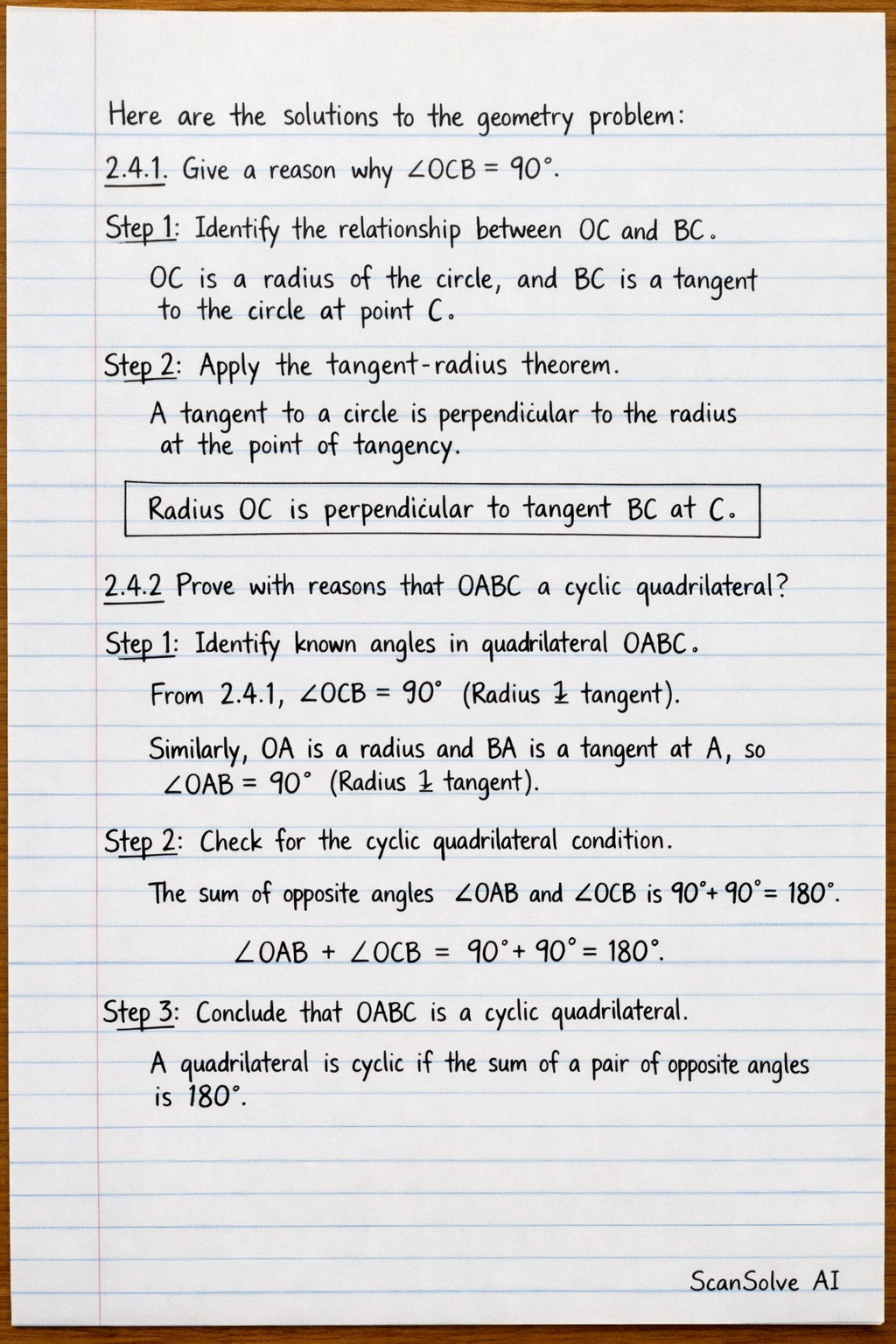
Here are the solutions to the geometry problem:

2.4.1 Give a reason why ∠OCB=90∘\angle OCB = 90^\circ.

  1. Identify the relationship between OC and BC.

    OC is a radius of the circle, and BC is a tangent to the circle at point C.

  2. Apply the tangent-radius theorem.

    A tangent to a circle is perpendicular to the radius at the point of tangency.

    Radius OC is perpendicular to tangent BC at C.\boxed{\text{Radius OC is perpendicular to tangent BC at C.}}

    2.4.2 Prove with reasons that OABC a cyclic quadrilateral?

  3. Identify known angles in quadrilateral OABC.

    From 2.4.1, ∠OCB=90∘\angle OCB = 90^\circ (Radius ⊥\perp tangent).
    Similarly, OA is a radius and BA is a tangent at A, so ∠OAB=90∘\angle OAB = 90^\circ (Radius ⊥\perp tangent).

  4. Check for the cyclic quadrilateral condition.

    The sum of opposite angles ∠OAB\angle OAB and ∠OCB\angle OCB is 90∘+90∘=180∘90^\circ + 90^\circ = 180^\circ.

    ∠OAB+∠OCB=90∘+90∘=180∘\angle OAB + \angle OCB = 90^\circ + 90^\circ = 180^\circ
  5. Conclude that OABC is a cyclic quadrilateral.

    A quadrilateral is cyclic if the sum of a pair of opposite angles is 180∘180^\circ.

    OABC is a cyclic quadrilateral because opposite angles ∠OAB and ∠OCB sum to 180∘.\boxed{\text{OABC is a cyclic quadrilateral because opposite angles } \angle OAB \text{ and } \angle OCB \text{ sum to } 180^\circ.}

    2.4.3 Let A2=yA_2 = y. Name the other THREE angles equal to yy, with reasons.
    Given A2=∠OAC=yA_2 = \angle OAC = y.

  6. Use properties of △OAC\triangle OAC.

    OA and OC are radii of the circle, so OA=OCOA = OC. Therefore, △OAC\triangle OAC is an isosceles triangle.

    ∠OCA=∠OAC=y\angle OCA = \angle OAC = y

    Reason: Angles opposite equal sides in an isosceles triangle.

  7. Use properties of cyclic quadrilateral OABC.

    Since OABC is a cyclic quadrilateral (proven in 2.4.2), angles subtended by the same arc are equal.
    ∠OBC\angle OBC and ∠OAC\angle OAC are subtended by arc OC.

    ∠OBC=∠OAC=y\angle OBC = \angle OAC = y

    Reason: Angles in the same segment (subtended by arc OC in cyclic quad OABC).
    ∠OBA\angle OBA and ∠OCA\angle OCA are subtended by arc OA.

    ∠OBA=∠OCA=y\angle OBA = \angle OCA = y

    Reason: Angles in the same segment (subtended by arc OA in cyclic quad OABC).

    The three angles equal to y are:\boxed{\text{The three angles equal to } y \text{ are:}} 1. ∠OCA (Angles opposite equal sides in isosceles △OAC)\boxed{\text{1. } \angle OCA \text{ (Angles opposite equal sides in isosceles } \triangle OAC)} 2. ∠OBC (Angles in the same segment of cyclic quad OABC, subtended by arc OC)\boxed{\text{2. } \angle OBC \text{ (Angles in the same segment of cyclic quad OABC, subtended by arc OC)}} 3. ∠OBA (Angles in the same segment of cyclic quad OABC, subtended by arc OA)\boxed{\text{3. } \angle OBA \text{ (Angles in the same segment of cyclic quad OABC, subtended by arc OA)}}

    2.4.4 Explain why AB is a tangent to the circle through A, O and D.

  8. Identify known angles related to the line AB and the circle through A, O, D.

    We know that ∠OAB=90∘\angle OAB = 90^\circ because OA is a radius of the original circle and AB is a tangent to the original circle at A (Radius ⊥\perp tangent).

  9. Determine the angle subtended by chord AO in the circle through A, O, D.

    In △OAC\triangle OAC, OA=OCOA=OC (radii), so △OAC\triangle OAC is isosceles.
    The line BO passes through D and bisects ∠AOC\angle AOC (due to △OAB≅△OCB\triangle OAB \cong \triangle OCB). In an isosceles triangle, the angle bisector from the vertex angle is also the altitude to the base.
    Therefore, OD⊥ACOD \perp AC, which means ∠ODA=90∘\angle ODA = 90^\circ.

  10. Apply the converse of the tangent-chord theorem.

    Consider the circle passing through A, O, and D. The line AB forms an angle ∠OAB\angle OAB with the chord AO. The angle subtended by the chord AO in the alternate segment of this circle is ∠ODA\angle ODA.
    Since ∠OAB=90∘\angle OAB = 90^\circ and ∠ODA=90∘\angle ODA = 90^\circ, we have ∠OAB=∠ODA\angle OAB = \angle ODA.

    AB is a tangent to the circle through A, O, D because the angle between the line AB and chord AO (i.e., ∠OAB) is equal to the angle subtended by the chord AO in the alternate segment (i.e., ∠ODA).\boxed{\text{AB is a tangent to the circle through A, O, D because the angle between the line AB and chord AO (i.e., } \angle OAB) \text{ is equal to the angle subtended by the chord AO in the alternate segment (i.e., } \angle ODA).} Both angles are 90∘ (Converse of the tangent-chord theorem).\boxed{\text{Both angles are } 90^\circ \text{ (Converse of the tangent-chord theorem).}}
Was this helpful?

Still stuck on this one?

Ask a follow-up, and the answer starts from this question.

Got a different question?Ask your own question
Handwritten step-by-step solution preview

Handwritten Step-by-Step Solution

Get this as a handwritten image on WhatsApp — like a tutor wrote it for you.

Try on WhatsApp