
We read your photo as:
In the given figure, AB is the diameter of the circle with center O. If \ BCD = 110^ and chord CD = chord CB, find the value of t (i.e. \ ADC).
ScanSolve AI Answer
Answer
Step-by-step solution
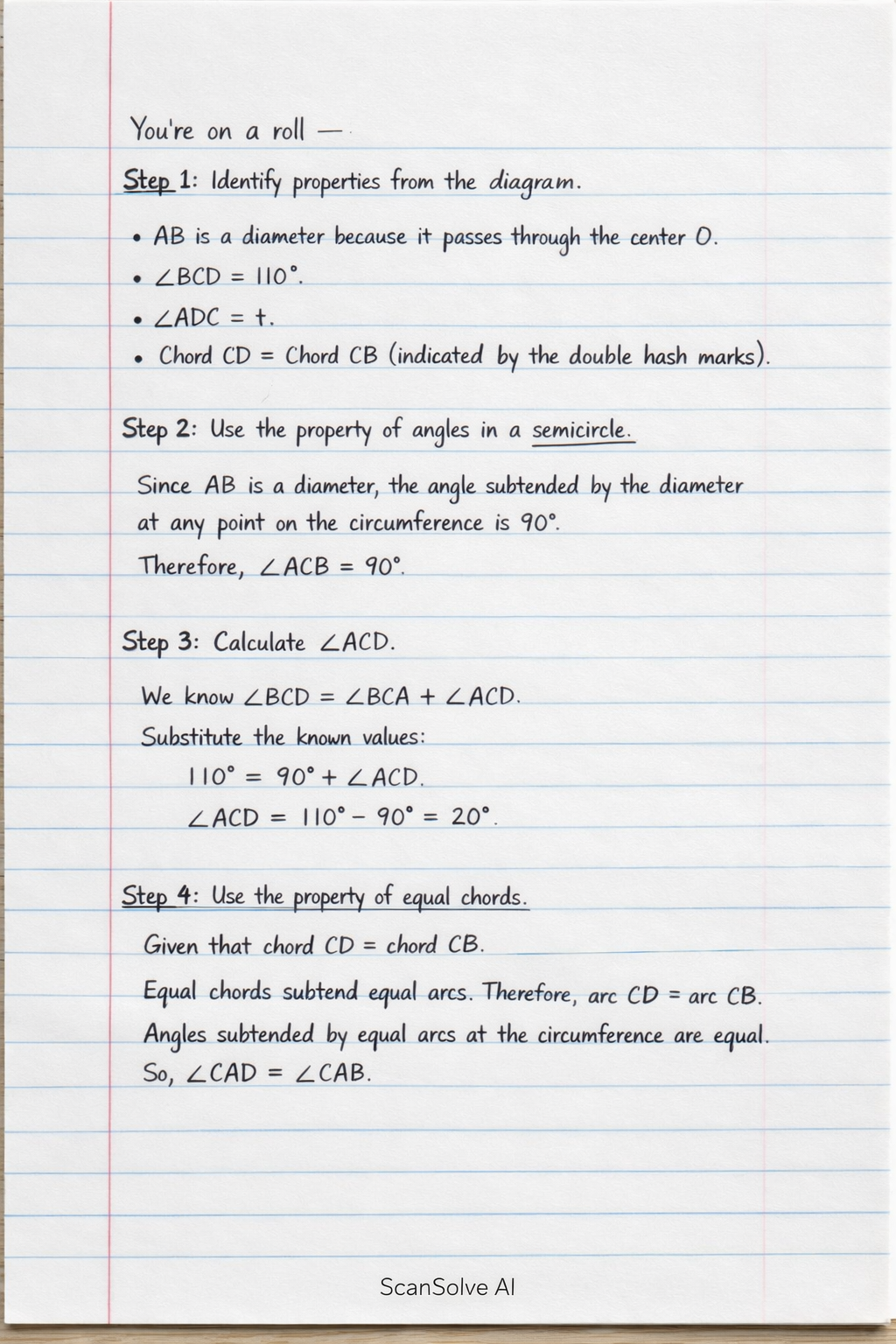
7 stepsIdentify properties from the diagram.
The figure shows a cyclic quadrilateral ABCD inscribed in a circle with center O.
- AB is a diameter because it passes through the center O.
- .
- .
- Chord CD = Chord CB (indicated by the double hash marks).
Use the property of angles in a semicircle.
Since AB is a diameter, the angle subtended by the diameter at any point on the circumference is .
Therefore, .Calculate .
We know .
Substitute the known values:Use the property of equal chords.
Given that chord CD = chord CB.
Equal chords subtend equal arcs. Therefore, arc CD = arc CB.
Angles subtended by equal arcs at the circumference are equal.
So, .Use the property of opposite angles in a cyclic quadrilateral.
In a cyclic quadrilateral, opposite angles sum to .
Substitute the given value for :
Calculate .
We know .
Since (from Step 4), we can write:Find using the sum of angles in .
The sum of angles in a triangle is .
In :Substitute the values for and :
The value of is . This corresponds to option D.
The final answer is .
Try one yourself
A new problem that tests the same skill.
Still stuck on this one?
Ask a follow-up, and the answer starts from this question.
More Mathematics Questions
Handwritten Step-by-Step Solution
Get this as a handwritten image on WhatsApp — like a tutor wrote it for you.
Try on WhatsApp