
We read your photo as:
In the figure below, PQRS is a rhombus attached to two semicircles and length QR is twice UV. The area of the rhombus is 24cm². Study and use it to answer the questions that follow. Find the length; (i) PQ
ScanSolve AI Answer
Answers
2 partsStep-by-step solution
5 stepsHere's how to solve the problem:
Part i· 3 steps
Find the length PQ
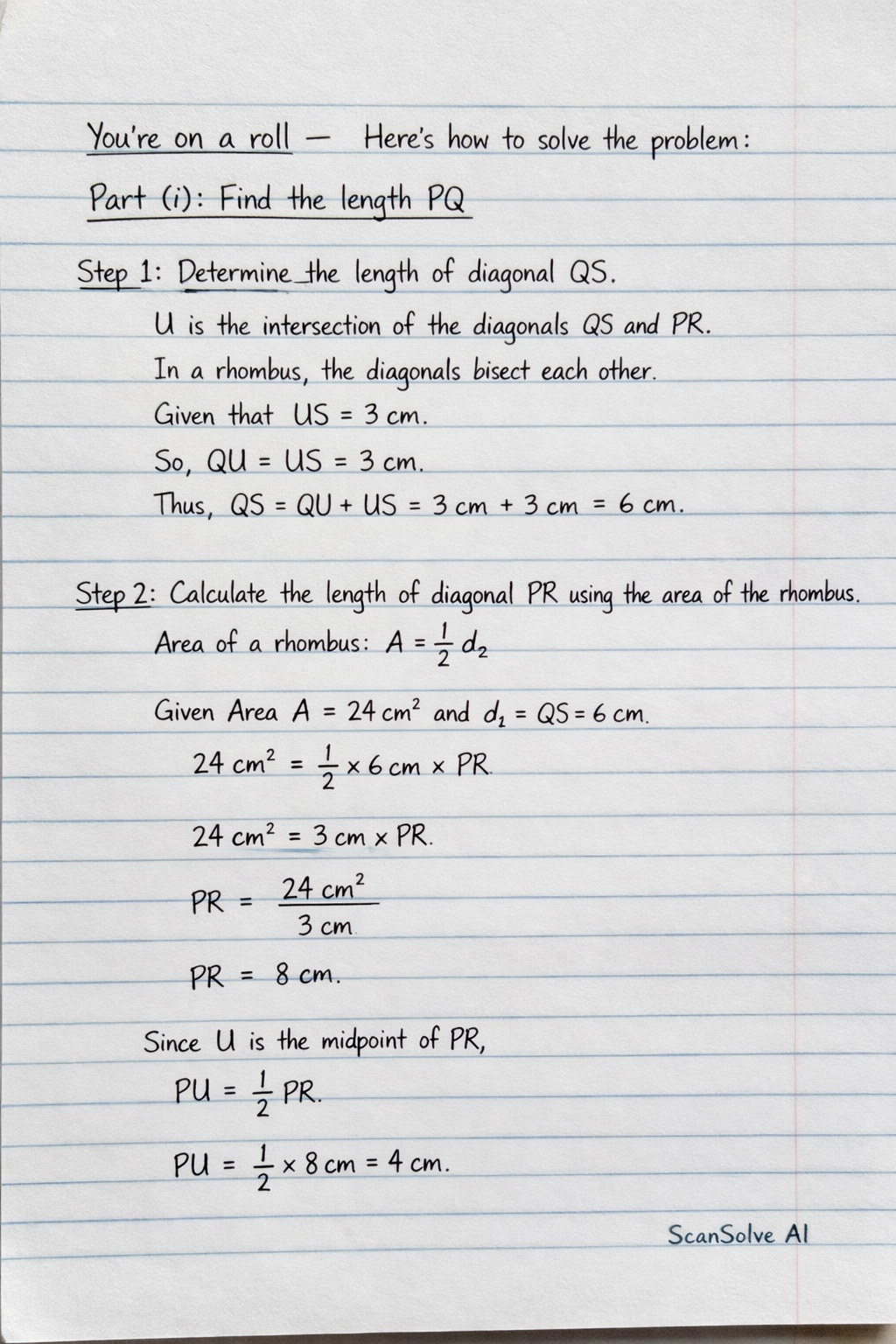
Determine the length of diagonal QS.
From the diagram, U is the intersection of the diagonals QS and PR. In a rhombus, the diagonals bisect each other.
Given that .
Therefore, .
The full length of diagonal .Calculate the length of diagonal PR using the area of the rhombus.
The area of a rhombus is given by the formula , where and are the lengths of the diagonals.
Given Area and .Since U is the midpoint of PR, .
Use the Pythagorean theorem to find the side length PQ.
The diagonals of a rhombus intersect at right angles. Thus, is a right-angled triangle with the right angle at U.
Using the Pythagorean theorem ():The length of PQ is .
Part ii
Find the length UV
Relate QR to PQ.
Since PQRS is a rhombus, all its sides are equal in length.
Therefore, .
From Part (i), we found .
So, .Use the given relationship between QR and UV.
The problem states that "length QR is twice UV".
Substitute the value of QR:
The length of UV is .
2 zimekamilika. Zimebaki 3 leo — tuma inayofuata.
Try one yourself
A new problem that tests the same skill.
Still stuck on this one?
Ask a follow-up, and the answer starts from this question.
More Mathematics Questions
Handwritten Step-by-Step Solution
Get this as a handwritten image on WhatsApp — like a tutor wrote it for you.
Try on WhatsApp