We read your photo as:

In triangle ABC, AB = 15 km, angle ABC = 79 degrees, and angle ACB = 40 degrees. Calculate: (i) The length of side AC. (ii) The area of triangle ABC. (iii) The shortest distance from vertex B to side

Mathematics

ScanSolve AI Answer

Answers

4 parts
a(i)

22.91 km22.91 \text{ km}

a(ii)

150.25 km2150.25 \text{ km}^2

a(iii)

13.12 km13.12 \text{ km}

b

20.46∘,339.54∘20.46^\circ, 339.54^\circ

Graph of y = sin(θ)

Use the left and right arrow keys to trace the curve, up and down to jump between key points, and plus and minus to zoom.

Key points of y = sin(θ)
Pointθy
x-intercept0°0
Maximum90°1
x-intercept180°0
Minimum270°−1
x-intercept360°0

Step-by-step solution

6 steps

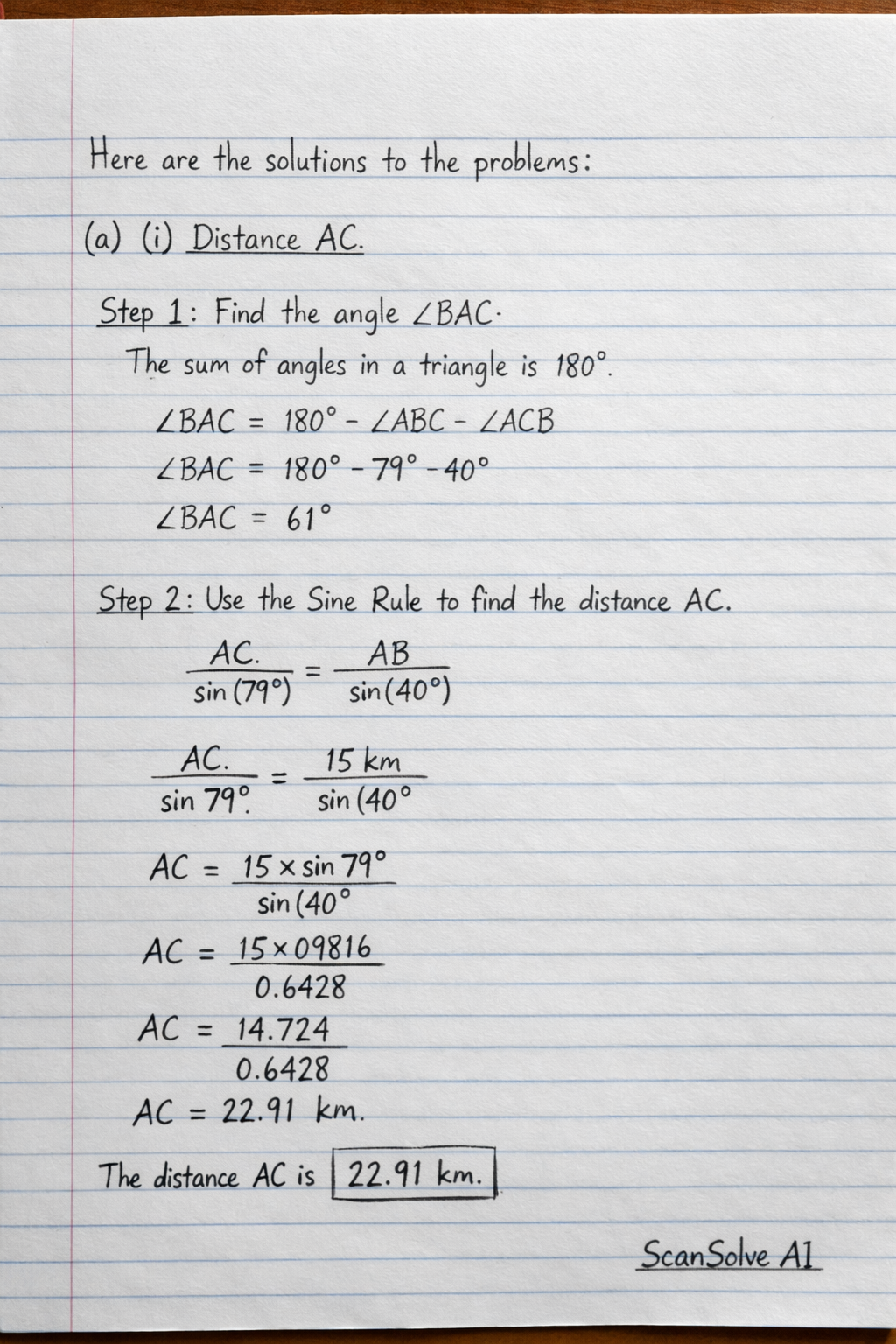
Here are the solutions to the problems:

Part a(i)· 2 steps

Distance AC

  1. Find the angle ∠BAC\angle BAC.

    The sum of angles in a triangle is 180∘180^\circ.

    ∠BAC=180∘−∠ABC−∠ACB\angle BAC = 180^\circ - \angle ABC - \angle ACB ∠BAC=180∘−79∘−40∘\angle BAC = 180^\circ - 79^\circ - 40^\circ ∠BAC=61∘\angle BAC = 61^\circ
  2. Use the Sine Rule to find the distance AC.

    ACsin⁡(∠ABC)=ABsin⁡(∠ACB)\frac{AC}{\sin(\angle ABC)} = \frac{AB}{\sin(\angle ACB)} ACsin⁡(79∘)=15 kmsin⁡(40∘)\frac{AC}{\sin(79^\circ)} = \frac{15 \text{ km}}{\sin(40^\circ)} AC=15×sin⁡(79∘)sin⁡(40∘)AC = \frac{15 \times \sin(79^\circ)}{\sin(40^\circ)} AC=15×0.98160.6428AC = \frac{15 \times 0.9816}{0.6428} AC=14.7240.6428AC = \frac{14.724}{0.6428} AC≈22.91 kmAC \approx 22.91 \text{ km}

    The distance AC is 22.91 km\boxed{22.91 \text{ km}}.

Part a(ii)

150.25 km2150.25 \text{ km}^2

Area of triangle ABC

  1. Use the formula for the area of a triangle given two sides and the included angle.

    Area=12×AB×AC×sin⁡(∠BAC)\text{Area} = \frac{1}{2} \times AB \times AC \times \sin(\angle BAC)

    Using the value of AC≈22.906 kmAC \approx 22.906 \text{ km} from the previous calculation for better precision.

    Area=12×15 km×22.906 km×sin⁡(61∘)\text{Area} = \frac{1}{2} \times 15 \text{ km} \times 22.906 \text{ km} \times \sin(61^\circ) Area=12×15×22.906×0.8746\text{Area} = \frac{1}{2} \times 15 \times 22.906 \times 0.8746 Area=7.5×22.906×0.8746\text{Area} = 7.5 \times 22.906 \times 0.8746 Area=171.795×0.8746\text{Area} = 171.795 \times 0.8746 Area≈150.25 km2\text{Area} \approx 150.25 \text{ km}^2

    The area of triangle ABC is 150.25 km2\boxed{150.25 \text{ km}^2}.

Part a(iii)

13.12 km13.12 \text{ km}

Shortest distance from B to AC

  1. The shortest distance from point B to line AC is the perpendicular height from B to AC.

    Let this height be hh.
    We can use the formula h=ABsin⁡(∠BAC)h = AB \sin(\angle BAC).

    h=15 km×sin⁡(61∘)h = 15 \text{ km} \times \sin(61^\circ) h=15×0.8746h = 15 \times 0.8746 h≈13.12 kmh \approx 13.12 \text{ km}

    The shortest distance from B to AC is 13.12 km\boxed{13.12 \text{ km}}.

Part b

20.46∘,339.54∘20.46^\circ, 339.54^\circ

Solve the equation cos⁡θ=0.937\cos \theta = 0.937 for 0∘≤θ≤360∘0^\circ \leq \theta \leq 360^\circ.

  1. Find the principal value of θ\theta.

    θ1=cos⁡−1(0.937)\theta_1 = \cos^{-1}(0.937) θ1≈20.46∘\theta_1 \approx 20.46^\circ
  2. Find the second solution.

    Since cos⁡θ\cos \theta is positive, the solutions lie in the 1st and 4th quadrants.
    The second solution is:

    θ2=360∘−θ1\theta_2 = 360^\circ - \theta_1 θ2=360∘−20.46∘\theta_2 = 360^\circ - 20.46^\circ θ2=339.54∘\theta_2 = 339.54^\circ

    The solutions are 20.46∘,339.54∘\boxed{20.46^\circ, 339.54^\circ}.

Part c

Sketch the graph of y=sin⁡θy = \sin \theta for 0∘≤θ≤360∘0^\circ \leq \theta \leq 360^\circ.

To sketch the graph of y=sin⁡θy = \sin \theta, plot the following key points and draw a smooth curve through them:

  • At θ=0∘\theta = 0^\circ, y=sin⁡(0∘)=0y = \sin(0^\circ) = 0.
  • At θ=90∘\theta = 90^\circ, y=sin⁡(90∘)=1y = \sin(90^\circ) = 1.
  • At θ=180∘\theta = 180^\circ, y=sin⁡(180∘)=0y = \sin(180^\circ) = 0.
  • At θ=270∘\theta = 270^\circ, y=sin⁡(270∘)=−1y = \sin(270^\circ) = -1.
  • At θ=360∘\theta = 360^\circ, y=sin⁡(360∘)=0y = \sin(360^\circ) = 0. The graph starts at (0∘,0)(0^\circ, 0), rises to a maximum of 1 at (90∘,1)(90^\circ, 1), falls to 0 at (180∘,0)(180^\circ, 0), continues to fall to a minimum of -1 at (270∘,−1)(270^\circ, -1), and rises back to 0 at (360∘,0)(360^\circ, 0).
Was this helpful?

Try one yourself

A new problem that tests the same skill.

Still stuck on this one?

Ask a follow-up, and the answer starts from this question.

Got a different question?Ask your own question
Handwritten step-by-step solution preview

Handwritten Step-by-Step Solution

Get this as a handwritten image on WhatsApp — like a tutor wrote it for you.

Try on WhatsApp