
We read your photo as:
Calculate the incline The volume of the solid Total surface area
Mathematics
ScanSolve AI Answer
Step-by-step solution
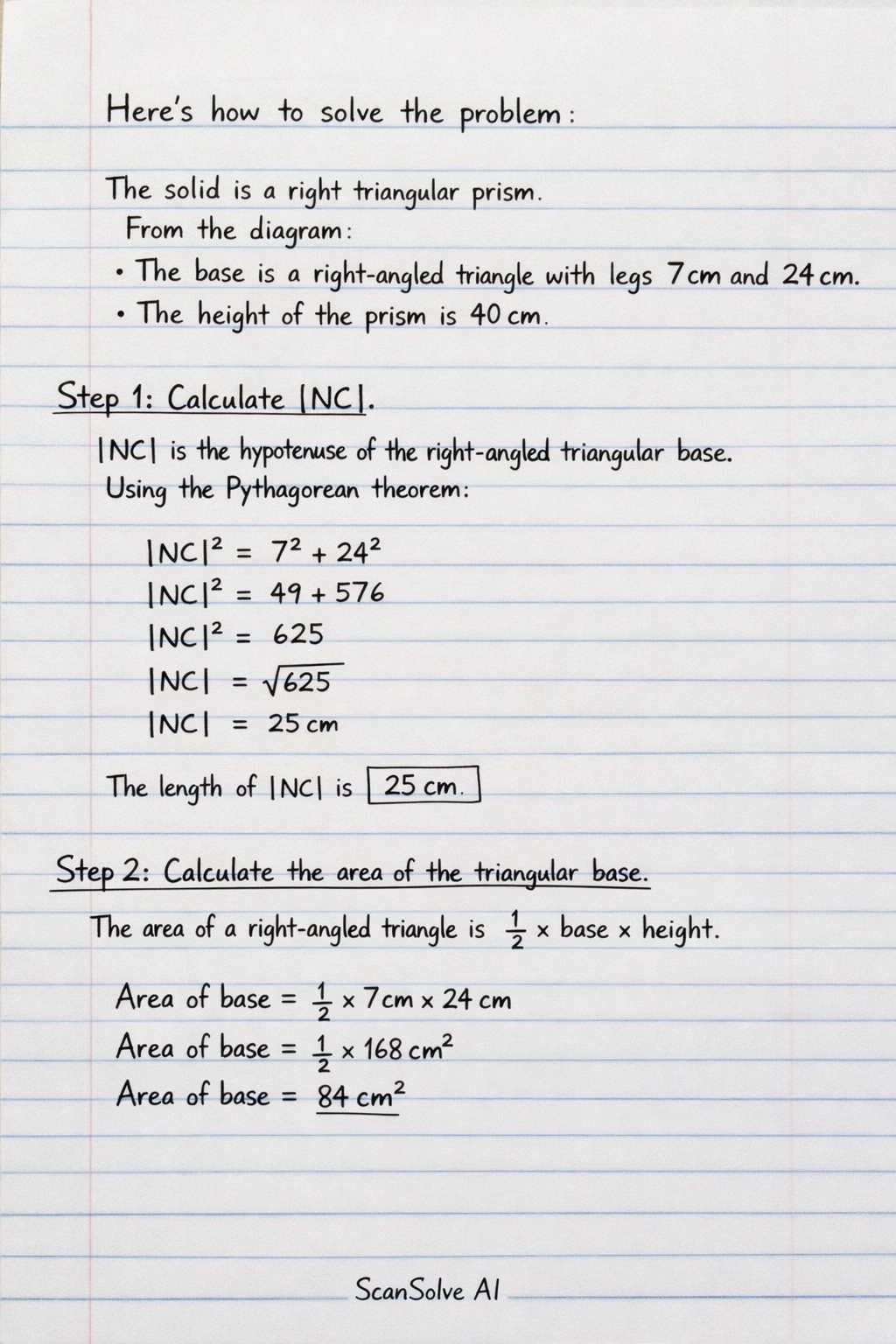
5 stepsHere's how to solve the problem:
The solid is a right triangular prism.
From the diagram:
- The base is a right-angled triangle with legs and .
- The height of the prism is .
Calculate $|NC|$.
is the hypotenuse of the right-angled triangular base. Using the Pythagorean theorem:
The length of is .
Calculate the area of the triangular base.
The area of a right-angled triangle is .
Calculate the volume of the solid.
The volume of a prism is given by the formula: .
The volume of the solid is .
Calculate the perimeter of the triangular base.
The perimeter of the base is the sum of its three sides.
Calculate the total surface area of the solid.
The total surface area of a prism is given by the formula: .
The total surface area of the solid is .
Was this helpful?
Still stuck on this one?
Ask a follow-up, and the answer starts from this question.
Got a different question?Ask your own question
More Mathematics Questions
QCalculate c Incl. The volume of the solid. Total surface areaQCalculate the surface area and volumeQCalculate the surface areaQCalculate the height and volume of a solid composed of a cone, cylinder, and hemisphere.
Browse by topic:Geometry
Handwritten Step-by-Step Solution
Get this as a handwritten image on WhatsApp — like a tutor wrote it for you.
Try on WhatsApp