Calculate the height and volume of a solid composed of a cone, cylinder, and hemisphere.
|Mathematics
Calculate the height and volume of a solid composed of a cone, cylinder, and hemisphere.
ScanSolve AI Answer
Answer
32.0 cm
Hey vokinyi623@gmail.com — ready when you are.
Here are the calculations for the solid:
Given:
Diameter D=10 cm
Radius r=2D=210=5 cm
Height of cylindrical part hcyl=15 cm
Slant height of conical part l=13 cmπ=3.142
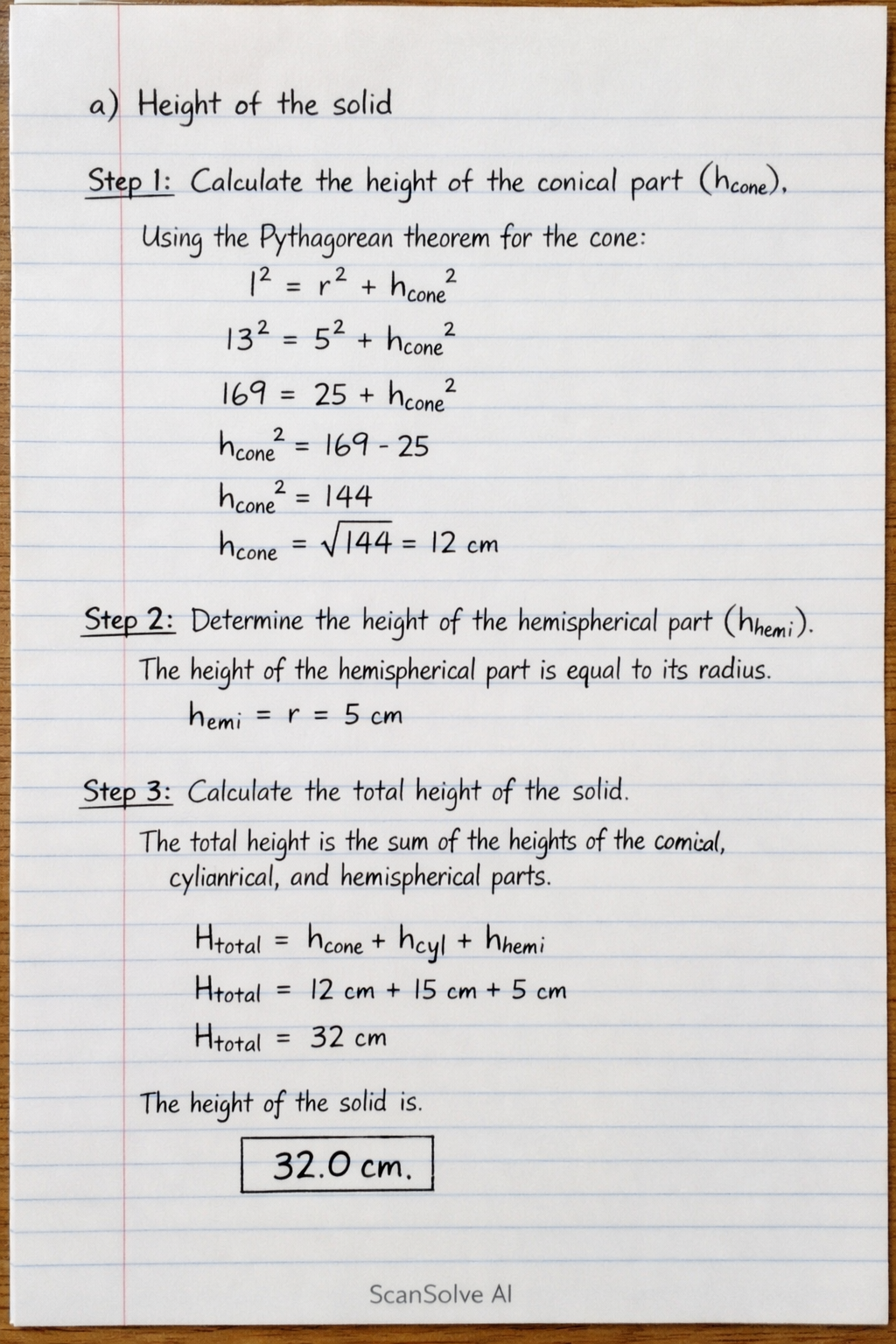
a) Height of the solid
Step 1: Calculate the height of the conical part (hcone).
Using the Pythagorean theorem for the cone: l2=r2+hcone2.
132=52+hcone2169=25+hcone2hcone2=169−25hcone2=144hcone=144=12 cm
Step 2: Determine the height of the hemispherical part (hhemi).
The height of the hemispherical part is equal to its radius.
hhemi=r=5 cm
Step 3: Calculate the total height of the solid.
The total height is the sum of the heights of the conical, cylindrical, and hemispherical parts.
Htotal=hcone+hcyl+hhemiHtotal=12cm+15cm+5 cmHtotal=32 cm
The height of the solid is 32.0cm.
b) Volume of the solid, correct to 1 decimal place
Step 1: Calculate the volume of the conical part (Vcone).
Vcone=31πr2hconeVcone=31×3.142×(5cm)2×12 cmVcone=31×3.142×25×12cm3Vcone=3.142×25×4cm3Vcone=314.2cm3
Step 2: Calculate the volume of the cylindrical part (Vcyl).
Vcyl=πr2hcylVcyl=3.142×(5cm)2×15 cmVcyl=3.142×25×15cm3Vcyl=1178.25cm3
Step 3: Calculate the volume of the hemispherical part (Vhemi).
Vhemi=32πr3Vhemi=32×3.142×(5cm)3Vhemi=32×3.142×125cm3Vhemi=3785.5cm3Vhemi≈261.8333cm3
Step 4: Calculate the total volume of the solid.
Vtotal=Vcone+Vcyl+VhemiVtotal=314.2cm3+1178.25cm3+261.8333cm3Vtotal=1754.2833cm3
Rounding to 1 decimal place:
Vtotal=1754.3cm3
The volume of the solid is 1754.3cm3.
c) Surface area of the solid, correct to 1 decimal place
Step 1: Calculate the curved surface area of the conical part (CSAcone).
CSAcone=πrlCSAcone=3.142×5cm×13 cmCSAcone=3.142×65cm2CSAcone=204.23cm2
Step 2: Calculate the curved surface area of the cylindrical part (CSAcyl).
CSAcyl=2πrhcyl
Was this helpful?
Need help with your own homework?
Get instant step-by-step solutions to any question. Free to start.
This mathematics problem involves applying core mathematical principles and formulas. Below you will find a complete step-by-step solution with detailed explanations for each step, helping you understand not just the answer but the method behind it.
ScanSolve AI Answer
Hey vokinyi623@gmail.com — ready when you are. Here are the calculations for the solid: Given: Diameter D = 10 cm Radius r = (D)/(2) = (10)/(2) = 5 cm Height of cylindrical part h_cyl = 15 cm Slant height of conical part l = 13 cm = 3.142 a) Height of the solid Step 1: Calculate the height of the conical part (h_cone). Using the Pythagorean theorem for the cone: l^2 = r^2 + h_cone^2. 13^2 = 5^2 + h_cone^2 169 = 25 + h_cone^2 h_cone^2 = 169 - 25 h_cone^2 = 144 h_cone = sqrt(144) = 12 cm Step 2: Determine the height of the hemispherical part (h_hemi). The height of the hemispherical part is equal to its radius. h_hemi = r = 5 cm Step 3: Calculate the total height of the solid. The total height is the sum of the heights of the conical, cylindrical, and hemispherical parts. H_total = h_cone + h_cyl + h_hemi H_total = 12 cm + 15 cm + 5 cm H_total = 32 cm The height of the solid is 32.0 cm. b) Volume of the solid, correct to 1 decimal place Step 1: Calculate the volume of the conical part (V_cone). V_cone = (1)/(3) r^2 h_cone V_cone = (1)/(3) × 3.142 × (5 cm)^2 × 12 cm V_cone = (1)/(3) × 3.142 × 25 × 12 cm^3 V_cone = 3.142 × 25 × 4 cm^3 V_cone = 314.2 cm^3 Step 2: Calculate the volume of the cylindrical part (V_cyl). V_cyl = r^2 h_cyl V_cyl = 3.142 × (5 cm)^2 × 15 cm V_cyl = 3.142 × 25 × 15 cm^3 V_cyl = 1178.25 cm^3 Step 3: Calculate the volume of the hemispherical part (V_hemi). V_hemi = (2)/(3) r^3 V_hemi = (2)/(3) × 3.142 × (5 cm)^3 V_hemi = (2)/(3) × 3.142 × 125 cm^3 V_hemi = (785.5)/(3) cm^3 V_hemi ≈ 261.8333 cm^3 Step 4: Calculate the total volume of the solid. V_total = V_cone + V_cyl + V_hemi V_total = 314.2 cm^3 + 1178.25 cm^3 + 261.8333 cm^3 V_total = 1754.2833 cm^3 Rounding to 1 decimal place: V_total = 1754.3 cm^3 The volume of the solid is 1754.3 cm^3. c) Surface area of the solid, correct to 1 decimal place Step 1: Calculate the curved surface area of the conical part (CSA_cone). CSA_cone = r l CSA_cone = 3.142 × 5 cm × 13 cm CSA_cone = 3.142 × 65 cm^2 CSA_cone = 204.23 cm^2 Step 2: Calculate the curved surface area of the cylindrical part (CSA_cyl). CSA_cyl = 2 r h_cyl CSA_cyl = 2 \