
We read your photo as:
Initial height, s0 = 0.5 m
ScanSolve AI Answer
Answers
3 partsStep-by-step solution
6 stepsHere's the solution to question 9:
Given:
Initial height, m
Initial velocity, m/s (upwards)
Acceleration due to gravity, m/s (negative because it acts downwards, opposite to the initial upward velocity)
Part a· 2 steps
an expression for its velocity after t seconds.
Integrate the acceleration to find the velocity expression.
The acceleration is given by .
Use the initial condition to find the constant of integration .
At , the initial velocity is m/s.
So, the expression for velocity is:
Part b
an expression for its height above the ground after t seconds.
Integrate the velocity expression to find the height (displacement) expression.
The velocity is given by .
Use the initial condition to find the constant of integration .
At , the initial height is m.
So, the expression for height above the ground is:
Part c
the maximum height reached by the ball.
Determine the time at which the maximum height is reached.
Maximum height occurs when the velocity of the ball is momentarily zero ().
Set the velocity expression from part (a) to zero:Substitute this time into the height expression from part (b) to find the maximum height.
Try one yourself
A new problem that tests the same skill.
Still stuck on this one?
Ask a follow-up, and the answer starts from this question.
More Mathematics Questions
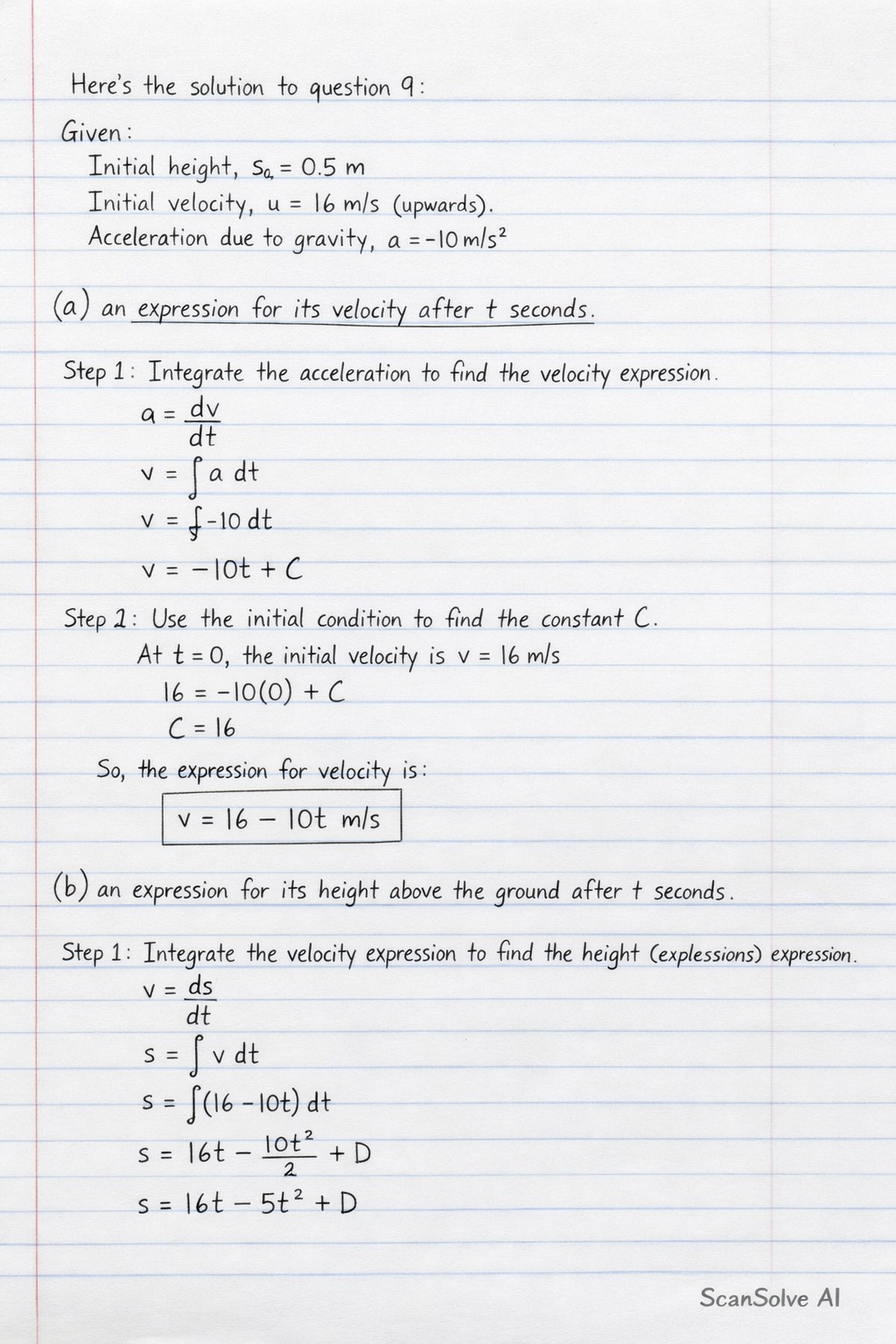
Handwritten Step-by-Step Solution
Get this as a handwritten image on WhatsApp — like a tutor wrote it for you.
Try on WhatsApp