We read your photo as:

Evaluate the integral integral ((5x))/(sqrt(1-25x2)) dx and find the exact value of sech( 2).

Mathematics

ScanSolve AI Answer

Step-by-step solution

11 steps

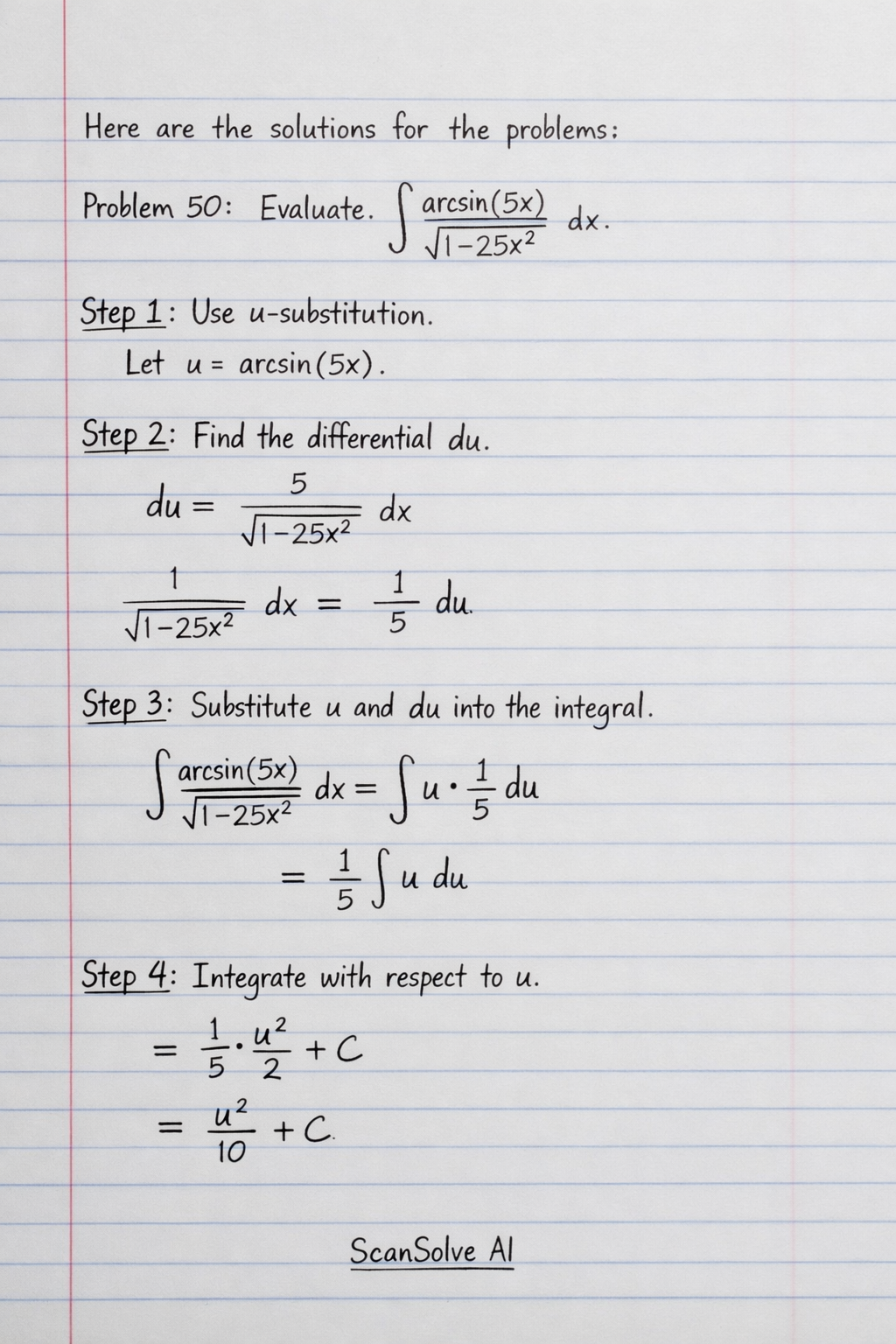
Here are the solutions for the problems:

:
We need to evaluate the integral ∫arcsin⁡(5x)1−5x2dx\int \frac{\arcsin(5x)}{\sqrt{1-5x^2}} dx.
Assumption: Based on the typical form for integrals involving arcsin⁡\arcsin, we assume the denominator is 1−(5x)2=1−25x2\sqrt{1-(5x)^2} = \sqrt{1-25x^2}. If the denominator is strictly 1−5x2\sqrt{1-5x^2}, the integral would be significantly more complex and not a direct u-substitution.

  1. Use u-substitution.

    Let u=arcsin⁡(5x)u = \arcsin(5x).

  2. Find the differential dudu.

    Recall that ddx(arcsin⁡(ax))=a1−(ax)2\frac{d}{dx}(\arcsin(ax)) = \frac{a}{\sqrt{1-(ax)^2}}.
    So, differentiating uu with respect to xx gives:

    du=51−(5x)2dx=51−25x2dxdu = \frac{5}{\sqrt{1-(5x)^2}} dx = \frac{5}{\sqrt{1-25x^2}} dx

    Rearrange to solve for 11−25x2dx\frac{1}{\sqrt{1-25x^2}} dx:

    15du=11−25x2dx\frac{1}{5} du = \frac{1}{\sqrt{1-25x^2}} dx
  3. Substitute uu and dudu into the integral.

    The integral becomes:

    ∫u⋅15du=15∫u du\int u \cdot \frac{1}{5} du = \frac{1}{5} \int u \, du
  4. Integrate with respect to uu.

    15⋅u22+C=u210+C\frac{1}{5} \cdot \frac{u^2}{2} + C = \frac{u^2}{10} + C
  5. Substitute back u=arcsin⁡(5x)u = \arcsin(5x).

    (arcsin⁡(5x))210+C\frac{(\arcsin(5x))^2}{10} + C

    The final answer is (arcsin⁡(5x))210+C\boxed{\frac{(\arcsin(5x))^2}{10} + C}.

    :
    We need to find the exact value of sech(ln⁡2)\text{sech}(\ln 2).

  6. Recall the definition of sech(x)\text{sech}(x).

    sech(x)=1cosh⁡(x)\text{sech}(x) = \frac{1}{\cosh(x)}

    And the definition of cosh⁡(x)\cosh(x):

    cosh⁡(x)=ex+e−x2\cosh(x) = \frac{e^x + e^{-x}}{2}
  7. Substitute x=ln⁡2x = \ln 2 into the definition of cosh⁡(x)\cosh(x).

    cosh⁡(ln⁡2)=eln⁡2+e−ln⁡22\cosh(\ln 2) = \frac{e^{\ln 2} + e^{-\ln 2}}{2}
  8. Simplify the exponential terms.

    Using the property eln⁡a=ae^{\ln a} = a:

    eln⁡2=2e^{\ln 2} = 2

    Using the property e−a=1eae^{-a} = \frac{1}{e^a}:

    e−ln⁡2=eln⁡(2−1)=2−1=12e^{-\ln 2} = e^{\ln(2^{-1})} = 2^{-1} = \frac{1}{2}
  9. Substitute these values back into the expression for cosh⁡(ln⁡2)\cosh(\ln 2).

    cosh⁡(ln⁡2)=2+122\cosh(\ln 2) = \frac{2 + \frac{1}{2}}{2}
  10. Calculate the value of cosh⁡(ln⁡2)\cosh(\ln 2).

    cosh⁡(ln⁡2)=42+122=522=54\cosh(\ln 2) = \frac{\frac{4}{2} + \frac{1}{2}}{2} = \frac{\frac{5}{2}}{2} = \frac{5}{4}
  11. Calculate sech(ln⁡2)\text{sech}(\ln 2).

    sech(ln⁡2)=1cosh⁡(ln⁡2)=154=45\text{sech}(\ln 2) = \frac{1}{\cosh(\ln 2)} = \frac{1}{\frac{5}{4}} = \frac{4}{5}

    The final answer is 45\boxed{\frac{4}{5}}.

Was this helpful?

Still stuck on this one?

Ask a follow-up, and the answer starts from this question.

Got a different question?Ask your own question
Handwritten step-by-step solution preview

Handwritten Step-by-Step Solution

Get this as a handwritten image on WhatsApp — like a tutor wrote it for you.

Try on WhatsApp