Evaluate the integral of (cos^-1 x)2 with respect to x.
|Mathematics
Evaluate the integral of (cos^-1 x)2 with respect to x.
ScanSolve AI Answer
Answer
x(cos−1x)2−21−x2cos−1x−2x+C
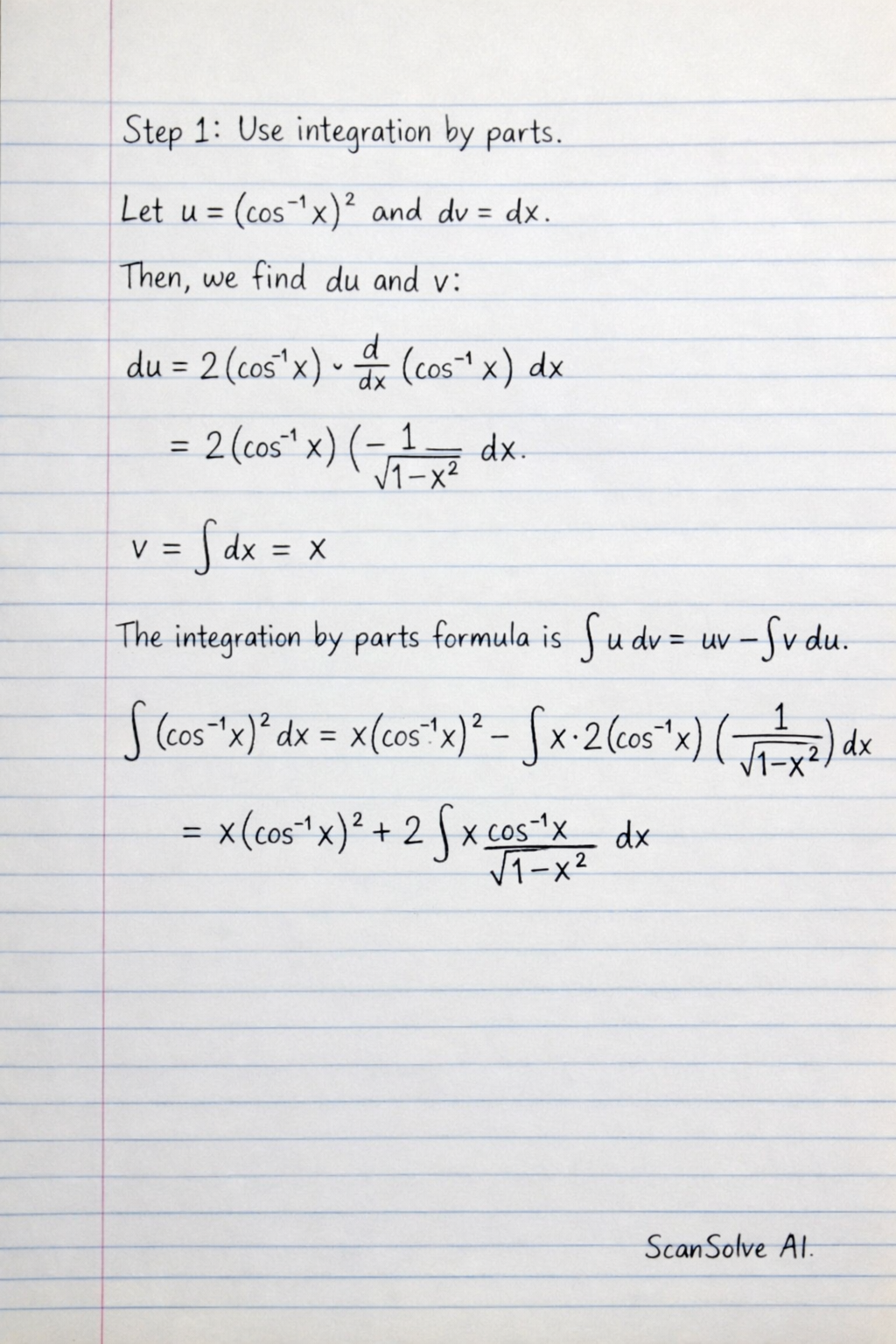
Step 1: Use integration by parts.
Let u=(cos−1x)2 and dv=dx.
Then, we find du and v:
du=2(cos−1x)⋅dxd(cos−1x)dx=2(cos−1x)(1−x2−1)dxv=∫dx=x
The integration by parts formula is ∫udv=uv−∫vdu.
∫(cos−1x)2dx=x(cos−1x)2−∫x⋅2(cos−1x)(1−x2−1)dx∫(cos−1x)2dx=x(cos−1x)2+2∫1−x2xcos−1xdx
Step 2: Evaluate the new integral using integration by parts again.
Consider the integral I2=∫1−x2xcos−1xdx.
Let U=cos−1x and dV=1−x2xdx.
Then, we find dU and V:
dU=1−x2−1dx
To find V, integrate dV:
Let w=1−x2, so dw=−2xdx, which means xdx=−21dw.
V=∫1−x2xdx=∫w−21dw=−21∫w−1/2dwV=−21(1/2w1/2)=−w1/2=−1−x2
Now apply the integration by parts formula UV−∫VdU for I2:
I2=(cos−1x)(−1−x2)−∫(−1−x2)(1−x2−1)dxI2=−1−x2cos−1x−∫1dxI2=−1−x2cos−1x−x
Step 3: Substitute I2 back into the expression from Step 1.
∫(cos−1x)2dx=x(cos−1x)2+2(−1−x2cos−1x−x)+C∫(cos−1x)2dx=x(cos−1x)2−21−x2cos−1x−2x+C
The final answer is x(cos−1x)2−21−x2cos−1x−2x+C.
Was this helpful?
Need help with your own homework?
Get instant step-by-step solutions to any question. Free to start.
This mathematics problem involves applying core mathematical principles and formulas. Below you will find a complete step-by-step solution with detailed explanations for each step, helping you understand not just the answer but the method behind it.
ScanSolve AI Answer
Step 1: Use integration by parts. Let u = (^-1 x)^2 and dv = dx. Then, we find du and v: du = 2(^-1 x) · (d)/(dx)(^-1 x) \, dx = 2(^-1 x) ((-1)/(sqrt(1-x^2))) \, dx v = dx = x The integration by parts formula is u \, dv = uv - v \, du. (^-1 x)^2 dx = x(^-1 x)^2 - x · 2(^-1 x) ((-1)/(sqrt(1-x^2))) \, dx (^-1 x)^2 dx = x(^-1 x)^2 + 2 x ^-1 xsqrt(1-x^2) \, dx Step 2: Evaluate the new integral using integration by parts again. Consider the integral I_2 = x ^-1 xsqrt(1-x^2) \, dx. Let U = ^-1 x and dV = (x)/(sqrt(1-x^2)) \, dx. Then, we find dU and V: dU = (-1)/(sqrt(1-x^2)) \, dx To find V, integrate dV: Let w = 1-x^2, so dw = -2x \, dx, which means x \, dx = -(1)/(2) dw. V = (x)/(sqrt(1-x^2)) \, dx = (-1)/(2) dwsqrt(w) = -(1)/(2) w^-1/2 \, dw V = -(1)/(2) (w^1/21/2) = -w^1/2 = -sqrt(1-x^2) Now apply the integration by parts formula UV - V \, dU for I_2: I_2 = (^-1 x)(-sqrt(1-x^2)) - (-sqrt(1-x^2)) ((-1)/(sqrt(1-x^2))) \, dx I_2 = -sqrt(1-x^2) ^-1 x - 1 \, dx I_2 = -sqrt(1-x^2) ^-1 x - x Step 3: Substitute I_2 back into the expression from Step 1. (^-1 x)^2 dx = x(^-1 x)^2 + 2 ( -sqrt(1-x^2) ^-1 x - x ) + C (^-1 x)^2 dx = x(^-1 x)^2 - 2sqrt(1-x^2) ^-1 x - 2x + C The final answer is x(^-1 x)^2 - 2sqrt(1-x^2) ^-1 x - 2x + C.