
We read your photo as:
Find the inverse Laplace transforms for the given functions.
Mathematics
ScanSolve AI Answer
Answer
Step-by-step solution
4 stepsHere are the solutions to the Laplace Transform problems:
1. Find
Use the inverse Laplace transform formula .
Here, , so . We need in the numerator.
Apply the formula.
The final answer is .
2. Find
Use partial fraction decomposition.
Let .
Solve for A, B, C.
For A, set : .
For B, set : $B = \frac{1}{(-1)(-1+9)} = \frac{1}{-8} = -\frac{
Was this helpful?
Try one yourself
A new problem that tests the same skill.
Still stuck on this one?
Ask a follow-up, and the answer starts from this question.
Got a different question?Ask your own question
More Mathematics Questions
QFind the Laplace transform of (e2t - 1)2 and the inverse Laplace transform of e−3ss3.QFind the inverse Laplace transform of F(s) = 1 / (s2(s+1)(s2+9)) using partial fraction…QApply the Laplace Transform to the differential equation.QWhat are the inverse functions for Fourier transforms and trigonometric/hyperbolic functions, and…QFind the inverse function f⁻¹(x) for the function f(x) = (2x−1)/(x+2).
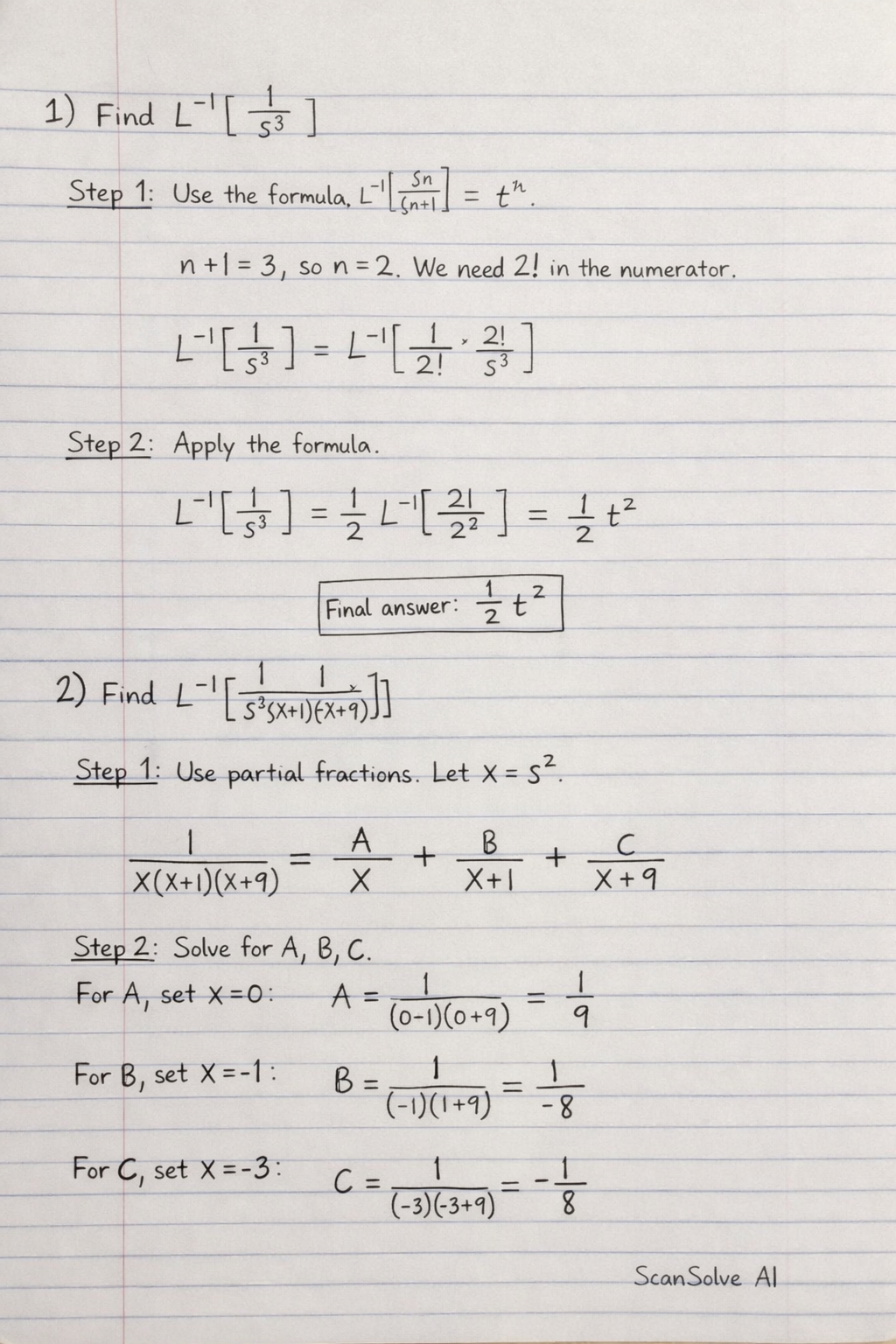
Handwritten Step-by-Step Solution
Get this as a handwritten image on WhatsApp — like a tutor wrote it for you.
Try on WhatsApp