
We read your photo as:
It takes y years for N 87,300.00 to amount to N 99,522.00 at 7% per annum simple interest. Find the value of y.
ScanSolve AI Answer
Answer
Step-by-step solution
9 stepsHere are the solutions for questions 3, 4, and 5.
Part 3· 3 steps
It takes years for N 87,300.00 to amount to N 99,522.00 at 7% per annum simple interest. Find the value of .
Calculate the simple interest (I).
The simple interest is the difference between the amount and the principal.
Use the simple interest formula to find .
The formula for simple interest is , where is the principal, is the annual interest rate (as a decimal), and is the time in years.
Given , , and .Solve for .
The value of is 2 years.
The correct option is C.
Part 4· 3 steps
Given that and , find the value of .
Solve the system of linear equations for and .
We have two equations:
From equation (2), express in terms of :
Substitute this expression for into equation (1):
Substitute the value of back into the expression for .
Calculate the value of .
The correct option is D.
Part 5· 3 steps
A line in the plane passes through the point . If the gradient of the line is , find the equation of the line.
Use the point-slope form of a linear equation.
The point-slope form is , where is a point on the line and is the gradient (slope).
Given point and gradient .Substitute the given values into the formula.
Simplify the equation to the slope-intercept form ().
Add 10 to both sides of the equation:
This can also be written as .
The correct option is C.
Try one yourself
A new problem that tests the same skill.
Still stuck on this one?
Ask a follow-up, and the answer starts from this question.
More Mathematics Questions
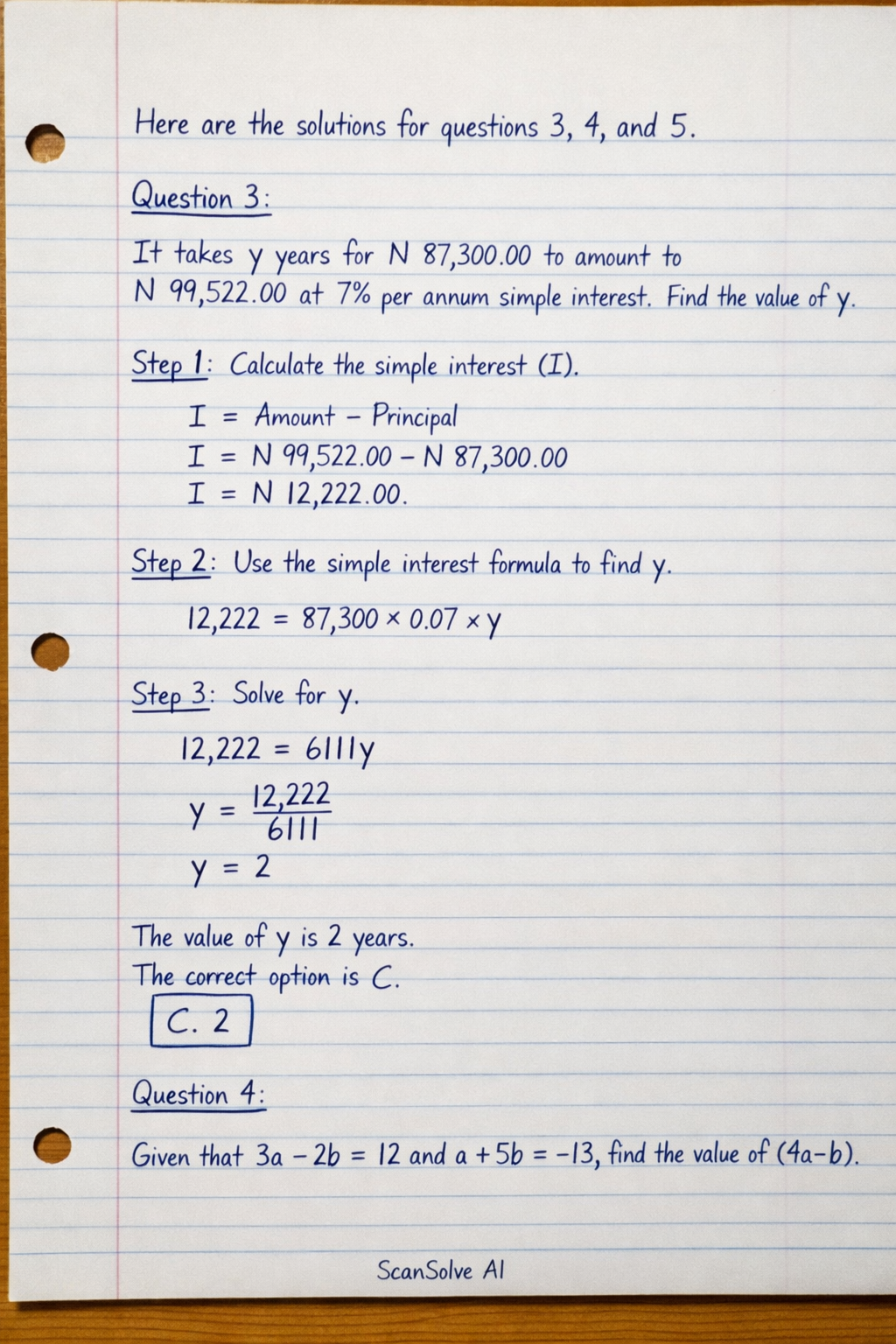
Handwritten Step-by-Step Solution
Get this as a handwritten image on WhatsApp — like a tutor wrote it for you.
Try on WhatsApp