
We read your photo as:
Which jug holds more: A or B?
ScanSolve AI Answer
Step-by-step solution
26 stepsHere are the solutions to the questions:
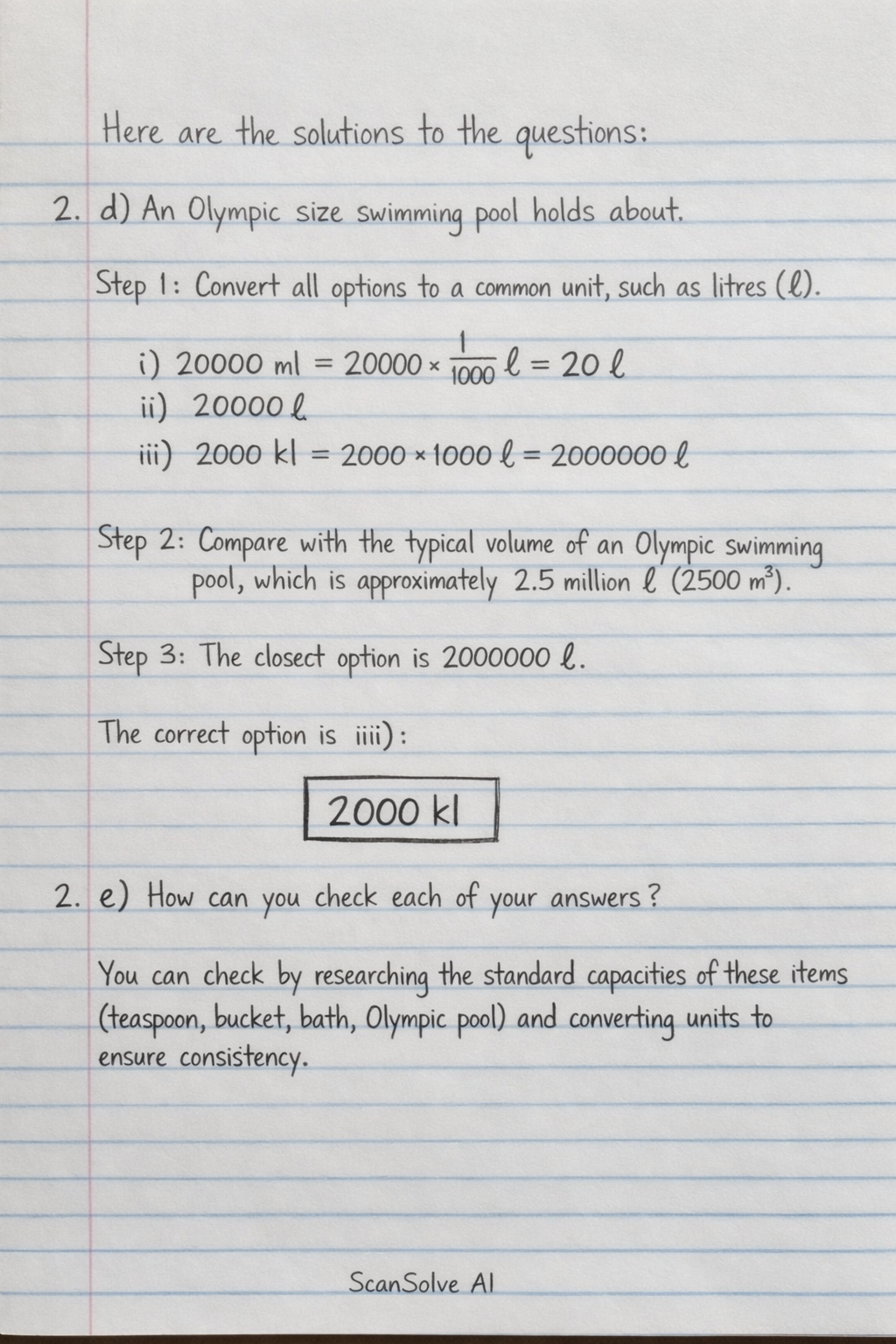
2. d) An Olympic size swimming pool holds about
Convert all options to a common unit, such as litres ().
- i)
- ii)
- iii)
Compare with the typical volume of an Olympic swimming pool, which is approximately ().
The closest option is .
The correct option is iii).
2. e) How can you check each of your answers?
You can check by researching the standard capacities of these items (teaspoon, bucket, bath, Olympic pool) and converting units to ensure consistency.3. Jug A
a) Does jug A hold more or less than 1 litre?
The top mark of Jug A is 500.
Assuming the units are millilitres (ml), as is common for measuring jugs.
Convert 1 litre to millilitres
.
Compare with .
Jug A holds less than 1 litre.
b) How much can jug A hold, if you fill it to the top mark?
The top mark on Jug A is 500.c) What does each mark in between the numbers show?
Observe the numbered marks, e.g., 100 and 200.
The difference is .
Count the number of intervals between these two numbered marks.
There are 5 intervals.
Divide the difference by the number of intervals
.
Each mark shows 20 ml.d) About how much milk is in the jug?
The milk level is above .
Count the number of small marks above .
The milk level is at the second mark above .
Multiply the number of marks by the value of each mark
.
Add this to the mark
.
There is about 240 ml of milk in Jug A.3. Jug B
a) Does jug B hold more or less than 1 litre?
The top mark of Jug B is 1000.
Assuming the units are millilitres (ml).
Convert 1 litre to millilitres
.
Compare with .
Jug B holds exactly 1 litre.
b) How much can this jug hold, if you fill it to the top mark?
The top mark on Jug B is 1000.c) What does each mark in between the numbers show?
Observe the numbered marks, e.g., 200 and 400.
The difference is .
Count the number of intervals between these two numbered marks.
There are 5 intervals.
Divide the difference by the number of intervals
.
Each mark shows 40 ml.d) About how much milk is in the jug?
The milk level is above .
Count the number of small marks above .
The milk level is at the first mark above .
Multiply the number of marks by the value of each mark
.
Add this to the mark
.
There is about 240 ml of milk in Jug B.Which jug holds more: A or B?
Jug A holds to its top mark.
Jug B holds to its top mark.
Compare the maximum capacities
.
Jug B holds more.
Still stuck on this one?
Ask a follow-up, and the answer starts from this question.
More Mathematics Questions
Handwritten Step-by-Step Solution
Get this as a handwritten image on WhatsApp — like a tutor wrote it for you.
Try on WhatsApp