
We read your photo as:
Which tube will collect the smallest volume of gas, A or B, and why?
ScanSolve AI Answer
Answer
The smallest volume of gas will be collected from Tube A (magnesium powder).
Step-by-step solution
3 stepsIdentify the reactions occurring in each tube.
- In Tube A, magnesium (Mg) reacts with oxygen () to form magnesium oxide () and with nitrogen () to form magnesium nitride () when heated:
- In Tube B, zinc (Zn) reacts with oxygen () to form zinc oxide () when heated. Zinc is generally not reactive enough to react with nitrogen under these conditions:
Compare the extent of gas removal.
Magnesium is more reactive than zinc. Therefore, magnesium reacts with both oxygen (approximately 21% of air) and nitrogen (approximately 78% of air). Zinc primarily reacts only with oxygen.
Conclude which tube collects the smallest volume of gas.
Since magnesium removes both oxygen and nitrogen from the air, a significantly larger volume of the gaseous components of air will be consumed in Tube A compared to Tube B, where only oxygen is removed. Thus, the volume of unreacted gas collected from Tube A will be smaller.
The smallest volume of gas will be collected from Tube A. This is because magnesium is more reactive than zinc and will react with both oxygen and nitrogen in the air, whereas zinc will primarily react only with oxygen.
Still stuck on this one?
Ask a follow-up, and the answer starts from this question.
More Chemistry Questions
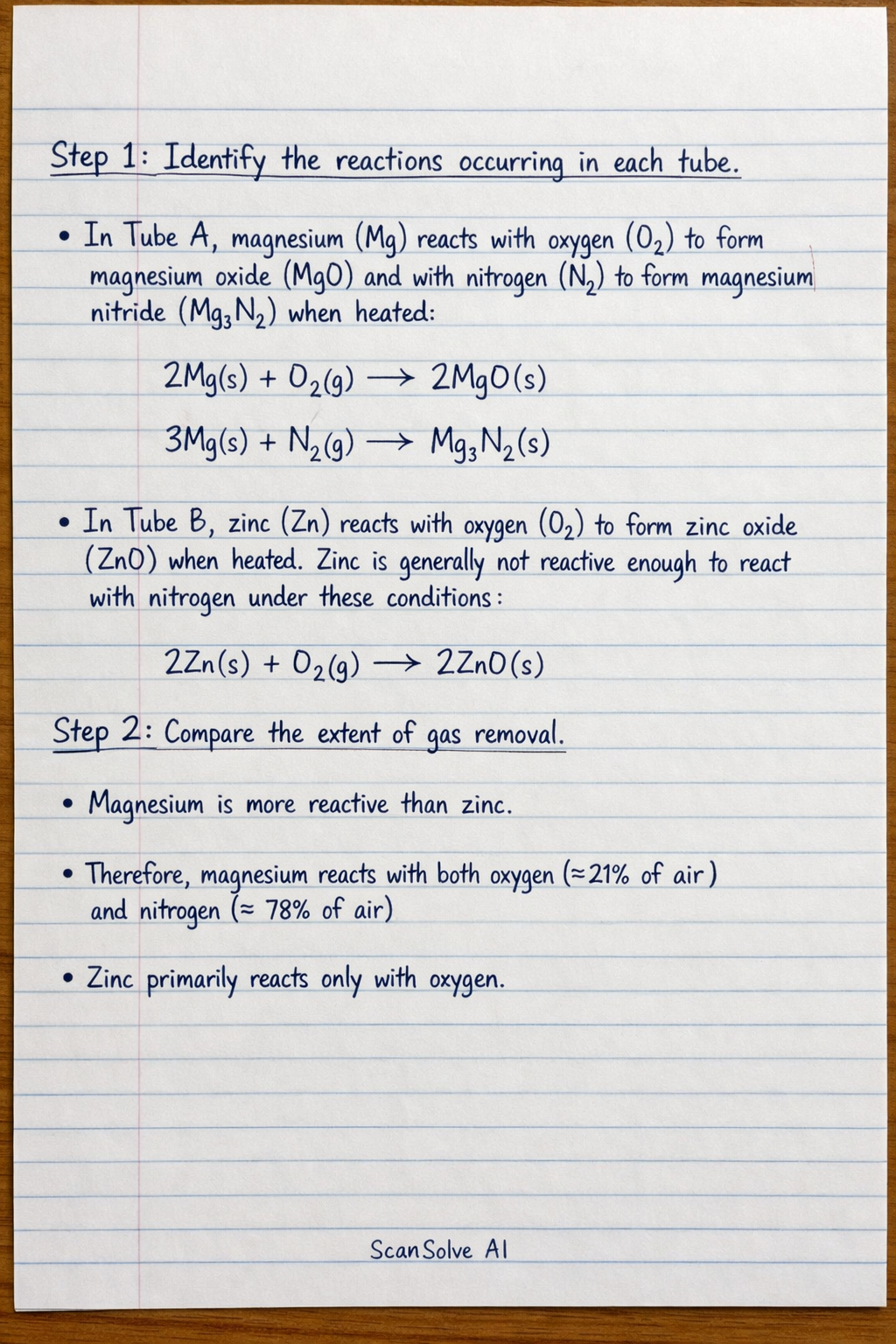
Handwritten Step-by-Step Solution
Get this as a handwritten image on WhatsApp — like a tutor wrote it for you.
Try on WhatsApp