

This mathematics problem involves applying core mathematical principles and formulas. Below you will find a complete step-by-step solution with detailed explanations for each step, helping you understand not just the answer but the method behind it.
ScanSolve AI Answer
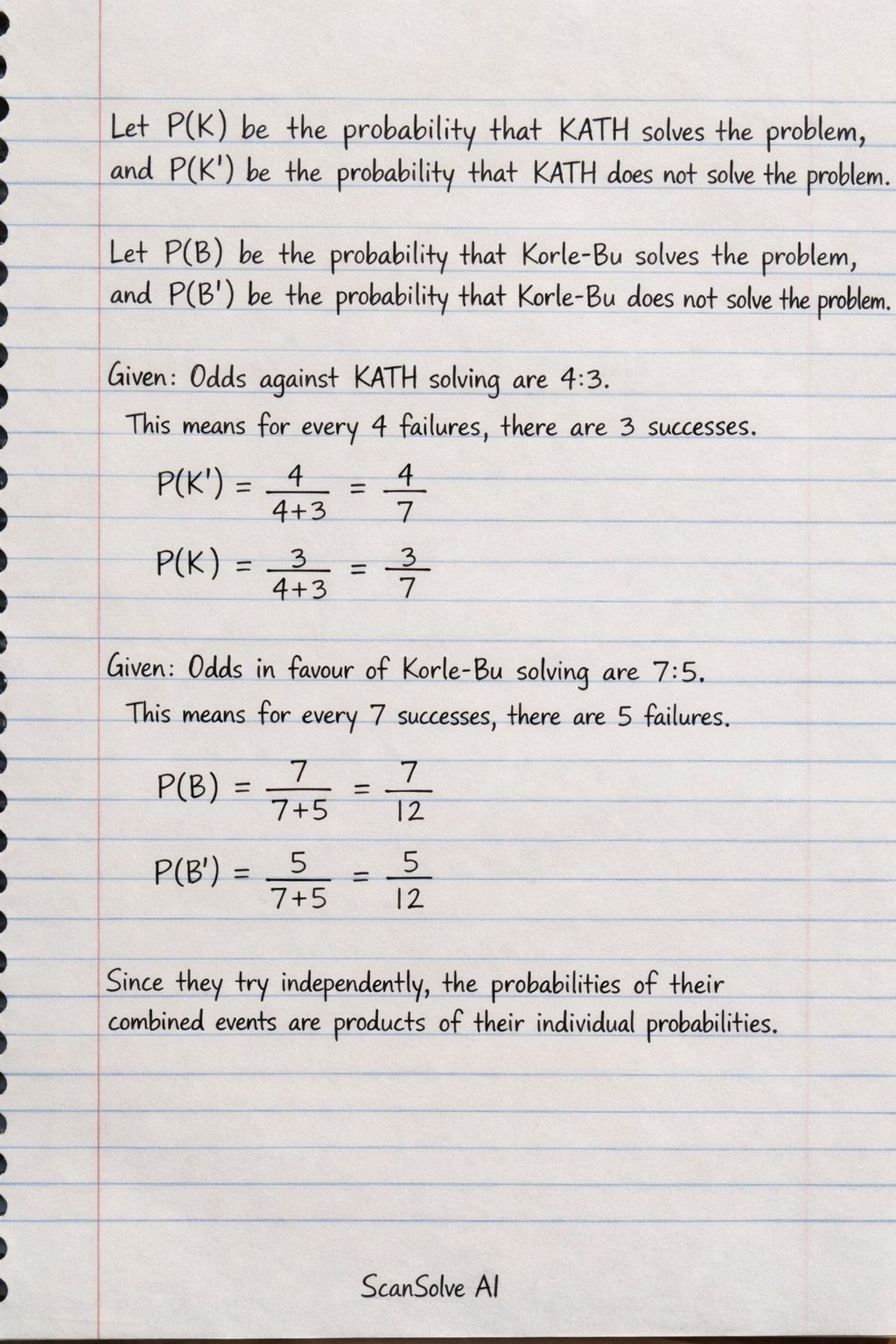
Let P(K) be the probability that KATH solves the problem, and P(K') be the probability that KATH does not solve the problem. Let P(B) be the probability that Korle-Bu solves the problem, and P(B') be the probability that Korle-Bu does not solve the problem. Given: Odds against KATH solving are 4:3. This means for every 4 failures, there are 3 successes. P(K') = (4)/(4+3) = (4)/(7) P(K) = (3)/(4+3) = (3)/(7) Given: Odds in favour of Korle-Bu solving are 7:5. This means for every 7 successes, there are 5 failures. P(B) = (7)/(7+5) = (7)/(12) P(B') = (5)/(7+5) = (5)/(12) Since they try independently, the probabilities of their combined events are products of their individual probabilities. 1. The problem will be solved if both try independently. This means at least one of them solves the problem. This is P(K B). It can be calculated as 1 - P(neither solves). P(neither solves) = P(K' B') = P(K') × P(B'). P(K' B') = (4)/(7) × (5)/(12) = (20)/(84) = (5)/(21) The probability that the problem will be solved is: P(K B) = 1 - P(K' B') = 1 - (5)/(21) = (21-5)/(21) = (16)/(21) The probability that the problem will be solved is (16)/(21). 2. The problem will not be solved. This means neither KATH nor Korle-Bu solves the problem, which is P(K' B'). From the calculation above: P(K' B') = (4)/(7) × (5)/(12) = (20)/(84) = (5)/(21) The probability that the problem will not be solved is (5)/(21). 3. KATH solves and Korle-Bu does not solve. This is P(K B'). P(K B') = P(K) × P(B') = (3)/(7) × (5)/(12) = (15)/(84) = (5)/(28) The probability that KATH solves and Korle-Bu does not solve is (5)/(28). 4. KATH does not solve but Korle-Bu solves. This is P(K' B). P(K' B) = P(K') × P(B) = (4)/(7) × (7)/(12) = (28)/(84) = (1)/(3) The probability that KATH does not solve but Korle-Bu solves is (1)/(3). 5. Only one of them solve the problem. This means (KATH solves AND Korle-Bu does not solve) OR (KATH does not solve AND Korle-Bu solves). This is P(K B') + P(K' B). Using the results from parts 3 and 4: P(only one solves) = (5)/(28) + (1)/(3) To add these fractions, find a common denominator, which is 28 × 3 = 84. P(only one solves) = (5 × 3)/(28 × 3) + (1 × 28)/(3 × 28) = (15)/(84) + (28)/(84) = (15+28)/(84) = (43)/(84) The probability that only one of them solves the problem is (43)/(84). Send me the next one 📸