
We read your photo as:
Explain the key components of hypothesis testing and outline the steps involved in conducting a hypothesis test.
ScanSolve AI Answer
Answer
Step-by-step solution
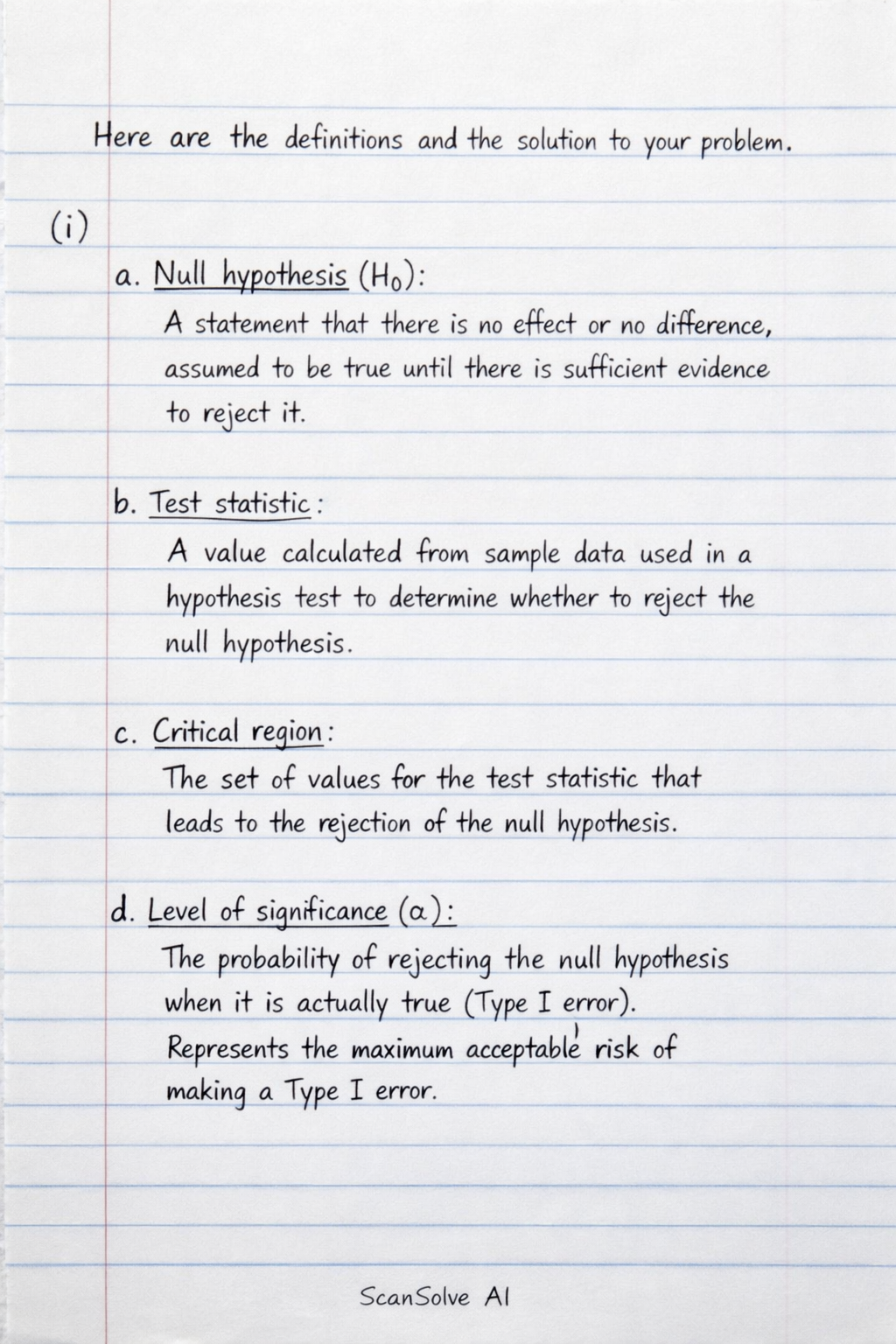
7 stepsHere are the definitions and the solution to your problem.
Part i
Part a
Null hypothesis ()**: A statement that there is no effect or no difference, which is assumed to be true until there is sufficient evidence to reject it.
Part b
Test statistic**: A value calculated from sample data during a hypothesis test, used to determine whether to reject the null hypothesis.
Part c
Critical region**: The set of values for the test statistic that leads to the rejection of the null hypothesis.
Part d(ii)
Level of significance ()**: The probability of rejecting the null hypothesis when it is actually true (Type I error). It represents the maximum acceptable risk of making a Type I error.
The procedure for performing a test of a statistical hypothesis is as follows:
- State the Hypotheses: Formulate the null hypothesis () and the alternative hypothesis ().
- Choose the Test Statistic: Select the appropriate statistical test based on the data type, sample size, and population parameters.
- Determine the Level of Significance: Set the significance level (), which is the probability of rejecting a true null hypothesis.
- Calculate the Test Statistic: Compute the value of the test statistic using the sample data.
- Determine the Critical Region or p-value: Find the critical value(s) from the appropriate distribution table or calculate the p-value.
- Make a Decision: Compare the calculated test statistic to the critical value(s) or compare the p-value to the level of significance.
- State the Conclusion: Interpret the decision in the context of the original problem.
Part d(iii)
We will follow the procedure outlined in (ii) to determine if the proprietor's complaint is justified.
Given Data:
- Population mean (stated value), g
- Sample size,
- Sample mean, g
- Sample standard deviation, g
- Level of significance,
State the Hypotheses
The proprietor complains that the average mass is less than the stated value.
This is a left-tailed test.
Choose the Test Statistic
Since the sample size is large () and the population standard deviation is unknown but the sample standard deviation is given, we use the z-test for the mean.
Determine the Level of Significance
The level of significance is given as .
Calculate the Test Statistic
Substitute the given values into the formula:
Determine the Critical Region
For a left-tailed test with , we find the critical z-value such that . From the standard normal distribution table, the critical z-value is approximately .
The critical region is .Make a Decision
Compare the calculated test statistic to the critical value:
Calculated
Critical
Since , the calculated test statistic falls within the critical region. Therefore, we reject the null hypothesis.State the Conclusion
At the 5% level of significance, there is sufficient evidence to conclude that the average mass of sachets supplied by the company is less than 100g.
The proprietor's complaint is justified.
Try one yourself
A new problem that tests the same skill.
Still stuck on this one?
Ask a follow-up, and the answer starts from this question.
More Mathematics Questions
Handwritten Step-by-Step Solution
Get this as a handwritten image on WhatsApp — like a tutor wrote it for you.
Try on WhatsApp