KLMN is a parallelogram with KN//LM and LK//MN. Using the diagram above, prove the theorem which states that the opposite sides of a parallelogram are equal.
|Mathematics
KLMN is a parallelogram with KN//LM and LK//MN. Using the diagram above, prove the theorem which states that the opposite sides of a parallelogram are equal.
ScanSolve AI Answer
3 steps
Answer
x≈55.08∘orx≈124.92∘
QUESTION 2
2.1 Solve for x in the following equations, correct to two decimal places.
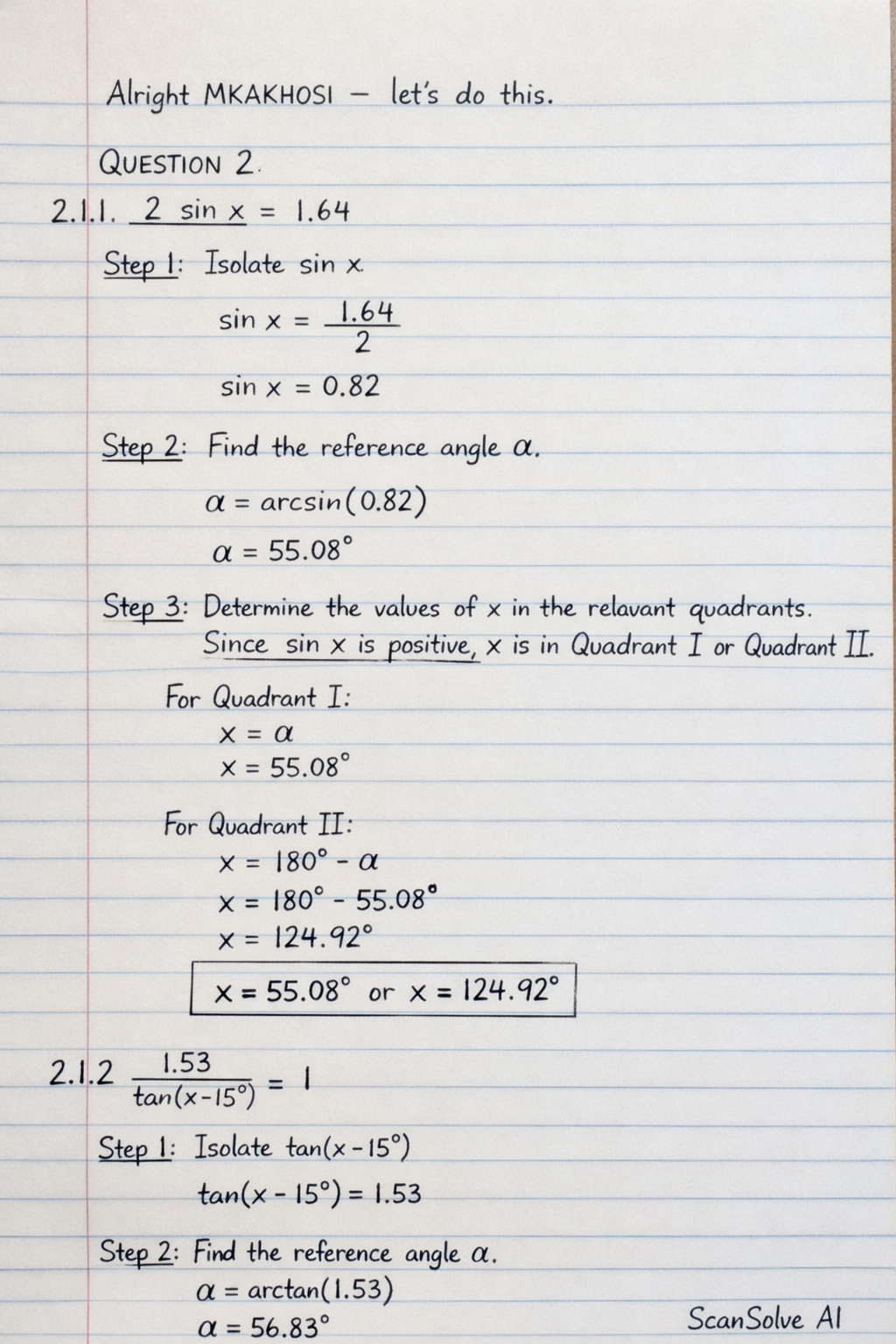
2.1.1 2sinx=1.64
Step 1: Isolate sinx.
sinx=21.64sinx=0.82
Step 2: Find the reference angle α.
α=arcsin(0.82)α≈55.08∘
Step 3: Determine the values of x in the relevant quadrants. Since sinx is positive, x is in Quadrant I or Quadrant II.
For Quadrant I:
x=αx≈55.08∘
For Quadrant II:
x=180∘−αx=180∘−55.08∘x≈124.92∘x≈55.08∘orx≈124.92∘
2.1.2 tan(x−15∘)1.53=1
Step 1: Isolate tan(x−15∘).
tan(x−15∘)=1.53
Step 2: Find the reference angle α.
α=arctan(1.53)α≈56.83∘
Step 3: Determine the general solution for (x−15∘). Since tan is positive, the angle is in Quadrant I or Quadrant III. The general solution for tan covers both.
x−15∘=56.83∘+k⋅180∘wherek∈Z
Step 4: Solve for x.
x=15∘+56.83∘+k⋅180∘x=71.83∘+k⋅180∘
For k=0:
x≈71.83∘
For k=1:
x≈71.83∘+180∘=251.83∘x≈71.83∘orx≈251.83∘
2.2 Evaluate without using a calculator: sin45∘(cot230∘1)cos45∘
Step 1: Recall the values of the special angles.
cos45∘=22sin45∘=22cot30∘=3
Step 2: Substitute the values into the expression.
22((3)21)22
Step 3: Simplify the expression.
22(31)22
Cancel out the common term 22:
311=33
2.3 If 13cosθ+12=0 and 180∘≤θ≤360∘, calculate with the aid of diagram, but without using a calculator, the value of: secθ1+sinθ
Step 1: Solve for cosθ.
13cosθ=−12cosθ=−1312
Step 2: Determine the quadrant for θ.
Since cosθ is negative and 180∘≤θ≤360∘, θ must be in Quadrant III.
Step 3: Draw a right-angled triangle in Quadrant III.
In Quadrant III, x is negative, y is negative, and r is positive.
We have cosθ=rx=−1312. So, x=−12 and r=13.
Use the Pythagorean theorem to find y:
x2+y2=r2(−12)2+y2=132144+y2=169y2=169−144y2=25
Since y is negative in Quadrant III, y=−5.
Step 4: Calculate sinθ and secθ1.
sinθ=ry=13−5=−135
Recall that secθ1=cosθ.
So, secθ1=−1312.
Step 5: Substitute the values into the expression secθ1+sinθ.
secθ1+sinθ=cosθ+sinθ=−1312+(−135)=−1312−135=−1317−1317
QUESTION 3
3.1 KLMN is a parallelogram with KN || LM and LK || MN. Using the diagram above, prove the theorem which states that the opposite sides of a parallelogram are equal.
Given: KLMN is a parallelogram.
This implies that KN || LM and KL || NM.
To Prove: KL = NM and KN = LM.
Construction: Draw diagonal LN.
Proof:
Consider △KLN and △MNL.
∠KLN=∠MNL (Alternate interior angles, since KL || NM and LN is a transversal).
∠KNL=∠MLN (Alternate interior angles, since KN || LM and LN is a transversal).
Since the triangles are congruent, their corresponding sides are equal:
• KL = NM (Corresponding sides of congruent triangles)
• KN = LM (Corresponding sides of congruent triangles)
Thus, the opposite sides of parallelogram KLMN are equal.
Proofcomplete
What's next?
Was this helpful?
Need help with your own homework?
Get instant step-by-step solutions to any question. Free to start.
QUESTION 2 2.1 Solve for x in the following equations, correct to two decimal places.
KLMN is a parallelogram with KN//LM and LK//MN. Using the diagram above, prove the theorem which states that the opposite sides of a parallelogram are equal.
This mathematics problem involves applying core mathematical principles and formulas. Below you will find a complete step-by-step solution with detailed explanations for each step, helping you understand not just the answer but the method behind it.
ScanSolve AI Answer
QUESTION 2 2.1 Solve for x in the following equations, correct to two decimal places. 2.1.1 2 x = 1.64 Step 1: Isolate x. x = (1.64)/(2) x = 0.82 Step 2: Find the reference angle . = (0.82) ≈ 55.08^ Step 3: Determine the values of x in the relevant quadrants. Since x is positive, x is in Quadrant I or Quadrant II. For Quadrant I: x = x ≈ 55.08^ For Quadrant II: x = 180^ - x = 180^ - 55.08^ x ≈ 124.92^ x ≈ 55.08^ or x ≈ 124.92^ 2.1.2 (1.53)/((x-15^)) = 1 Step 1: Isolate (x-15^). (x-15^) = 1.53 Step 2: Find the reference angle . = (1.53) ≈ 56.83^ Step 3: Determine the general solution for (x-15^). Since is positive, the angle is in Quadrant I or Quadrant III. The general solution for covers both. x - 15^ = 56.83^ + k · 180^ where k Z Step 4: Solve for x. x = 15^ + 56.83^ + k · 180^ x = 71.83^ + k · 180^ For k=0: x ≈ 71.83^ For k=1: x ≈ 71.83^ + 180^ = 251.83^ x ≈ 71.83^ or x ≈ 251.83^ 2.2 Evaluate without using a calculator: ( 45^)/( 45^ (1)^2 30^) Step 1: Recall the values of the special angles. 45^ = sqrt(2)2 45^ = sqrt(2)2 30^ = sqrt(3) Step 2: Substitute the values into the expression. sqrt(2)2sqrt(2)2 ((1)/((sqrt(3))^2)) Step 3: Simplify the expression. sqrt(2)2sqrt(2)2 ((1)/(3)) Cancel out the common term sqrt(2)2: (1)/(1)3 = 3 3 2.3 If 13 + 12 = 0 and 180^ 360^, calculate with the aid of diagram, but without using a calculator, the value of: (1)/( ) + Step 1: Solve for . 13 = -12 = -(12)/(13) Step 2: Determine the quadrant for . Since is negative and 180^ 360^, must be in Quadrant III. Step 3: Draw a right-angled triangle in Quadrant III. In Quadrant III, x is negative, y is negative, and r is positive. We have = (x)/(r) = -(12)/(13). So, x = -12 and r = 13. Use the Pythagorean theorem to find y: x^2 + y^2 = r^2 (-12)^2 + y^2 = 13^2 144 + y^2 = 169 y^2 = 169 - 144 y^2 = 25 Since y is negative in Quadrant III, y = -5. Step 4: Calculate and (1)/( ). = (y)/(r) = (-5)/(13) = -(5)/(13) Recall that (1)/( ) = . So, (1)/( ) = -(12)/(13). Step 5: Substitute the values into the expression (1)/( ) + . (1)/( ) + = + = -(12)/(13) + (-(5)/(13)) = -(12)/(13) - (5)/(13) = -(17)/(13) -(17)/(13) QUESTION 3 3.1 KLMN is a parallelogram with KN || LM and LK || MN. Using the diagram above, prove the theorem which states that the opposite sides of a parallelogram are equal. Given: KLMN is a parallelogram. This implies that KN || LM and KL || NM. To Prove: KL = NM and KN = LM. Construction: Draw diagonal LN. Proof: Consider KLN and MNL. 1. KLN = MNL (Alternate interior angles, since KL || NM and LN is a transversal). 2. KNL = MLN (Alternate interior angles, since KN || LM and LN is a transversal). 3. LN = NL (Common side to both triangles). Therefore, KLN MNL (Angle-Side-Angle (ASA) congruence criterion). Since the triangles are congruent, their corresponding sides are equal: • KL = NM (Corresponding sides of congruent triangles) • KN = LM (Corresponding sides of congruent triangles) Thus, the opposite sides of parallelogram KLMN are equal. Proof complete What's next?