
We read your photo as:
Find the Laplace transform of (e2t - 1)2 and the inverse Laplace transform of e-3ss3.
ScanSolve AI Answer
Answers
3 partsStep-by-step solution
11 stepsHere are the solutions for the given Laplace transform problems.
Part 3.1· 4 steps
Expand the expression .
Apply the linearity property of the Laplace transform.
Use the standard Laplace transform formulas and .
Substitute these transforms back into the expression.
To combine into a single fraction:
The final answer is .
Part 3.2
Identify the form for the Second Shifting Theorem.
The expression is of the form , where and .
Find the inverse Laplace transform of .
We know that . For , .
Therefore,Apply the Second Shifting Theorem, which states .
Here and .
So, .where is the Heaviside step function.
The final answer is .
Part 3.3
Complete the square in the denominator.
Rewrite the expression using the completed square.
Apply the First Shifting Theorem.
The expression is of the form , where .
We know that .
In this case, and .
So, .Include the constant factor of 3.
The final answer is .
Try one yourself
A new problem that tests the same skill.
Still stuck on this one?
Ask a follow-up, and the answer starts from this question.
More Mathematics Questions
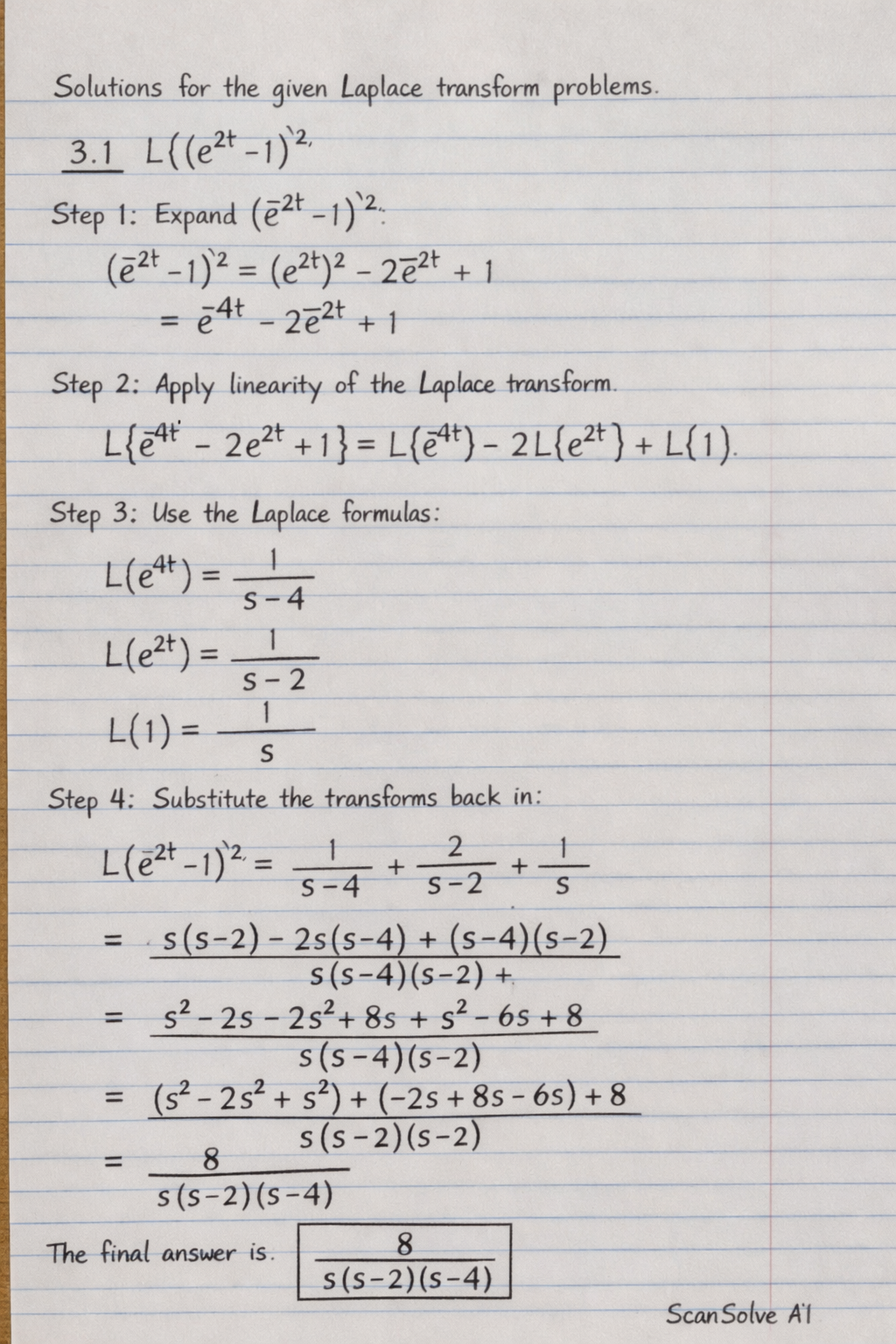
Handwritten Step-by-Step Solution
Get this as a handwritten image on WhatsApp — like a tutor wrote it for you.
Try on WhatsApp