
We read your photo as:
Calculate the lateral surface area, total surface area, and volume of a right circular cylinder with radius 4 cm and height 10 cm.
Mathematics
ScanSolve AI Answer
Step-by-step solution
3 stepsHere are the calculations for the right circular cylinder:
Given:
Radius,
Altitude (height),
Calculate the Lateral Surface Area (LSA).
The formula for the lateral surface area of a cylinder is .
The lateral surface area is .
Calculate the Total Surface Area (TSA).
The formula for the total surface area of a cylinder is .
The total surface area is .
Calculate the Volume (V).
The formula for the volume of a cylinder is .
The volume is .
Was this helpful?
Still stuck on this one?
Ask a follow-up, and the answer starts from this question.
Got a different question?Ask your own question
More Mathematics Questions
QCalculate the total surface area of a cylinder with radius 7 cm and height 10 cm, using pi = 22/7.QFind the surface area of a cone whose base radius is 4 cm and the height is 10 cm. (Take pi = 3.142)QThe cylinder below has the radius of 4cm and a height of 9cm. Answer the questions based on it…QCalculate the volume of a cylinder of radius 14 cm and height 20 cm. (Use pi = 22/7)QThe curved surface area of a cylinder of radius 7cm and height 10cm is:
Browse by topic:Geometry
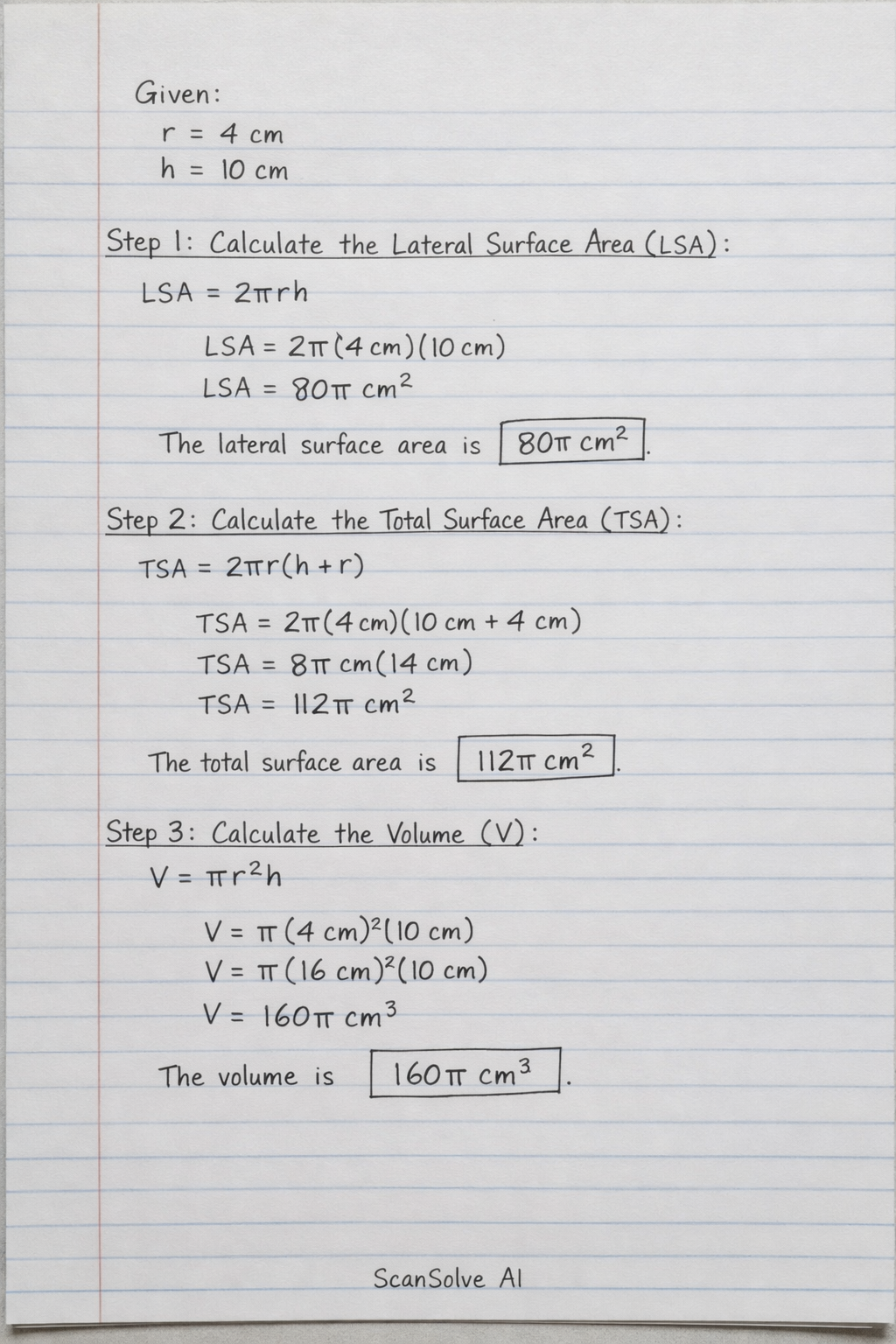
Handwritten Step-by-Step Solution
Get this as a handwritten image on WhatsApp — like a tutor wrote it for you.
Try on WhatsApp