
We read your photo as:
Calculate the LCM of 2 and 6, and simplify the following fractions: 8/5, n/(n-2) (with n<2), and (n+2)/(n2-1) (with n<1).
ScanSolve AI Answer
Answers
2 partsStep-by-step solution
7 stepsPart a· 2 steps
احسب (Calculate)
The question asks to calculate for the numbers 2 and 6. Assuming it asks for the Least Common Multiple (LCM) of 2 and 6.
Find the prime factorization of each number.
Determine the LCM by taking the highest power of all prime factors present.
The LCM of 2 and 6 is .
Part b
بسط (Simplify)
- Simplify .
Identify common factors between the numerator and the denominator.
The prime factors of 8 are .
The prime factors of 5 are 5.
There are no common prime factors other than 1.
The fraction is already in its simplest form.
The simplified expression is .- Simplify with the condition .
Identify common factors between the numerator and the denominator.
The numerator is . The denominator is .
These two terms do not share any common factors.
The expression is already in its simplest form. The condition ensures that the denominator .
The simplified expression is .- Simplify with the condition .
Factor the denominator.
The denominator is a difference of squares, which factors as .
Rewrite the expression with the factored denominator.
Identify common factors between the numerator and the denominator.
The numerator is . The factors in the denominator are and .
There are no common factors.
The expression is already in its simplest form. The condition ensures that the denominator .
The simplified expression is .
Try one yourself
A new problem that tests the same skill.
Still stuck on this one?
Ask a follow-up, and the answer starts from this question.
More Mathematics Questions
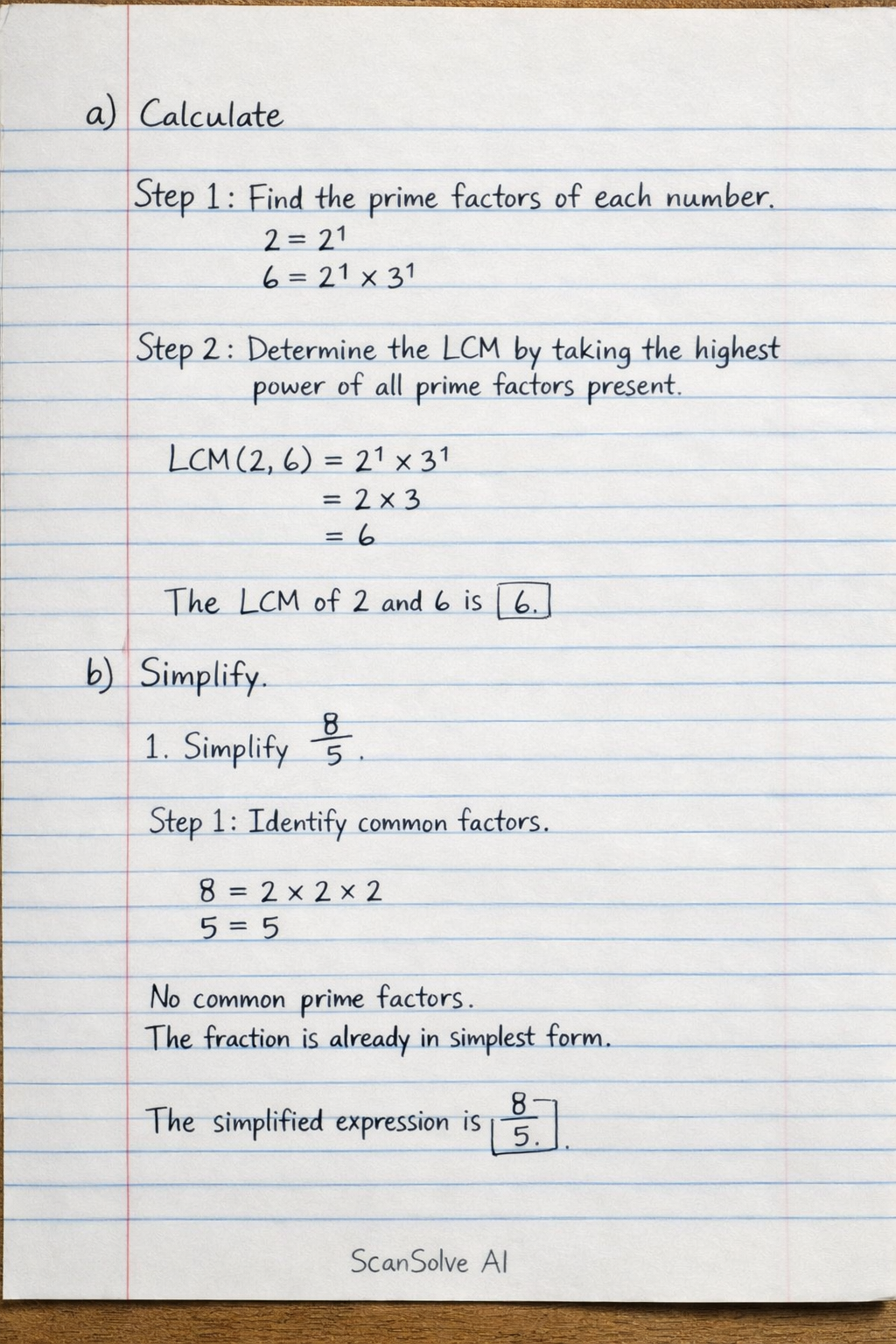
Handwritten Step-by-Step Solution
Get this as a handwritten image on WhatsApp — like a tutor wrote it for you.
Try on WhatsApp