
We read your photo as:
What is the lowest common multiple (LCM) of 8 and 6? Order common fraction below in ascending order. The fractions are 3/1000, 1/100, 3/100, 7/1000.
ScanSolve AI Answer
Answer
Step-by-step solution
9 stepsHere are the solutions to the questions:
Part 1.1· 2 steps
What is the lowest common multiple (LCM) of 8 and 6?
List the multiples of each number.
Multiples of 8:
Multiples of 6:Identify the smallest number that appears in both lists.
The lowest common multiple of 8 and 6 is 24.
The correct option is D.
Part 1.2· 3 steps
Order common fraction below in ascending order.
The fractions are , , , .
Convert all fractions to have a common denominator, which is 1000.
Compare the numerators to order the fractions in ascending order.
The numerators are 3, 10, 30, 7.
In ascending order, they are 3, 7, 10, 30.Write the fractions in ascending order using their original forms.
So the order is .
The correct option is C.
Part 1.3· 2 steps
Which decimal fraction is equivalent to ?
Divide the numerator by the denominator.
Perform the division.
The correct option is B.
Part 1.4· 2 steps
Which number below is a square number?
Recall the definition of a square number.
A square number is the result of multiplying an integer by itself.
Check each option to see if it is a perfect square.
A) 33: Not a perfect square (, )
B) 39: Not a perfect square
C) 37: Not a perfect square
D) 36: Is a perfect square, as .The correct option is D.
Try one yourself
A new problem that tests the same skill.
Still stuck on this one?
Ask a follow-up, and the answer starts from this question.
More Mathematics Questions
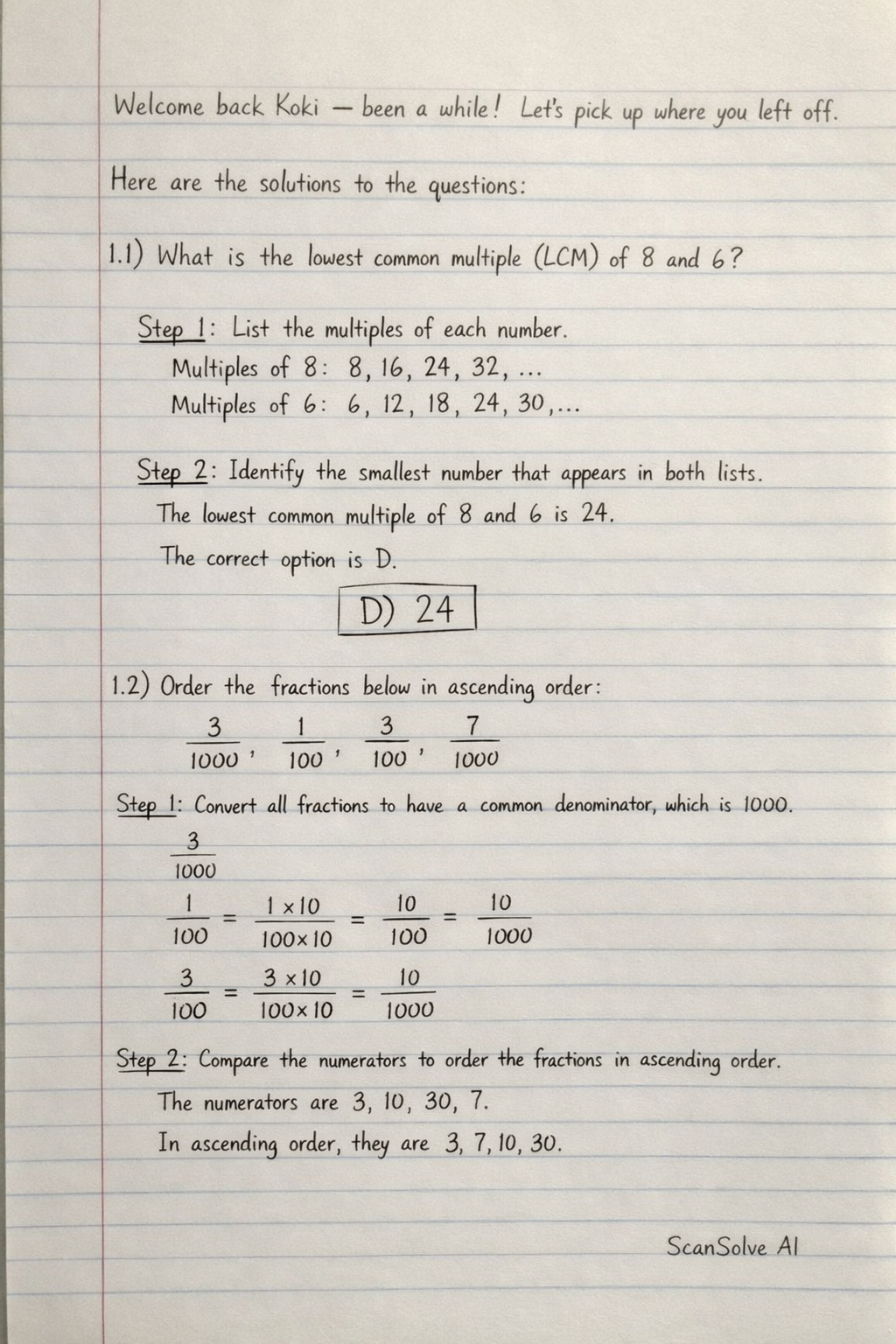
Handwritten Step-by-Step Solution
Get this as a handwritten image on WhatsApp — like a tutor wrote it for you.
Try on WhatsApp