
We read your photo as:
Determine the number that makes the following statement true: 53 - (a certain number) = 65.
Mathematics
ScanSolve AI Answer
Step-by-step solution
16 steps4.1. Determine the number that makes the following statement true.
Let the certain number be .
Subtract 53 from both sides of the equation.
Multiply both sides by -1 to solve for .
The certain number:
4.2.1. Calculate the following without the use of a calculator.
Calculate the numerator.
Calculate the denominator.
Factor out 50.
Form the fraction and simplify.
Divide both numerator and denominator by their greatest common divisor, which is 25.
The simplified value is .
4.2.2. Calculate the following without the use of a calculator.
Evaluate the multiplication term.
Evaluate the exponential term.
Substitute these values back into the expression.
Simplify the double negative signs.
Perform the additions from left to right.
The value is .
4.2.3. Calculate the following without the use of a calculator.
Evaluate the terms in the numerator.
Substitute these values into the numerator and simplify.
Evaluate the terms in the denominator.
Substitute these values into the denominator and simplify.
Form the fraction with the simplified numerator and denominator.
The value is .
Was this helpful?
Still stuck on this one?
Ask a follow-up, and the answer starts from this question.
Got a different question?Ask your own question
More Mathematics Questions
QSolve the following addition problems using the regrouping method: a) 65 + 52, b) 76 + 63, c) 86…QSolve for a: 32 a + 52 a − 62 a = 2 64QSolve the following: (a) 25+61= (b) 2552-1330= (c) 27.3×33= (d) 7/4 + 7/3 =QRight numbers a) 235 − 19 = ? b) 456 − 28 = ? c) 782 − 512 = ?QWhat is the result of the following divisions? a) 65/5 b) 39/3 c) 78/6
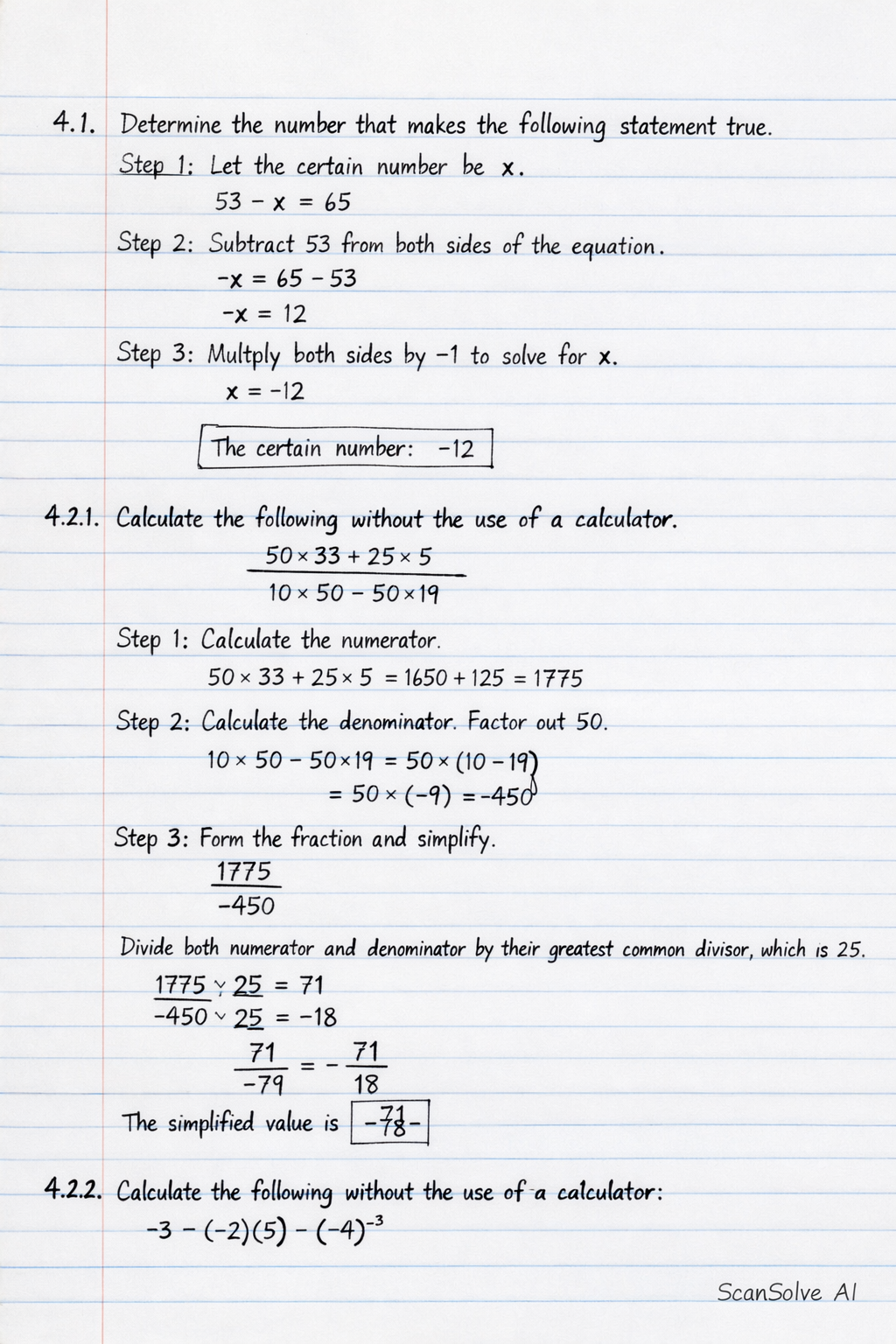
Handwritten Step-by-Step Solution
Get this as a handwritten image on WhatsApp — like a tutor wrote it for you.
Try on WhatsApp