

This mathematics problem involves applying core mathematical principles and formulas. Below you will find a complete step-by-step solution with detailed explanations for each step, helping you understand not just the answer but the method behind it.
ScanSolve AI Answer
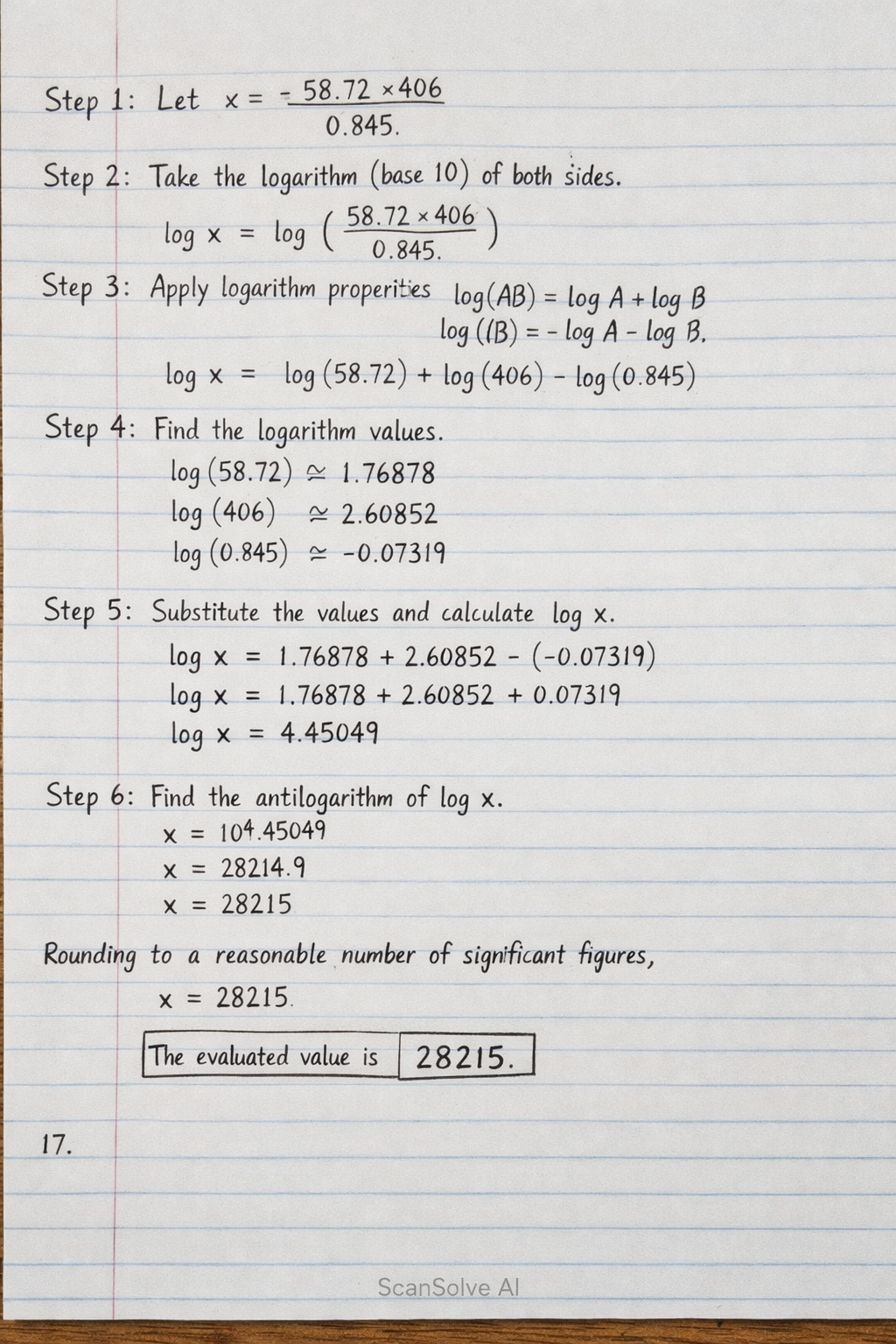
Step 1: Let x = (58.72 × 406)/(0.845). Step 2: Take the logarithm (base 10) of both sides. x = ((58.72 × 406)/(0.845)) Step 3: Apply logarithm properties (AB) = A + B and ((A)/(B)) = A - B. x = (58.72) + (406) - (0.845) Step 4: Find the logarithm values. (58.72) ≈ 1.76878 (406) ≈ 2.60852 (0.845) ≈ -0.07319 Step 5: Substitute the values and calculate x. x = 1.76878 + 2.60852 - (-0.07319) x = 1.76878 + 2.60852 + 0.07319 x = 4.45049 Step 6: Find the antilogarithm of x. x = 10^4.45049 x ≈ 28214.9 Rounding to a reasonable number of significant figures (e.g., 4 or 5). x ≈ 28215 The evaluated value is 28215. 17. a) Form quadratic equation to represent this situation. Step 1: Let the width of the rectangular plot be w metres. Step 2: The length of the plot is 3 metres more than its width, so the length l = w + 3 metres. Step 3: The area of a rectangle is given by length × width. The total area is 180 m^2. Area = l × w 180 = (w+3)w Step 4: Expand the equation. 180 = w^2 + 3w Step 5: Rearrange the equation into the standard quadratic form ax^2 + bx + c = 0. w^2 + 3w - 180 = 0 The quadratic equation is w^2 + 3w - 180 = 0. b) Solve the equation by factorisation method to find the dimensions of the plot. Step 1: The quadratic equation is w^2 + 3w - 180 = 0. Step 2: Find two numbers that multiply to -180 and add to 3. These numbers are 15 and -12. Step 3: Rewrite the middle term using these numbers. w^2 + 15w - 12w - 180 = 0 Step 4: Factor by grouping. w(w + 15) - 12(w + 15) = 0 (w - 12)(w + 15) = 0 Step 5: Set each factor to zero and solve for w. w - 12 = 0 w = 12 w + 15 = 0 w = -15 Step 6: Since width cannot be negative, we take the positive value for w. w = 12 m Step 7: Calculate the length using l = w + 3. l = 12 + 3 = 15 m The dimensions of the plot are: Width = 12 m Length = 15 m Send me the next one 📸