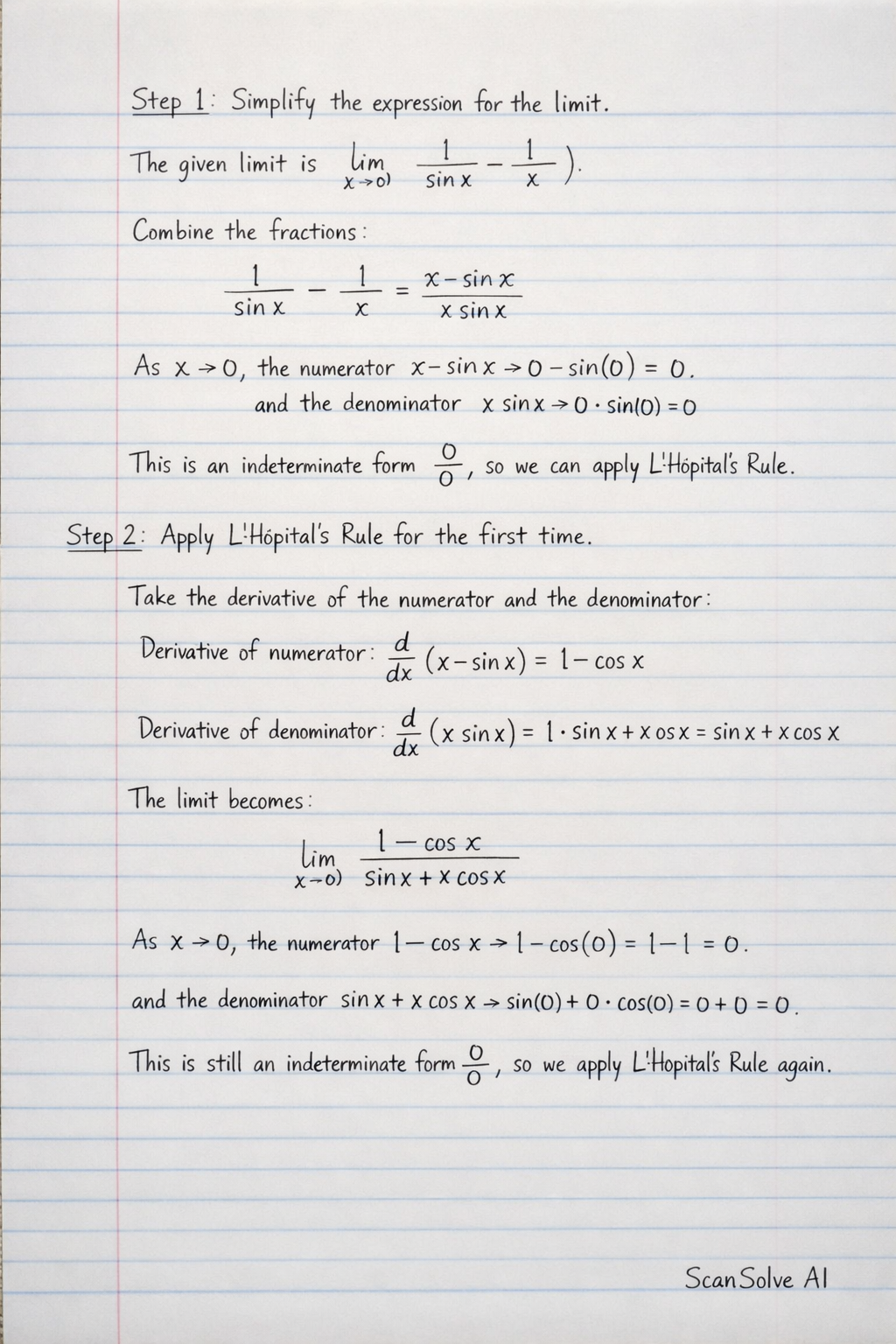
Step 1: Simplify the expression for the limit.
The given limit is limx→0(sinx1−x1).
Combine the fractions:
sinx1−x1=xsinxx−sinx
As x→0, the numerator x−sinx→0−sin(0)=0, and the denominator xsinx→0⋅sin(0)=0. This is an indeterminate form 00, so we can apply L'Hôpital's Rule.
Step 2: Apply L'Hôpital's Rule for the first time.
Take the derivative of the numerator and the denominator:
Derivative of numerator: dxd(x−sinx)=1−cosx
Derivative of denominator: dxd(xsinx)=1⋅sinx+x⋅cosx=sinx+xcosx
The limit becomes:
limx→0sinx+xcosx1−cosx
As x→0, the numerator 1−cosx→1−cos(0)=1−1=0, and the denominator sinx+xcosx→sin(0)+0⋅cos(0)=0+0=0. This is still an indeterminate form 00, so we apply L'Hôpital's Rule again.
Step 3: Apply L'Hôpital's Rule for the second time.
Take the derivative of the new numerator and denominator:
Derivative of numerator: dxd(1−cosx)=0−(−sinx)=sinx
Derivative of denominator: dxd(sinx+xcosx)=cosx+(1⋅cosx+x⋅(−sinx))=cosx+cosx−xsinx=2cosx−xsinx
The limit becomes:
limx→02cosx−xsinxsinx
Step 4: Evaluate the limit.
Substitute x=0 into the expression:
2cos(0)−0⋅sin(0)sin(0)=2⋅1−00=20=0
The limit is 0.
The correct option is A.
The final answer is A)0.
Step 1: Calculate the product AB.
Given matrices A=(1−235−13) and B=524.
To find AB, multiply the rows of A by the column of B:
AB=((1)(5)+(3)(2)+(−1)(4)(−2)(5)+(5)(2)+(3)(4))AB=(5+6−4−10+10+12)AB=(712)
Step 2: Calculate the product (AB)C.
Given matrix C=(2−3) and we found AB=(712).
To find (AB)C, multiply the rows of AB by the columns of C:
(AB)C=(712)(2−3)(AB)C=((7)(2)(12)(2)(7)(−3)(12)(−3))(AB)C=(1424−21−36)
The calculated product matches option A.
The final answer is A)(1424−21−36).
Step 1: Recall the formula for the equation of a plane.
The equation of a plane passing through a point P(x0,y0,z0) with a normal vector n=abc is given by:
a(x−x0)+b(y−y0)+c(z−z0)=0
Step 2: Substitute the given values into the formula.
Given point P(2,−1,−1), so x0=2, y0=−1, z0=−1.
Given normal vector n=2−31, so a=2, b=−3, c=1.
Substitute these values:
2(x−2)+(−3)(y−(−1))+1(z−(−1))=02(x−2)−3(y+1)+1(z+1)=0
Step 3: Expand and simplify the equation.
2x−4−3y−3+z+1=0
Combine the constant terms:
2x−3y+z+(−4−3+1)=02x−3y+z−6=0
The final answer is 2x−3y+z−6=0.
Send me the next one 📸
Was this helpful?
Need help with your own homework?
Get instant step-by-step solutions to any question. Free to start.
This mathematics problem involves applying core mathematical principles and formulas. Below you will find a complete step-by-step solution with detailed explanations for each step, helping you understand not just the answer but the method behind it.
ScanSolve AI Answer
Step 1: Simplify the expression for the limit. The given limit is _x 0 ((1)/( x) - (1)/(x)). Combine the fractions: (1)/( x) - (1)/(x) = (x - x)/(x x) As x 0, the numerator x - x 0 - (0) = 0, and the denominator x x 0 · (0) = 0. This is an indeterminate form (0)/(0), so we can apply L'Hôpital's Rule. Step 2: Apply L'Hôpital's Rule for the first time. Take the derivative of the numerator and the denominator: Derivative of numerator: (d)/(dx)(x - x) = 1 - x Derivative of denominator: (d)/(dx)(x x) = 1 · x + x · x = x + x x The limit becomes: _x 0 (1 - x)/( x + x x) As x 0, the numerator 1 - x 1 - (0) = 1 - 1 = 0, and the denominator x + x x (0) + 0 · (0) = 0 + 0 = 0. This is still an indeterminate form (0)/(0), so we apply L'Hôpital's Rule again. Step 3: Apply L'Hôpital's Rule for the second time. Take the derivative of the new numerator and denominator: Derivative of numerator: (d)/(dx)(1 - x) = 0 - (- x) = x Derivative of denominator: (d)/(dx)( x + x x) = x + (1 · x + x · (- x)) = x + x - x x = 2 x - x x The limit becomes: _x 0 ( x)/(2 x - x x) Step 4: Evaluate the limit. Substitute x = 0 into the expression: ((0))/(2 (0) - 0 · (0)) = (0)/(2 · 1 - 0) = (0)/(2) = 0 The limit is 0. The correct option is A. The final answer is A) 0. --- Step 1: Calculate the product AB. Given matrices A = 1 & 3 & -1 \\ -2 & 5 & 3 and B = 5 \\ 2 \\ 4 . To find AB, multiply the rows of A by the column of B: AB = (1)(5) + (3)(2) + (-1)(4) \\ (-2)(5) + (5)(2) + (3)(4) AB = 5 + 6 - 4 \\ -10 + 10 + 12 AB = 7 \\ 12 Step 2: Calculate the product (AB)C. Given matrix C = (2 \ -3) and we found AB = 7 \\ 12 . To find (AB)C, multiply the rows of AB by the columns of C: (AB)C = 7 \\ 12 (2 \ -3) (AB)C = (7)(2) & (7)(-3) \\ (12)(2) & (12)(-3) (AB)C = 14 & -21 \\ 24 & -36 The calculated product matches option A. The final answer is A) 14 & -21 \\ 24 & -36 . --- Step 1: Recall the formula for the equation of a plane. The equation of a plane passing through a point P(x_0, y_0, z_0) with a normal vector n = a \\ b \\ c is given by: a(x - x_0) + b(y - y_0) + c(z - z_0) = 0 Step 2: Substitute the given values into the formula. Given point P(2, -1, -1), so x_0 = 2, y_0 = -1, z_0 = -1. Given normal vector n = 2 \\ -3 \\ 1 , so a = 2, b = -3, c = 1. Substitute these values: 2(x - 2) + (-3)(y - (-1)) + 1(z - (-1)) = 0 2(x - 2) - 3(y + 1) + 1(z + 1) = 0 Step 3: Expand and simplify the equation. 2x - 4 - 3y - 3 + z + 1 = 0 Combine the constant terms: 2x - 3y + z + (-4 - 3 + 1) = 0 2x - 3y + z - 6 = 0 The final answer is 2x - 3y + z - 6 = 0. Send me the next one 📸