lim x->0 [tan(pi/4+x)]1/x का मान है

Mathematics
lim x->0 [tan(pi/4+x)]1/x का मान है

ScanSolve AI Answer

Answer

3. e2\text{3. } e^2

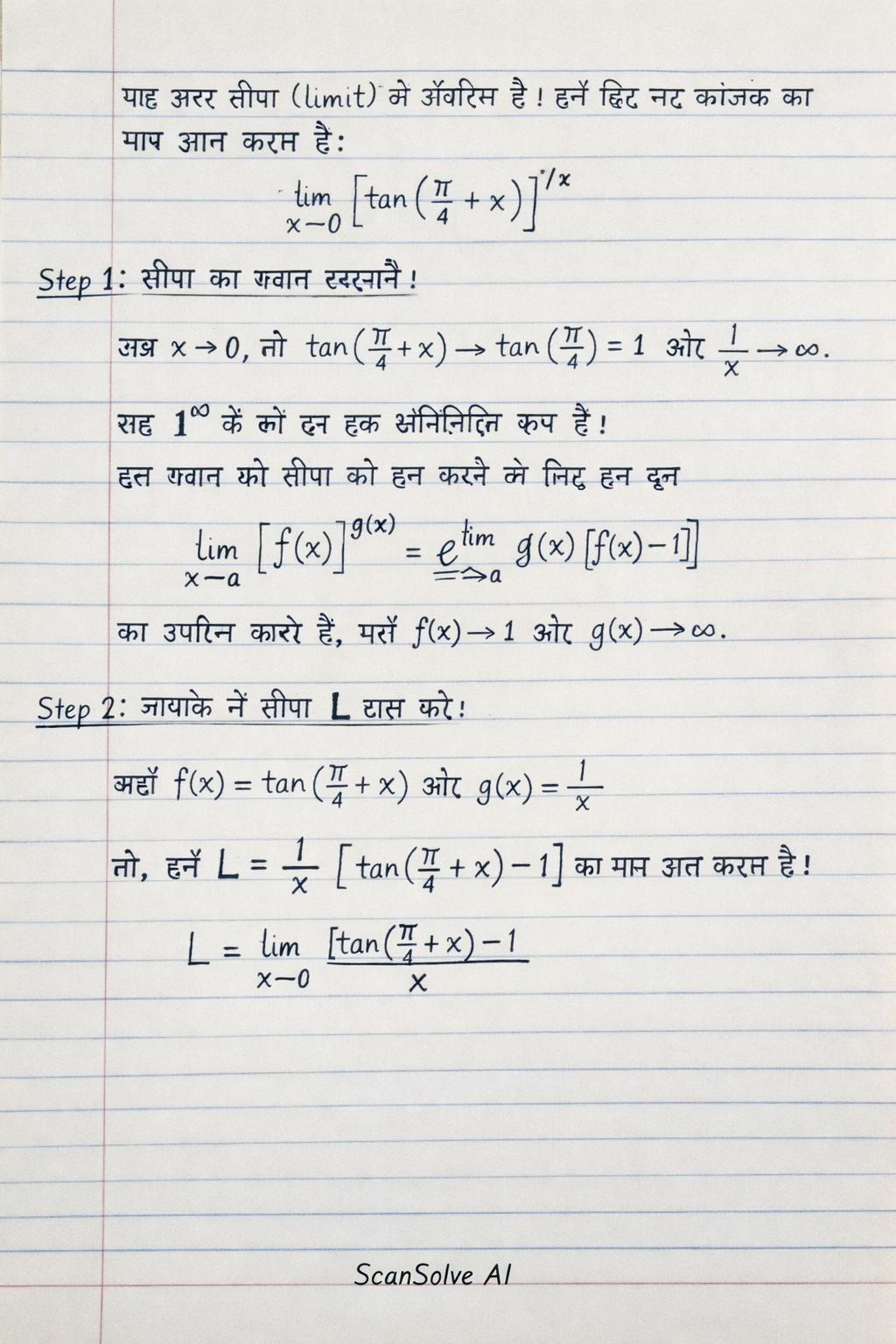
यह प्रश्न सीमा (limit) से संबंधित है। हमें दिए गए व्यंजक का मान ज्ञात करना है: limx0[tan(π4+x)]1x\lim_{x \to 0} \left[ \tan\left(\frac{\pi}{4} + x\right) \right]^{\frac{1}{x}}

Step 1: सीमा का प्रकार पहचानें। जब x0x \to 0, तो tan(π4+x)tan(π4)=1\tan\left(\frac{\pi}{4} + x\right) \to \tan\left(\frac{\pi}{4}\right) = 1 और 1x\frac{1}{x} \to \infty। यह 11^\infty के रूप का एक अनिर्धारित रूप (indeterminate form) है। इस प्रकार की सीमा को हल करने के लिए, हम सूत्र limxa[f(x)]g(x)=elimxag(x)[f(x)1]\lim_{x \to a} [f(x)]^{g(x)} = e^{\lim_{x \to a} g(x) [f(x) - 1]} का उपयोग करते हैं, जहाँ f(x)1f(x) \to 1 और g(x)g(x) \to \infty

Step 2: घातांक में सीमा LL ज्ञात करें। यहाँ f(x)=tan(π4+x)f(x) = \tan\left(\frac{\pi}{4} + x\right) और g(x)=1xg(x) = \frac{1}{x}। तो, हमें L=limx01x[tan(π4+x)1]L = \lim_{x \to 0} \frac{1}{x} \left[ \tan\left(\frac{\pi}{4} + x\right) - 1 \right] का मान ज्ञात करना है। L=limx0tan(π4+x)1xL = \lim_{x \to 0} \frac{\tan\left(\frac{\pi}{4} + x\right) - 1}{x}

Step 3: tan(π4+x)\tan\left(\frac{\pi}{4} + x\right) को सरल करें। हम tan(A+B)=tanA+tanB1tanAtanB\tan(A+B) = \frac{\tan A + \tan B}{1 - \tan A \tan B} सूत्र का उपयोग करते हैं। A=π4A = \frac{\pi}{4} और B=xB = x रखने पर: tan(π4+x)=tan(π4)+tanx1tan(π4)tanx=1+tanx1tanx\tan\left(\frac{\pi}{4} + x\right) = \frac{\tan\left(\frac{\pi}{4}\right) + \tan x}{1 - \tan\left(\frac{\pi}{4}\right) \tan x} = \frac{1 + \tan x}{1 - \tan x}

Step 4: LL के व्यंजक में प्रतिस्थापित करें और सरल करें। L=limx01+tanx1tanx1xL = \lim_{x \to 0} \frac{\frac{1 + \tan x}{1 - \tan x} - 1}{x} L=limx0(1+tanx)(1tanx)1tanxxL = \lim_{x \to 0} \frac{\frac{(1 + \tan x) - (1 - \tan x)}{1 - \tan x}}{x} L=limx01+tanx1+tanx1tanxxL = \lim_{x \to 0} \frac{\frac{1 + \tan x - 1 + \tan x}{1 - \tan x}}{x} L=limx02tanx1tanxxL = \lim_{x \to 0} \frac{\frac{2 \tan x}{1 - \tan x}}{x} L=limx02tanxx(1tanx)L = \lim_{x \to 0} \frac{2 \tan x}{x(1 - \tan x)}

Step 5: सीमा का मूल्यांकन करें। हम जानते हैं कि limx0tanxx=1\lim_{x \to 0} \frac{\tan x}{x} = 1 और limx0(1tanx)=10=1\lim_{x \to 0} (1 - \tan x) = 1 - 0 = 1L=2×limx0tanxx×limx011tanxL = 2 \times \lim_{x \to 0} \frac{\tan x}{x} \times \lim_{x \to 0} \frac{1}{1 - \tan x} L=2×1×11L = 2 \times 1 \times \frac{1}{1} L=2L = 2

वैकल्पिक रूप से, L'Hopital's Rule का उपयोग करके: L=limx0tan(π4+x)1xL = \lim_{x \to 0} \frac{\tan\left(\frac{\pi}{4} + x\right) - 1}{x} यह 00\frac{0}{0} रूप का है। अंश का अवकलज sec2(π4+x)\sec^2\left(\frac{\pi}{4} + x\right) है और हर का अवकलज 11 है। L=limx0sec2(π4+x)1=sec2(π4+0)=sec2(π4)=(2)2=2L = \lim_{x \to 0} \frac{\sec^2\left(\frac{\pi}{4} + x\right)}{1} = \sec^2\left(\frac{\pi}{4} + 0\right) = \sec^2\left(\frac{\pi}{4}\right) = (\sqrt{2})^2 = 2

Step 6: अंतिम उत्तर ज्ञात करें। चूंकि मूल सीमा eLe^L के बराबर है, तो: limx0[tan(π4+x)]1x=e2\lim_{x \to 0} \left[ \tan\left(\frac{\pi}{4} + x\right) \right]^{\frac{1}{x}} = e^2

यह विकल्प (3) से मेल खाता है।

The final answer is 3.e2\boxed{3. e^2} Last free one today — make it count tomorrow, or type /upgrade for unlimited.

Was this helpful?

Need help with your own homework?

Get instant step-by-step solutions to any question. Free to start.

Ask Your Question
Handwritten step-by-step solution preview

Handwritten Step-by-Step Solution

Get this as a handwritten image on WhatsApp — like a tutor wrote it for you.

Try on WhatsApp

Still have questions?

Quick Answer

यह प्रश्न सीमा (limit) से संबंधित है। हमें दिए गए व्यंजक का मान ज्ञात करना है: _x 0 [ (()/(4) + x) ]^(1)/(x) Step 1: सीमा का प्रकार पहचानें। जब x 0, तो (()/(4) + x) (()/(4)) = 1 और (1)/(x) । यह 1^ के रूप का एक अनिर्धारित रूप (indeterminate form) है। इ…

lim x->0 [tan(pi/4+x)]1/x का मान है
Mathematics

This mathematics problem involves applying core mathematical principles and formulas. Below you will find a complete step-by-step solution with detailed explanations for each step, helping you understand not just the answer but the method behind it.

ScanSolve AI Answer
यह प्रश्न सीमा (limit) से संबंधित है। हमें दिए गए व्यंजक का मान ज्ञात करना है: _x 0 [ (()/(4) + x) ]^(1)/(x) Step 1: सीमा का प्रकार पहचानें। जब x 0, तो (()/(4) + x) (()/(4)) = 1 और (1)/(x) । यह 1^ के रूप का एक अनिर्धारित रूप (indeterminate form) है। इस प्रकार की सीमा को हल करने के लिए, हम सूत्र _x a [f(x)]^g(x) = e^_x a g(x) [f(x) - 1] का उपयोग करते हैं, जहाँ f(x) 1 और g(x) । Step 2: घातांक में सीमा L ज्ञात करें। यहाँ f(x) = (()/(4) + x) और g(x) = (1)/(x)। तो, हमें L = _x 0 (1)/(x) [ (()/(4) + x) - 1 ] का मान ज्ञात करना है। L = _x 0 (()/(4) + x) - 1x Step 3: (()/(4) + x) को सरल करें। हम (A+B) = ( A + B)/(1 - A B) सूत्र का उपयोग करते हैं। A = ()/(4) और B = x रखने पर: (()/(4) + x) = (()/(4)) + x1 - (()/(4)) x = (1 + x)/(1 - x) Step 4: L के व्यंजक में प्रतिस्थापित करें और सरल करें। L = _x 0 (1 + x)/(1 - x) - 1x L = _x 0 ((1 + x) - (1 - x))/(1 - x)x L = _x 0 (1 + x - 1 + x)/(1 - x)x L = _x 0 (2 x)/(1 - x)x L = _x 0 (2 x)/(x(1 - x)) Step 5: सीमा का मूल्यांकन करें। हम जानते हैं कि _x 0 ( x)/(x) = 1 और _x 0 (1 - x) = 1 - 0 = 1। L = 2 × _x 0 ( x)/(x) × _x 0 (1)/(1 - x) L = 2 × 1 × (1)/(1) L = 2 वैकल्पिक रूप से, L'Hopital's Rule का उपयोग करके: L = _x 0 (()/(4) + x) - 1x यह (0)/(0) रूप का है। अंश का अवकलज ^2(()/(4) + x) है और हर का अवकलज 1 है। L = _x 0 (^2()/(4) + x)1 = ^2(()/(4) + 0) = ^2(()/(4)) = (sqrt(2))^2 = 2 Step 6: अंतिम उत्तर ज्ञात करें। चूंकि मूल सीमा e^L के बराबर है, तो: _x 0 [ (()/(4) + x) ]^(1)/(x) = e^2 यह विकल्प (3) से मेल खाता है। The final answer is 3. e^2 Last free one today — make it count tomorrow, or type /upgrade for unlimited.