

This mathematics problem involves applying core mathematical principles and formulas. Below you will find a complete step-by-step solution with detailed explanations for each step, helping you understand not just the answer but the method behind it.
ScanSolve AI Answer
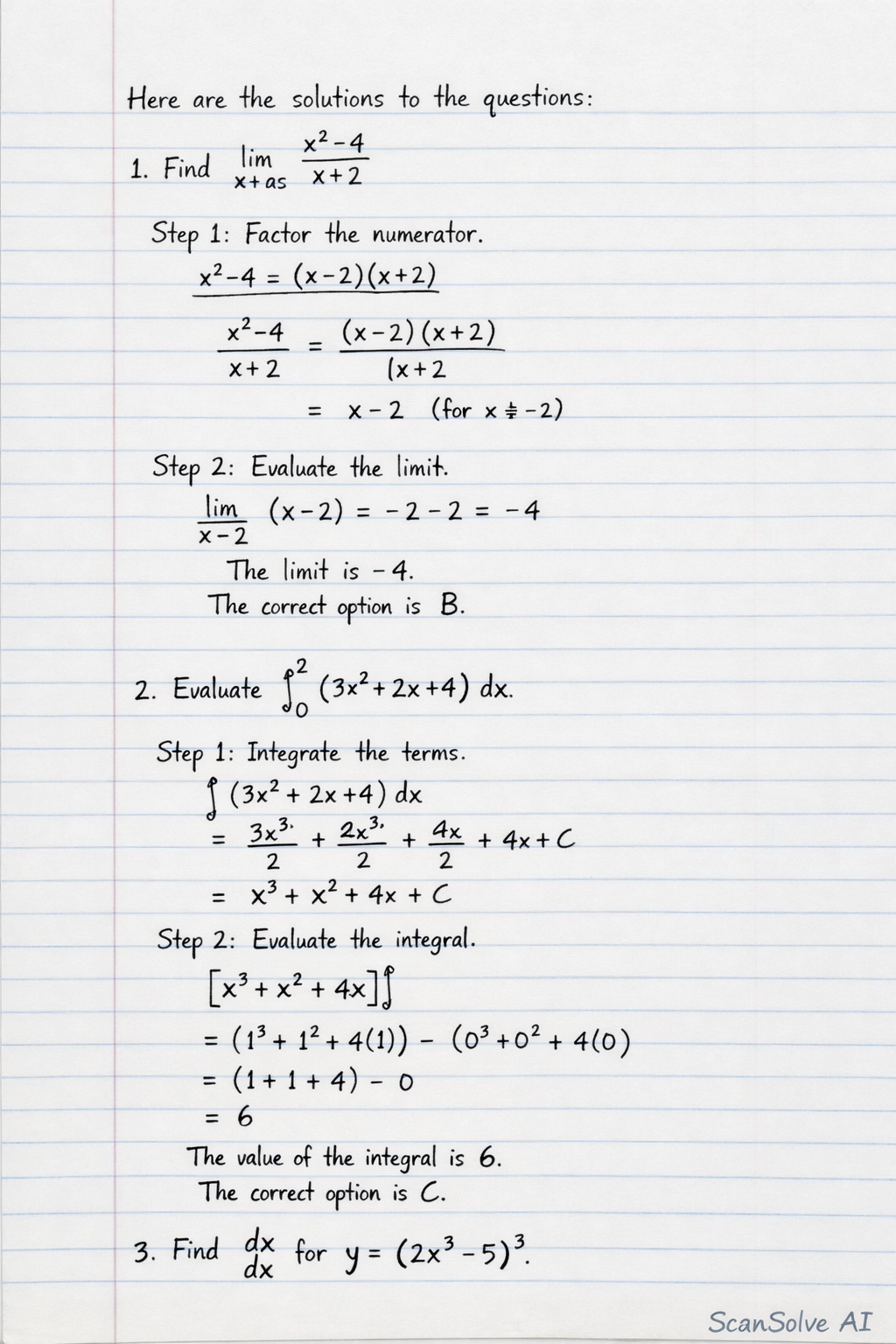
Here are the solutions to the questions: 1. Find _x -2 ((x^2-4)/(x+2)) Step 1: Factor the numerator. The numerator x^2-4 is a difference of squares, which can be factored as (x-2)(x+2). (x^2-4)/(x+2) = ((x-2)(x+2))/(x+2) For x ≠ -2, we can cancel out the (x+2) term. ((x-2)(x+2))/(x+2) = x-2 Step 2: Evaluate the limit by substituting x = -2. _x -2 (x-2) = -2 - 2 = -4 The limit is -4. The correct option is B. 2. Evaluate _0^1 (3x^2 + 2x + 4)\,dx Step 1: Integrate each term of the polynomial. (3x^2 + 2x + 4)\,dx = 3x^2+12+1 + 2x^1+11+1 + 4x + C = (3x^3)/(3) + (2x^2)/(2) + 4x + C = x^3 + x^2 + 4x + C Step 2: Evaluate the definite integral using the limits of integration. [x^3 + x^2 + 4x]_0^1 = (1^3 + 1^2 + 4(1)) - (0^3 + 0^2 + 4(0)) = (1 + 1 + 4) - (0) = 6 The value of the integral is 6. The correct option is C. 3. Find (dy)/(dx) for y = (2x^3 - 5)^3 Step 1: Apply the chain rule. Let u = 2x^3 - 5. Then y = u^3. First, find the derivative of y with respect to u: (dy)/(du) = (d)/(du)(u^3) = 3u^2 Next, find the derivative of u with respect to x: (du)/(dx) = (d)/(dx)(2x^3 - 5) = 2(3x^3-1) - 0 = 6x^2 Step 2: Multiply the derivatives to find (dy)/(dx). (dy)/(dx) = (dy)/(du) · (du)/(dx) = (3u^2)(6x^2) Substitute u = 2x^3 - 5 back into the expression: (dy)/(dx) = 3(2x^3 - 5)^2 (6x^2) (dy)/(dx) = 18x^2 (2x^3 - 5)^2 The derivative is 18x^2 (2x^3 - 5)^2. None of the provided options match this result. There might be a typo in the question or the options. 4. 10^ 80^ + 80^ 10^ is Step 1: Recognize the sum formula for sine. The formula for (A+B) is A B + A B. In this expression, A = 10^ and B = 80^. So, the expression can be written as (10^ + 80^). Step 2: Calculate the sum of the angles and evaluate the sine. (10^ + 80^) = (90^) We know that (90^) = 1. The value of the expression is 1. The correct option is A. 5. Convert (5)/(3) into degree Step 1: Use the conversion factor from radians to degrees. To convert radians to degrees, multiply by (180^)/(). (5)/(3) radians × (180^)/( radians) Step 2: Perform the calculation. (5)/(3) × (180^)/() = (5 × 180^)/(3) = 5 × 60^ = 300^ The angle in degrees is 300^. The correct option is B. 6. The angle 210^ lies on : Step 1: Recall the ranges for each quadrant. • First quadrant: 0^ < < 90^ • Second quadrant: 90^ < < 180^ • Third quadrant: 180^ < < 270^ • Fourth quadrant: 270^ < < 360^ Step 2: Determine where 210^ falls within these ranges. Since 180^ < 210^ < 270^, the angle 210^ lies in the third quadrant. The angle 210^ lies on the third quadrant. The correct option is C. 7. Find the interquartile range for the data 4, 6, 9, 10, 17, 19, and 20 Step 1: Order the data. The data is already in ascending order: 4, 6, 9, 10, 17, 19, 20. There are n=7 data points. Step 2: Find the median (Q_2). The median is the middle value. For n=7, the median is the (7+1)/(2) = 4^th value. Q_2 = 10. Step 3: Find the first quartile (Q_1). Q_1 is the median of the lower half of the data (excluding Q_2 for an odd number of data points). Lower half: 4, 6, 9. The median of these three values is the (3+1)/(2) = 2^nd value. Q_1 = 6. Step 4: Find the third quartile (Q_3). Q_3 is the median of the upper half of the data (excluding Q_2). Upper half: 17, 19, 20. The median of these three values is the (3+1)/(2) = 2^nd value. Q_3 = 19. Step 5: Calculate the interquartile range (IQR). The interquartile range is IQR = Q_3 - Q_1. IQR = 19 - 6 = 13 The interquartile range is 13. The correct option is D. That's 2 down. 3 left today — send the next one.