
We read your photo as:
Evaluate the limit: lim (x->0) [sqrt(1+x) - sqrt(1-x)] / x
Mathematics
ScanSolve AI Answer
Answer
1
Step-by-step solution
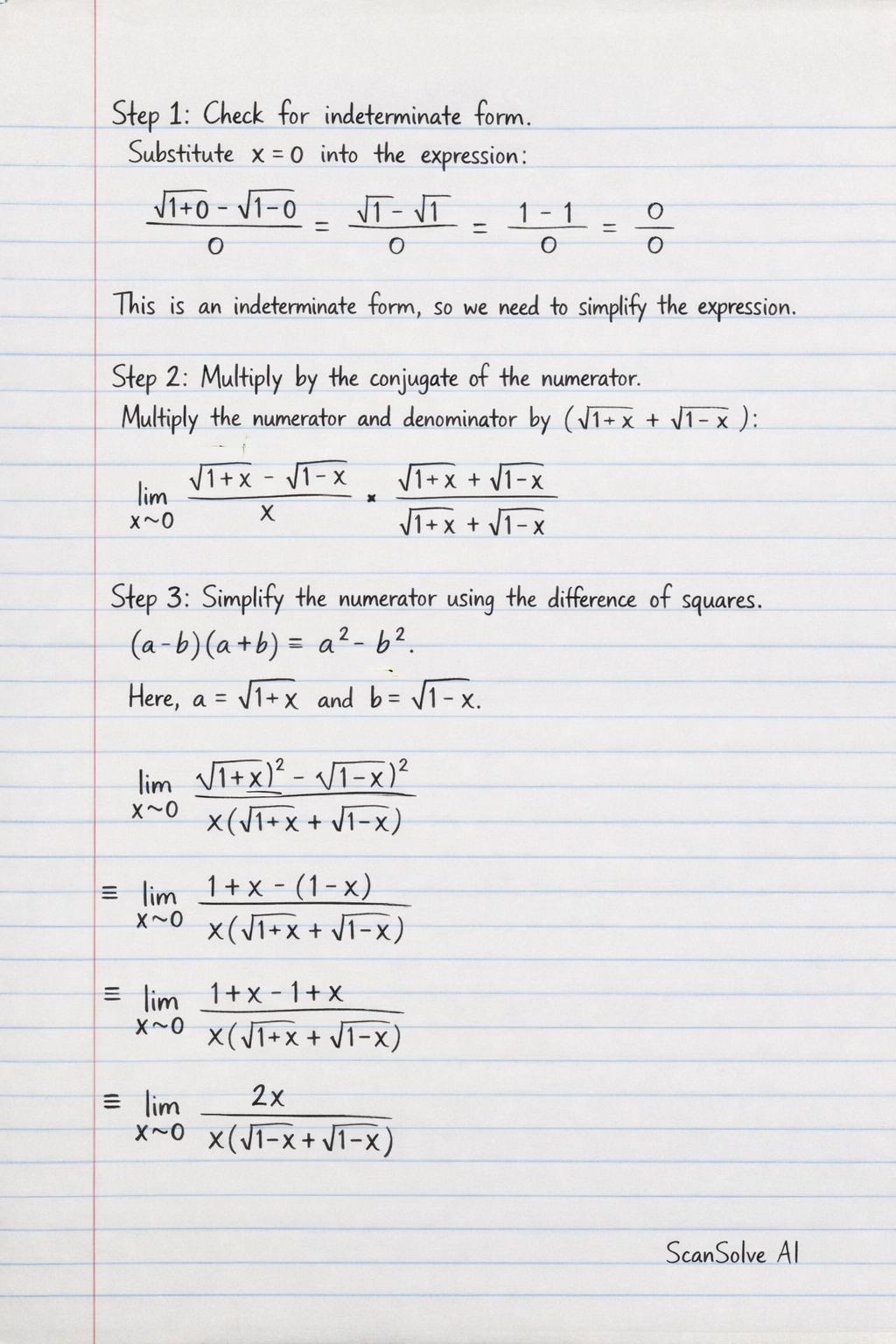
5 stepsCheck for indeterminate form.
Substitute into the expression:
This is an indeterminate form, so we need to simplify the expression.
Multiply by the conjugate of the numerator.
Multiply the numerator and the denominator by :
Simplify the numerator using the difference of squares formula .
Here, and .
Cancel out the common factor .
Since , , so we can cancel from the numerator and denominator:
Substitute into the simplified expression.
The limit is 1.
Was this helpful?
Try one yourself
A new problem that tests the same skill.
Still stuck on this one?
Ask a follow-up, and the answer starts from this question.
Got a different question?Ask your own question
More Mathematics Questions
QEvaluate the limit: lim (x->0) [sqrt(2x+3) - sqrt(3)] / xQEvaluate the limit: lim x->0 (sqrt(x2+9)−3)/x2 and lim x->1 (e^(x−1)−1)/(x−1)2QEvaluate the limit: lim (2x − 1) * sqrt(x+4) as x approaches 0.QEvaluate the limit: lim (x-> −2) (x+2) / (sqrt(x+6) − 2)QEvaluate the limit: lim (t->0) x / (3 - sqrt(x+9))
Browse by topic:Calculus
Handwritten Step-by-Step Solution
Get this as a handwritten image on WhatsApp — like a tutor wrote it for you.
Try on WhatsApp