
We read your photo as:
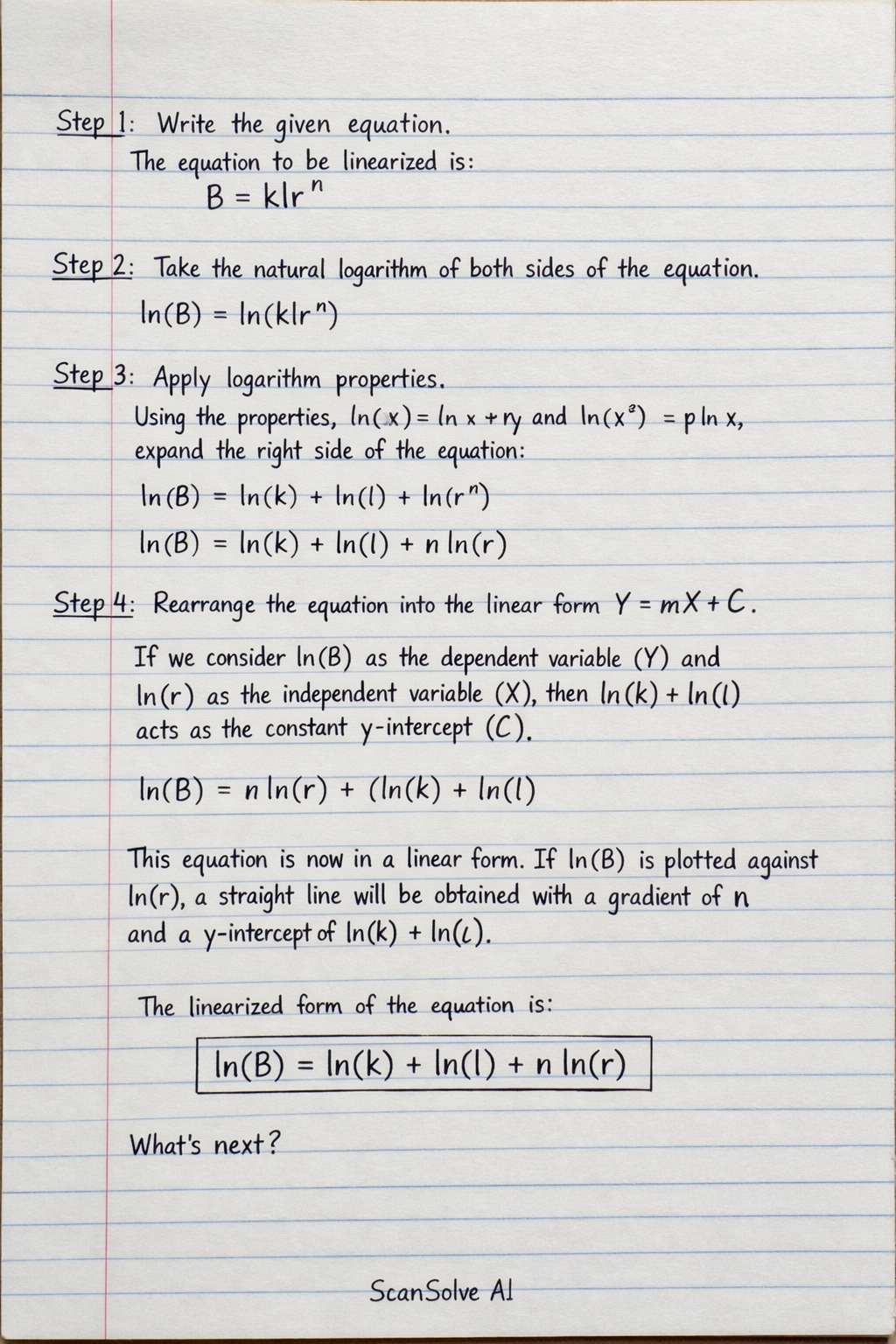
Linearize the equation B = k l rⁿ
Mathematics
ScanSolve AI Answer
Answer
Step-by-step solution
4 stepsWrite the given equation.
The equation to be linearized is:
Take the natural logarithm () of both sides of the equation.
Apply logarithm properties.
Using the properties and , expand the right side of the equation:
Rearrange the equation into the linear form .
If we consider as the dependent variable () and as the independent variable (), then acts as the constant y-intercept ().
This equation is now in a linear form. If is plotted against , a straight line will be obtained with a gradient of and a y-intercept of .
Was this helpful?
Try one yourself
A new problem that tests the same skill.
Still stuck on this one?
Ask a follow-up, and the answer starts from this question.
Got a different question?Ask your own question
More Mathematics Questions
QLinearize the following equations into the form y = mx + c: R = R0 exp(-λt), θ = A(t − B), P = P0 (1…QLinearize the equation I = I0 ( raceVkT) into the form y = mx + c.QLinearize the following equations into the form y = mx + c: T = sqrt((m + m0/3)/(kg)), v = l/(4f)…QLinearize the following equations using natural logarithms: P = P0 (1 - kh)ⁿ, I = B e^-lambda t, and…QLinearize the equations E = V + Ir, F = Q2 / (4πε₀r²), and R = R₀(1 + αθ) into the form y = mx + c.
Handwritten Step-by-Step Solution
Get this as a handwritten image on WhatsApp — like a tutor wrote it for you.
Try on WhatsApp