We read your photo as:

Linearize the following equations into the form y = mx + c: R = R0 exp(-λt), θ = A(t - B), P = P0 (1 - kh)ⁿ.

Mathematics

ScanSolve AI Answer

Answer

ln⁡(R)=(−λ)t+ln⁡(R0)\ln(R) = (-\lambda)t + \ln(R_0)

θ=At−AB\theta = At - AB

ln⁡(P)=nln⁡(1−kh)+ln⁡(P0)\ln(P) = n \ln(1 - kh) + \ln(P_0)

Step-by-step solution

8 steps

here are the linearized forms of the equations from the paper:

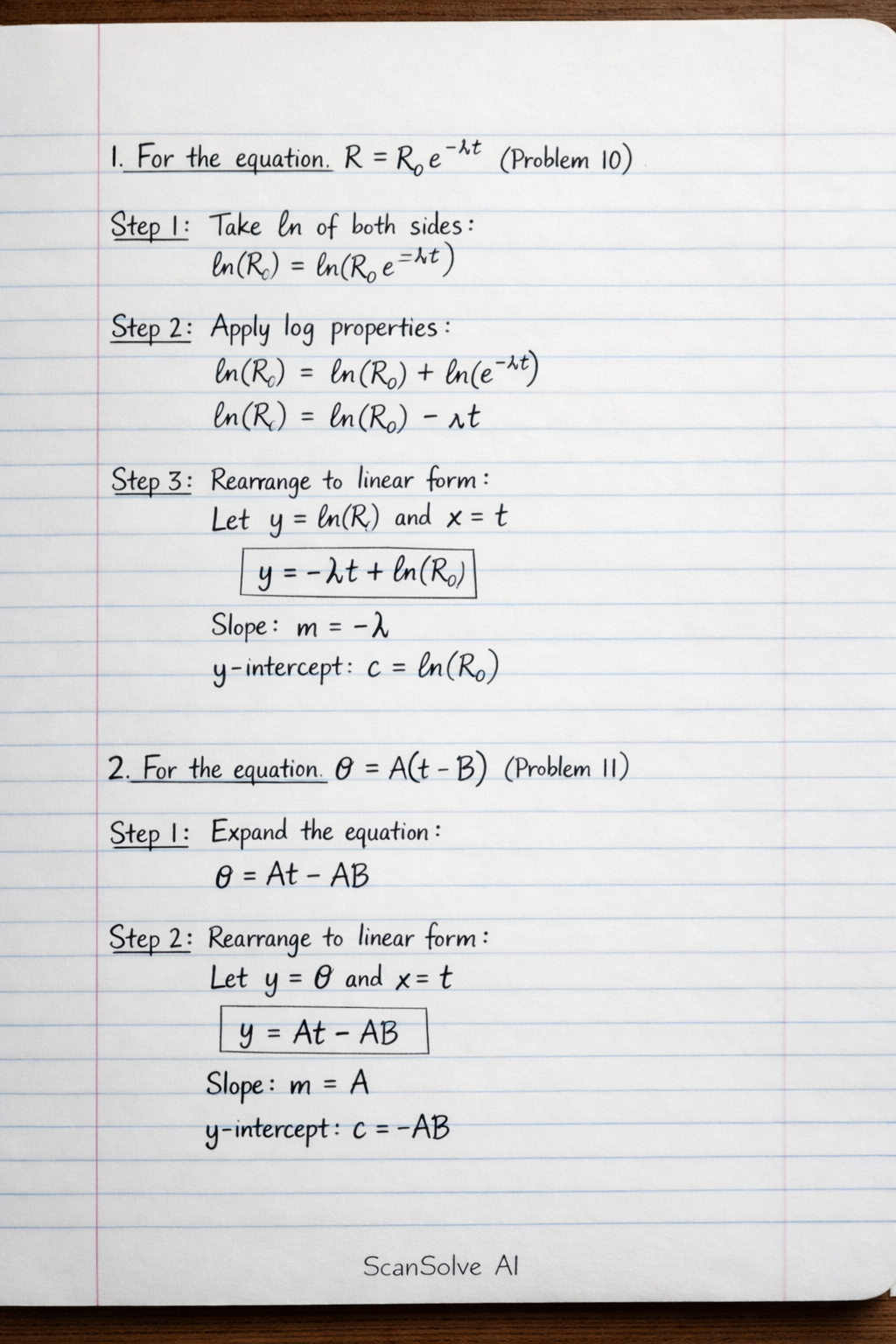
1. For the equation R=R0exp⁡(−λt)R = R_0 \exp(-\lambda t) ()

  1. Take the natural logarithm (ln⁡\ln) of both sides of the equation.

    ln⁡(R)=ln⁡(R0exp⁡(−λt))\ln(R) = \ln(R_0 \exp(-\lambda t))
  2. Use logarithm properties ln⁡(AB)=ln⁡(A)+ln⁡(B)\ln(AB) = \ln(A) + \ln(B) and ln⁡(ex)=x\ln(e^x) = x.

    ln⁡(R)=ln⁡(R0)+ln⁡(exp⁡(−λt))\ln(R) = \ln(R_0) + \ln(\exp(-\lambda t)) ln⁡(R)=ln⁡(R0)−λt\ln(R) = \ln(R_0) - \lambda t
  3. Rearrange into the linear form y=mx+cy = mx + c.

    Let y=ln⁡(R)y = \ln(R) and x=tx = t.
    The linearized equation is:

    ln⁡(R)=(−λ)t+ln⁡(R0)\boxed{\ln(R) = (-\lambda)t + \ln(R_0)}

    Here, the slope mslope=−λm_{slope} = -\lambda and the y-intercept cintercept=ln⁡(R0)c_{intercept} = \ln(R_0).

    2. For the equation θ=A(t−B)\theta = A(t - B) ()

  4. Expand the right side of the equation.

    θ=At−AB\theta = At - AB
  5. Rearrange into the linear form y=mx+cy = mx + c.

    Let y=θy = \theta and x=tx = t.
    The linearized equation is:

    θ=At−AB\boxed{\theta = At - AB}

    Here, the slope mslope=Am_{slope} = A and the y-intercept cintercept=−ABc_{intercept} = -AB.

    3. For the equation P=P0(1−kh)nP = P_0 (1 - kh)^n ()

  6. Take the natural logarithm (ln⁡\ln) of both sides of the equation.

    ln⁡(P)=ln⁡(P0(1−kh)n)\ln(P) = \ln(P_0 (1 - kh)^n)
  7. Use logarithm properties ln⁡(AB)=ln⁡(A)+ln⁡(B)\ln(AB) = \ln(A) + \ln(B) and ln⁡(Xn)=nln⁡(X)\ln(X^n) = n \ln(X).

    ln⁡(P)=ln⁡(P0)+ln⁡((1−kh)n)\ln(P) = \ln(P_0) + \ln((1 - kh)^n) ln⁡(P)=ln⁡(P0)+nln⁡(1−kh)\ln(P) = \ln(P_0) + n \ln(1 - kh)
  8. Rearrange into the linear form y=mx+cy = mx + c.

    Let y=ln⁡(P)y = \ln(P) and x=ln⁡(1−kh)x = \ln(1 - kh).
    The linearized equation is:

    ln⁡(P)=nln⁡(1−kh)+ln⁡(P0)\boxed{\ln(P) = n \ln(1 - kh) + \ln(P_0)}

    Here, the slope mslope=nm_{slope} = n and the y-intercept cintercept=ln⁡(P0)c_{intercept} = \ln(P_0).

Was this helpful?

Try one yourself

A new problem that tests the same skill.

Still stuck on this one?

Ask a follow-up, and the answer starts from this question.

Got a different question?Ask your own question
Handwritten step-by-step solution preview

Handwritten Step-by-Step Solution

Get this as a handwritten image on WhatsApp — like a tutor wrote it for you.

Try on WhatsApp