List prime numbers between 100 and 120 and find the product of the largest and smallest. Classify 1, 2, and sqrt(5) as rational or irrational. Calculate the fraction of journey covered.
|Mathematics
List prime numbers between 100 and 120 and find the product of the largest and smallest. Classify 1, 2, and sqrt(5) as rational or irrational. Calculate the fraction of journey covered.
ScanSolve AI Answer
Answer
11413
Here is the solution to your math problems:
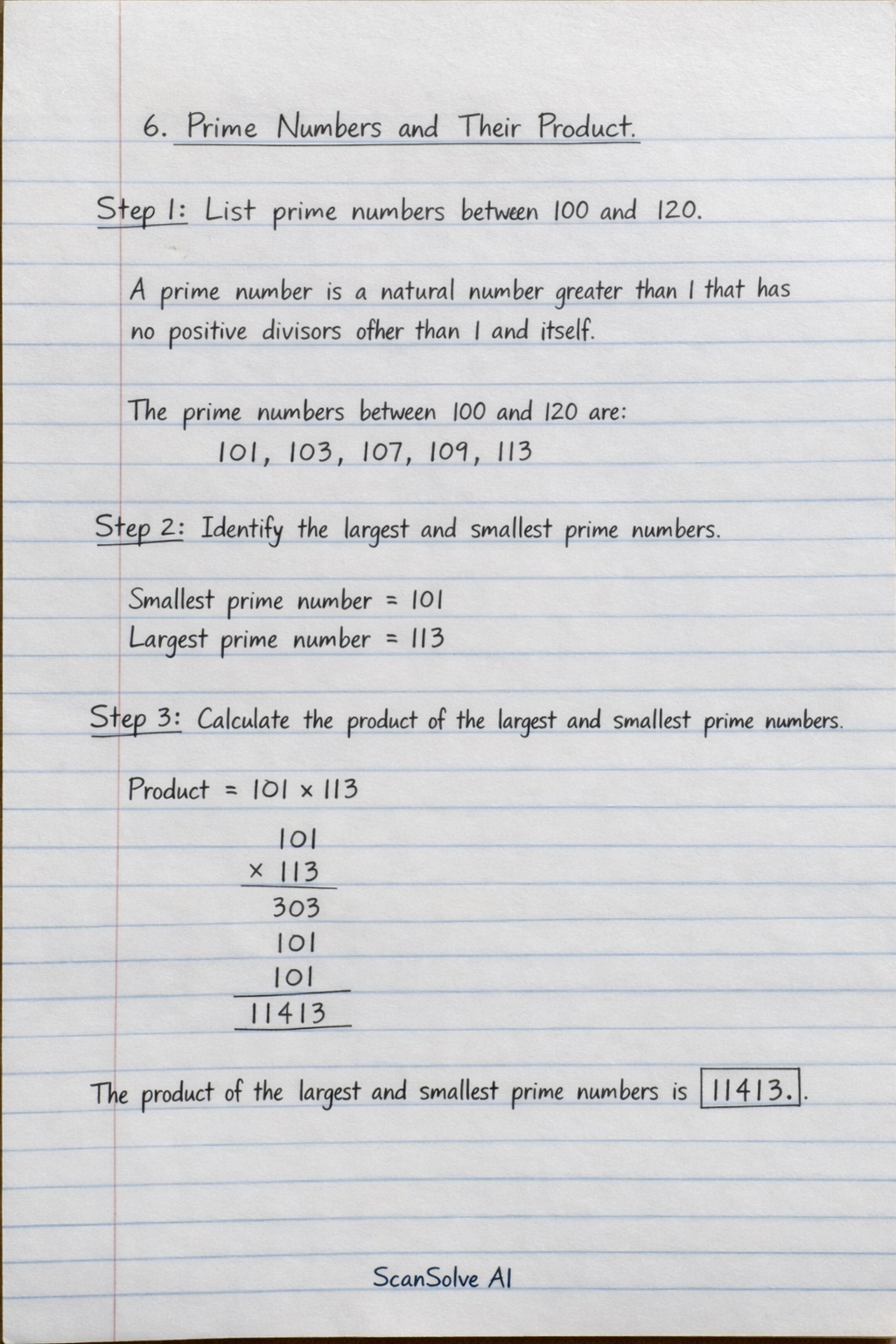
6. Prime numbers and their product
Step 1: List prime numbers between 100 and 120.
A prime number is a natural number greater than 1 that has no positive divisors other than 1 and itself.
The prime numbers between 100 and 120 are:
101,103,107,109,113
Step 2: Identify the largest and smallest prime numbers.
Smallest prime number = 101
Largest prime number = 113
Step 3: Calculate the product of the largest and smallest prime numbers.
Product = 101×113101×113=11413
The product of the largest and smallest prime numbers is 11413.
7. Classification of numbers
Step 1: Define rational and irrational numbers.
A rational number can be expressed as a fraction qp where p and q are integers and q=0.
An irrational number cannot be expressed as a simple fraction; its decimal representation is non-terminating and non-repeating.
Step 2: Classify the given numbers.
1: This can be written as 11. Therefore, 1 is a rational number.
2: This can be written as 12. Therefore, 2 is a rational number.
5: The square root of 5 is approximately 2.2360679..., which is a non-terminating and non-repeating decimal. Therefore, 5 is an irrational number.
8. Fraction of journey covered
Step 1: Determine the total time for the journey.
Total time = 5 hours.
Step 2: Determine the fraction of the journey covered in 1 hour.
Fraction covered in 1 hour = 5hours1hour=51.
Step 3: Use reciprocal tables to find the value of 51.
From reciprocal tables, the reciprocal of 5 is 0.2.
51=0.2
The fraction of the journey covered in 1 hour is 0.2.
9. Evaluation using mathematical tables
Step 1: Evaluate 0.9811 using reciprocal tables.
From reciprocal tables, 0.9811≈1.01936799...
Rounding to 5 decimal places for intermediate calculation: 1.01937
Step 2: Evaluate 9.811 using reciprocal tables.
From reciprocal tables, 9.811≈0.101936799...
Rounding to 5 decimal places for intermediate calculation: 0.10194
Step 3: Add the results.
1.01937+0.10194=1.12131
The value is approximately 1.1213.
10. Laws of indices
Step 1: Rewrite the expression using fractional exponents.
381256=(81256)31
Step 2: Express the numbers as powers of their prime factors.
256=2881=34
Step 3: Substitute these into the expression.
(3428)31=(34)31(28)31=334238
Step 4: Simplify the exponents.
238=22+32=22⋅232=4⋅322=434334=31+31=31⋅331=333
Step 5: Combine the terms.
333434
To rationalize the denominator, multiply the numerator and denominator by 332=39.
333434×3939=333×9434×9=33274336=3×34336=94336
The simplified expression is 94336.
11. Evaluation using logarithm tables
Let x=6080.724×20.37.
Step 1: Take the logarithm base 10 of both sides.
log10x=log10(6080.724×20.37)
Step 2: Apply logarithm rules.
log10x=log10(0.724)+log10(20.37)−log10(608)
Step 3: Find the logarithms of each number using tables.
log10(0.724): Characteristic is 1ˉ. Mantissa of 724 is 0.8597. So, log10(0.724)=1ˉ.8597.
log10(20.37): Characteristic is 1. Mantissa of 2037 is 0.3090. So, log10(20.37)=1.3090.
log10(608): Characteristic is 2. Mantissa of 608 is 0.7839. So, log10(608)=2.7839.
Step 4: Perform the addition and subtraction.
log10x=1ˉ.8597+1.3090−2.7839log10x=(−1+0.8597)+(1+0.3090)−(2+0.7839)log10x=−1+0.8597+1+0.3090−2−0.7839log10x=(−1+1−2)+(0.8597+0.3090−0.7839)log10x=−2+(1.1687−0.7839)log10x=−2+0.3848log10x=2ˉ.3848
Step 5: Find the antilogarithm of 2ˉ.3848.
The mantissa is $0.3848
Was this helpful?
Need help with your own homework?
Get instant step-by-step solutions to any question. Free to start.
Prime numbers and their product Step 1: List prime numbers between 100 and 120.
A prime number is a natural number greater than 1 that has no positive divisors other than 1 and itself.
The prime numbers between 100 and 120 are: 101, 103, 107, 109, 113 Step 2: Identify the largest and smallest prime numbers.
List prime numbers between 100 and 120 and find the product of the largest and smallest. Classify 1, 2, and sqrt(5) as rational or irrational. Calculate the fraction of journey covered.
This mathematics problem involves applying core mathematical principles and formulas. Below you will find a complete step-by-step solution with detailed explanations for each step, helping you understand not just the answer but the method behind it.
ScanSolve AI Answer
Here is the solution to your math problems: 6. Prime numbers and their product Step 1: List prime numbers between 100 and 120. A prime number is a natural number greater than 1 that has no positive divisors other than 1 and itself. The prime numbers between 100 and 120 are: 101, 103, 107, 109, 113 Step 2: Identify the largest and smallest prime numbers. Smallest prime number = 101 Largest prime number = 113 Step 3: Calculate the product of the largest and smallest prime numbers. Product = 101 × 113 101 × 113 = 11413 The product of the largest and smallest prime numbers is 11413. 7. Classification of numbers Step 1: Define rational and irrational numbers. A rational number can be expressed as a fraction (p)/(q) where p and q are integers and q ≠ 0. An irrational number cannot be expressed as a simple fraction; its decimal representation is non-terminating and non-repeating. Step 2: Classify the given numbers. 1: This can be written as (1)/(1). Therefore, 1 is a rational number*. 2: This can be written as (2)/(1). Therefore, 2 is a rational number*. sqrt(5): The square root of 5 is approximately 2.2360679..., which is a non-terminating and non-repeating decimal. Therefore, sqrt(5) is an irrational number*. 8. Fraction of journey covered Step 1: Determine the total time for the journey. Total time = 5 hours. Step 2: Determine the fraction of the journey covered in 1 hour. Fraction covered in 1 hour = 1 hour5 hours = (1)/(5). Step 3: Use reciprocal tables to find the value of (1)/(5). From reciprocal tables, the reciprocal of 5 is 0.2. (1)/(5) = 0.2 The fraction of the journey covered in 1 hour is 0.2. 9. Evaluation using mathematical tables Step 1: Evaluate (1)/(0.981) using reciprocal tables. From reciprocal tables, (1)/(0.981) ≈ 1.01936799... Rounding to 5 decimal places for intermediate calculation: 1.01937 Step 2: Evaluate (1)/(9.81) using reciprocal tables. From reciprocal tables, (1)/(9.81) ≈ 0.101936799... Rounding to 5 decimal places for intermediate calculation: 0.10194 Step 3: Add the results. 1.01937 + 0.10194 = 1.12131 The value is approximately 1.1213. 10. Laws of indices Step 1: Rewrite the expression using fractional exponents. 3/(81) = ((256)/(81))^(1)/(3) Step 2: Express the numbers as powers of their prime factors. 256 = 2^8 81 = 3^4 Step 3: Substitute these into the expression. ((2^8)/(3^4))^(1)/(3) = ((2^8)^1)/(3)(3^4)^(1)/(3) = (2^8)/(3)3^(4)/(3) Step 4: Simplify the exponents. 2^(8)/(3) = 2^2 + (2)/(3) = 2^2 · 2^(2)/(3) = 4 · [3]2^2 = 4 [3]4 3^(4)/(3) = 3^1 + (1)/(3) = 3^1 · 3^(1)/(3) = 3 [3]3 Step 5: Combine the terms. 4 [3]43 [3]3 To rationalize the denominator, multiply the numerator and denominator by [3]3^2 = [3]9. 4 [3]43 [3]3 × [3]9[3]9 = 4 [3]4 × 93 [3]3 × 9 = 4 [3]363 [3]27 = 4 [3]363 × 3 = 4 [3]369 The simplified expression is 4 [3]369. 11. Evaluation using logarithm tables Let x = (0.724 × 20.37)/(608). Step 1: Take the logarithm base 10 of both sides. _10 x = _10 ((0.724 × 20.37)/(608)) Step 2: Apply logarithm rules. _10 x = _10 (0.724) + _10 (20.37) - _10 (608) Step 3: Find the logarithms of each number using tables. _10 (0.724): Characteristic is 1. Mantissa of 724 is 0.8597. So, _10 (0.724) = 1.8597. _10 (20.37): Characteristic is 1. Mantissa of 2037 is 0.3090. So, _10 (20.37) = 1.3090. _10 (608): Characteristic is 2. Mantissa of 608 is 0.7839. So, _10 (608) = 2.7839. Step 4: Perform the addition and subtraction. _10 x = 1.8597 + 1.3090 - 2.7839 _10 x = ( -1 + 0.8597 ) + ( 1 + 0.3090 ) - ( 2 + 0.7839 ) _10 x = -1 + 0.8597 + 1 + 0.3090 - 2 - 0.7839 _10 x = (-1 + 1 - 2) + (0.8597 + 0.3090 - 0.7839) _10 x = -2 + (1.1687 - 0.7839) _10 x = -2 + 0.3848 _10 x = 2.3848 Step 5: Find the antilogarithm of 2.3848. The mantissa is $0.3848