
We read your photo as:
List the following sets of whole numbers up to 20 in both listing and set-builder forms: composite, prime, even, odd, and square numbers.
ScanSolve AI Answer
Step-by-step solution
8 stepsHere are the sets formed from whole numbers up to 20 (i.e., ) in both listing and set-builder forms:
Part a(i)· 1 step
Set of composite numbers
Identify composite numbers up to 20.
Composite numbers are natural numbers greater than 1 that are not prime.
Listing form:Set-builder form:
Part a(ii)· 1 step
Set of prime numbers
Identify prime numbers up to 20.
Prime numbers are natural numbers greater than 1 that have no positive divisors other than 1 and themselves.
Listing form:Set-builder form:
Part a(iii)· 1 step
Set of even numbers
Identify even numbers up to 20.
Even numbers are integers divisible by 2.
Listing form:Set-builder form:
Part a(iv)· 1 step
Set of odd numbers
Identify odd numbers up to 20.
Odd numbers are integers not divisible by 2.
Listing form:Set-builder form:
Part a(v)· 1 step
Set of square numbers
Identify square numbers up to 20.
These are numbers that are the square of an integer.
Listing form:Set-builder form:
Part a(vi)· 1 step
Set of cube numbers
Identify cube numbers up to 20.
These are numbers that are the cube of an integer.
Listing form:Set-builder form:
Part a(vii)· 1 step
Set of multiples of 5
Identify multiples of 5 up to 20.
These are numbers that can be divided by 5 without a remainder.
Listing form:Set-builder form:
Part a(viii)· 1 step
Set of factors of 20
Identify factors of 20.
These are positive integers that divide 20 evenly.
Listing form:Set-builder form:
Still stuck on this one?
Ask a follow-up, and the answer starts from this question.
More Mathematics Questions
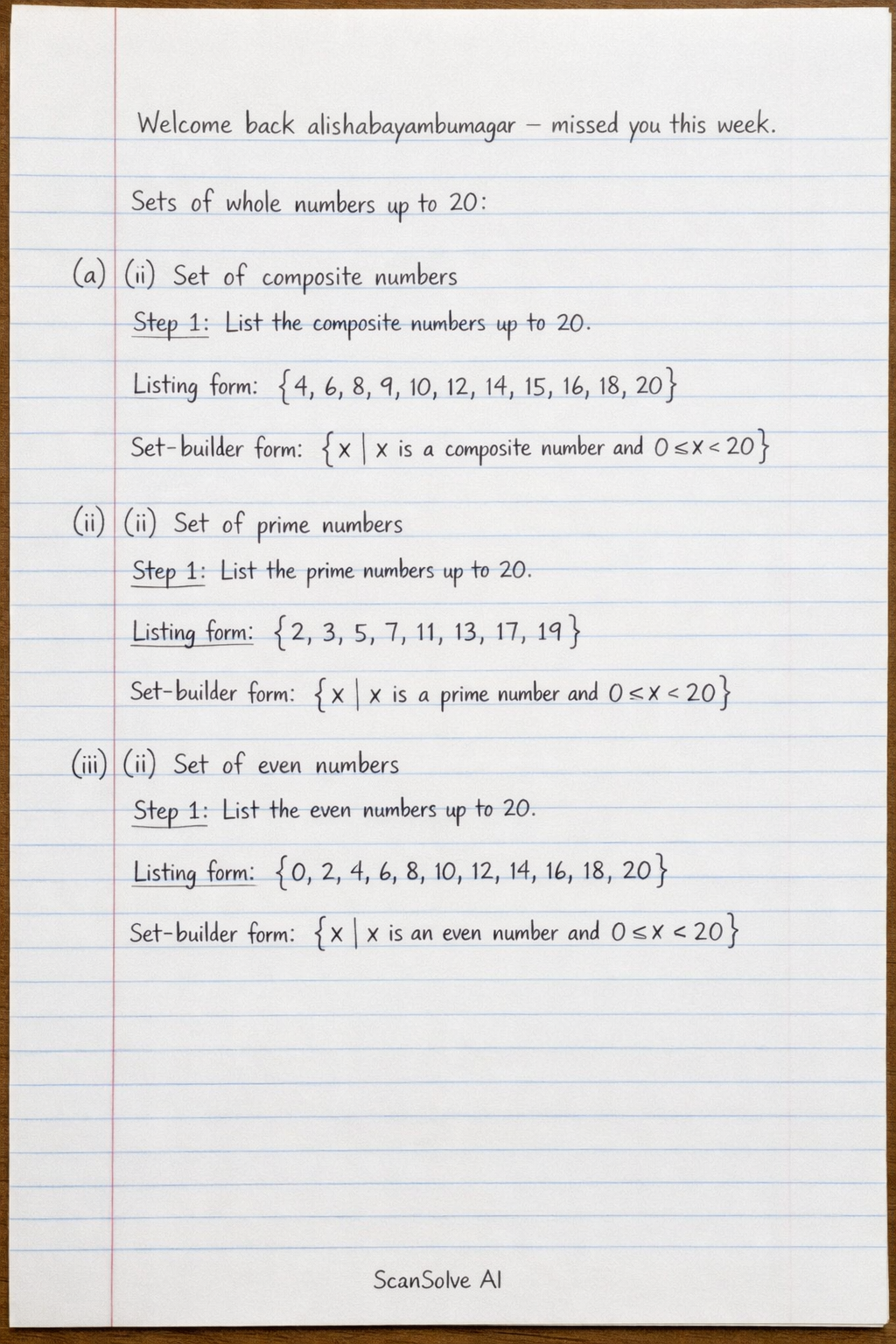
Handwritten Step-by-Step Solution
Get this as a handwritten image on WhatsApp — like a tutor wrote it for you.
Try on WhatsApp