A battery is connected to two resistors, A and B, with resistances 4 and 20 respectively. What is the current?

Physics
A battery is connected to two resistors, A and B, with resistances 4 and 20 respectively. What is the current?

ScanSolve AI Answer

Answer

\frac{5}{1} = 5$$

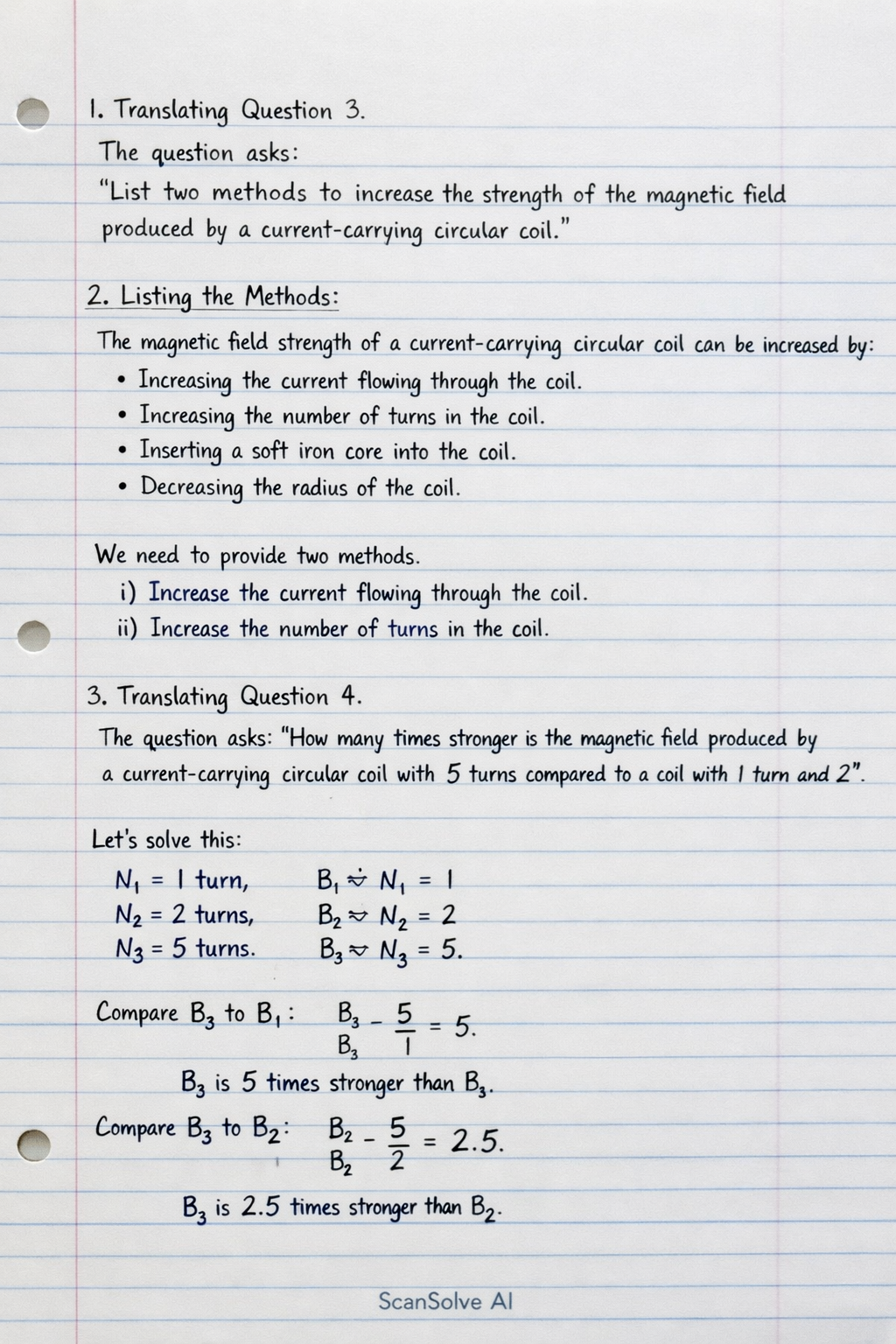
Step 1: Translate Question 3. The question asks: "List two methods to increase the strength of the magnetic field produced by a current-carrying circular coil."

Step 2: List the methods. The magnetic field strength of a current-carrying circular coil can be increased by:

  • Increasing the current flowing through the coil.
  • Increasing the number of turns in the coil.
  • Inserting a soft iron core (ferromagnetic material) into the coil.
  • Decreasing the radius of the coil.

We need to provide two methods. i) Increase the current flowing through the coil. ii) Increase the number of turns in the coil.

Step 3: Translate Question 4. The question asks: "How many times stronger is the magnetic field produced by a current-carrying circular coil with 5 turns compared to a coil with 1 turn and 2 turns?"

Step 4: Determine the relationship and calculate the ratios. The magnetic field strength (BB) produced by a current-carrying circular coil is directly proportional to the number of turns (NN) in the coil, assuming the current and radius are constant. BNB \propto N • Comparing a 5-turn coil to a 1-turn coil: B5turnsB1turn=51=5\frac{B_{5 turns}}{B_{1 turn}} = \frac{5}{1} = 5 The magnetic field is 5 times stronger than that of a 1-turn coil.

• Comparing a 5-turn coil to a 2-turn coil: B5turnsB2turns=52=2.5\frac{B_{5 turns}}{B_{2 turns}} = \frac{5}{2} = 2.5 The magnetic field is 2.5 times stronger than that of a 2-turn coil.

Step 5: Translate Question 5. The question asks: "In the circuit diagram shown, which resistor, A or B, dissipates more electrical power? Give a reason."

Step 6: Analyze the circuit and calculate power. The resistors RA=4ΩR_A = 4 \, \Omega and RB=20ΩR_B = 20 \, \Omega are connected in series. In a series circuit, the current (II) flowing through each resistor is the same. The power (PP) dissipated by a resistor is given by the formula P=I2RP = I^2 R.

• Power dissipated by resistor A: PA=I2RA=I2(4Ω)P_A = I^2 R_A = I^2 (4 \, \Omega) • Power dissipated by resistor B: PB=I2RB=I2(20Ω)P_B = I^2 R_B = I^2 (20 \, \Omega)

Step 7: Compare power dissipation and provide a reason. Since RB=20ΩR_B = 20 \, \Omega is greater than RA=4ΩR_A = 4 \, \Omega, and the current II is the same for both resistors, resistor B dissipates more power. PB>PAP_B > P_A Resistor B dissipates more electrical power. Reason: In a series circuit, the current flowing through all components is the same. The power dissipated by a resistor is directly proportional to its resistance (P=I2RP = I^2 R). Since resistor B has a higher resistance (20Ω20 \, \Omega) than resistor A (4Ω4 \, \Omega), it dissipates more power.

Was this helpful?

Need help with your own homework?

Get instant step-by-step solutions to any question. Free to start.

Ask Your Question
Handwritten step-by-step solution preview

Handwritten Step-by-Step Solution

Get this as a handwritten image on WhatsApp — like a tutor wrote it for you.

Try on WhatsApp

Still have questions?

Quick Answer

Translate Question 3. The question asks: "List two methods to increase the strength of the magnetic field produced by a current-carrying circular coil." Step 2: List the methods.

A battery is connected to two resistors, A and B, with resistances 4 and 20 respectively. What is the current?
Physics

This physics problem tests your understanding of fundamental physical laws and their applications. The step-by-step solution below breaks down the problem using relevant equations and physical reasoning.

ScanSolve AI Answer
Step 1: Translate Question 3. The question asks: "List two methods to increase the strength of the magnetic field produced by a current-carrying circular coil." Step 2: List the methods. The magnetic field strength of a current-carrying circular coil can be increased by: Increasing the current flowing through the coil. Increasing the number of turns in the coil. Inserting a soft iron core (ferromagnetic material) into the coil. Decreasing the radius of the coil. We need to provide two methods. i) Increase the current flowing through the coil. ii) Increase the number of turns in the coil. Step 3: Translate Question 4. The question asks: "How many times stronger is the magnetic field produced by a current-carrying circular coil with 5 turns compared to a coil with 1 turn and 2 turns?" Step 4: Determine the relationship and calculate the ratios. The magnetic field strength (B) produced by a current-carrying circular coil is directly proportional to the number of turns (N) in the coil, assuming the current and radius are constant. B N • Comparing a 5-turn coil to a 1-turn coil: B_5 turnsB_1 turn = (5)/(1) = 5 The magnetic field is 5 times stronger than that of a 1-turn coil. • Comparing a 5-turn coil to a 2-turn coil: B_5 turnsB_2 turns = (5)/(2) = 2.5 The magnetic field is 2.5 times stronger than that of a 2-turn coil. Step 5: Translate Question 5. The question asks: "In the circuit diagram shown, which resistor, A or B, dissipates more electrical power? Give a reason." Step 6: Analyze the circuit and calculate power. The resistors R_A = 4 \, and R_B = 20 \, are connected in series. In a series circuit, the current (I) flowing through each resistor is the same. The power (P) dissipated by a resistor is given by the formula P = I^2 R. • Power dissipated by resistor A: P_A = I^2 R_A = I^2 (4 \, ) • Power dissipated by resistor B: P_B = I^2 R_B = I^2 (20 \, ) Step 7: Compare power dissipation and provide a reason. Since R_B = 20 \, is greater than R_A = 4 \, , and the current I is the same for both resistors, resistor B dissipates more power. P_B > P_A Resistor B dissipates more electrical power. Reason: In a series circuit, the current flowing through all components is the same. The power dissipated by a resistor is directly proportional to its resistance (P = I^2 R). Since resistor B has a higher resistance (20 \, ) than resistor A (4 \, ), it dissipates more power.