

This mathematics problem involves applying core mathematical principles and formulas. Below you will find a complete step-by-step solution with detailed explanations for each step, helping you understand not just the answer but the method behind it.
ScanSolve AI Answer
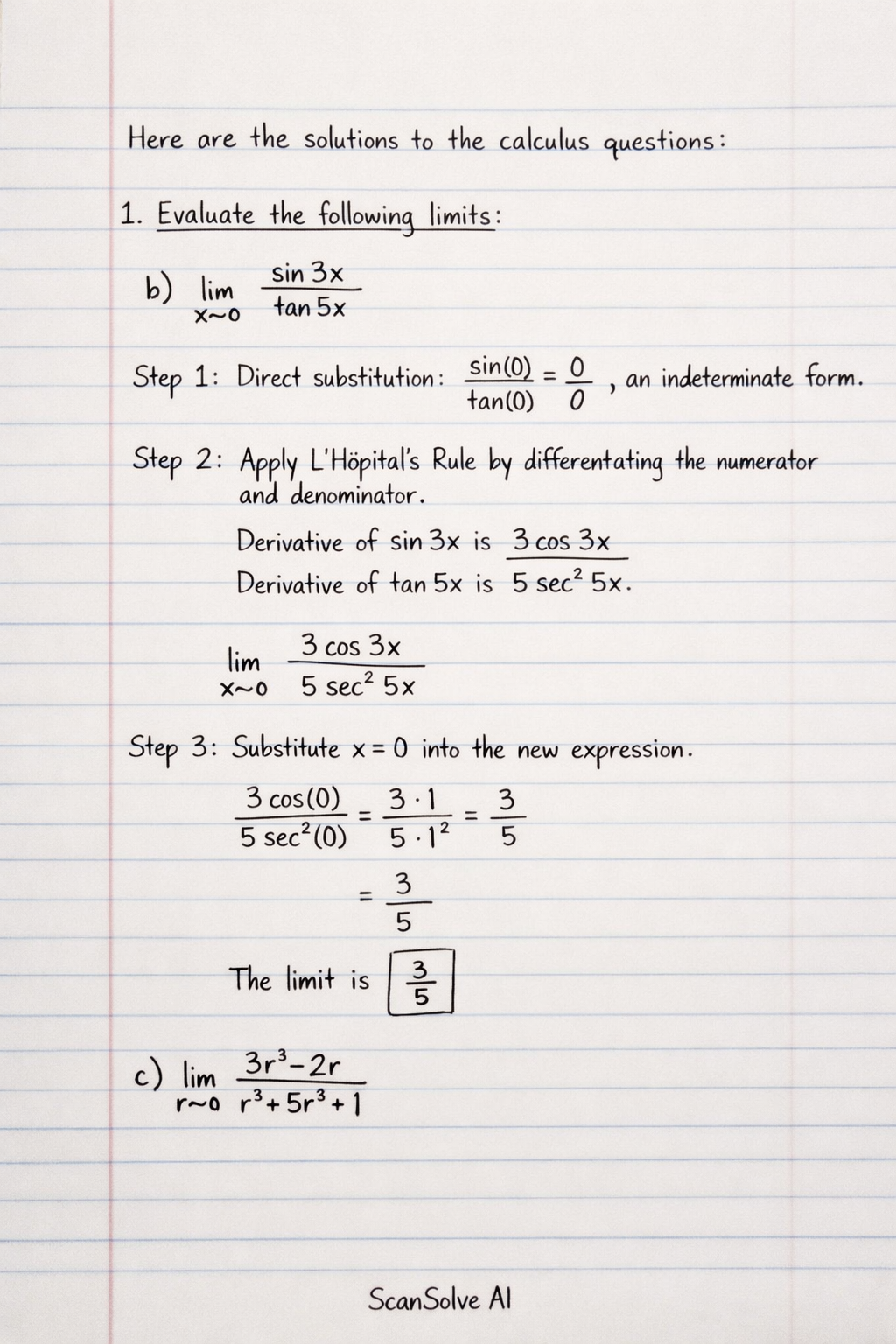
Here are the solutions to the calculus questions: 1. Evaluate the following limits: b) _x 0 ( 3x)/( 5x) Step 1: Direct substitution yields ((0))/((0)) = (0)/(0), an indeterminate form. Step 2: Apply L'Hôpital's Rule by differentiating the numerator and denominator. The derivative of 3x is 3 3x. The derivative of 5x is 5 ^2 5x. _x 0 (3 3x)/(5 ^2 5x) Step 3: Substitute x=0 into the new expression. (3 (0))/(5 ^2(0)) = (3 · 1)/(5 · 1^2) = (3)/(5) The limit is (3)/(5). c) _r (3r^3 - 2r)/(r^3 + 5r^2 + 1) Step 1: Divide every term in the numerator and denominator by the highest power of r in the denominator, which is r^3. _r (3r^3)/(r^3) - (2r)/(r^3)(r^3)/(r^3) + (5r^2)/(r^3) + (1)/(r^3) Step 2: Simplify the expression. _r (3 - 2)/(r^2)1 + (5)/(r) + (1)/(r^3) Step 3: Apply the limit. As r , terms of the form (c)/(r^n) approach 0. (3 - 0)/(1 + 0 + 0) = (3)/(1) = 3 The limit is 3. 2. Differentiate from first principles: a) y = x^2 + 3x Step 1: Write the definition of the derivative from first principles. (dy)/(dx) = _h 0 (f(x+h) - f(x))/(h) Step 2: Substitute f(x) = x^2 + 3x and f(x+h) = (x+h)^2 + 3(x+h). f(x+h) - f(x) = [(x+h)^2 + 3(x+h)] - [x^2 + 3x] = [x^2 + 2xh + h^2 + 3x + 3h] - [x^2 + 3x] = 2xh + h^2 + 3h Step 3: Substitute this into the limit and simplify. (dy)/(dx) = _h 0 (2xh + h^2 + 3h)/(h) = _h 0 (h(2x + h + 3))/(h) = _h 0 (2x + h + 3) Step 4: Apply the limit as h 0. (dy)/(dx) = 2x + 0 + 3 = 2x + 3 The derivative is 2x + 3. b) y = x Step 1: Write the definition of the derivative from first principles. (dy)/(dx) = _h 0 (f(x+h) - f(x))/(h) Step 2: Substitute f(x) = x and f(x+h) = (x+h). f(x+h) - f(x) = (x+h) - x Step 3: Use the trigonometric identity A - B = -2 ((A+B)/(2)) ((A-B)/(2)). (x+h) - x = -2 ((2x+h)/(2)) ((h)/(2)) = -2 (x + (h)/(2)) ((h)/(2)) Step 4: Substitute into the limit and rearrange. (dy)/(dx) = _h 0 (-2 (x + h)/(2)) ((h)/(2))h = _h 0 [ -(x + (h)/(2)) · ((h)/(2))(h)/(2) ] Step 5: Apply the limit, using _ 0 ( )/() = 1. (dy)/(dx) = -(x + 0) · 1 = - x The derivative is - x. 3. Find dy/dx: a) y = (x^2 + 1)^5 Step 1: Use the chain rule. Let u = x^2 + 1, so y = u^5. Step 2: Differentiate y with respect to u and u with respect to x. (dy)/(du) = 5u^4 (du)/(dx) = 2x Step 3: Apply the chain rule (dy)/(dx) = (dy)/(du) · (du)/(dx). (dy)/(dx) = 5u^4 · 2x = 5(x^2 + 1)^4 · 2x = 10x(x^2 + 1)^4 The derivative is 10x(x^2 + 1)^4. b) y = x^3 e^-2x Step 1: Use the product rule: (d)/(dx)(uv) = u'v + uv'. Let u = x^3 and v = e^-2x. Step 2: Find the derivatives of u and v. u' = 3x^2 v' = -2e^-2x Step 3: Apply the product rule. (dy)/(dx) = (3x^2)(e^-2x) + (x^3)(-2e^-2x) (dy)/(dx) = 3x^2 e^-2x - 2x^3 e^-2x Step 4: Factor out common terms. (dy)/(dx) = x^2 e^-2x(3 - 2x) The derivative is x^2 e^-2x(3 - 2x). c) y = ( x) Step 1: Use the chain rule. Let u = x, so y = u. Step 2: Differentiate y with respect to u and u with respect to x. (dy)/(du) = (1)/(u) (du)/(dx) = - x Step 3: Apply the chain rule (dy)/(dx) = (dy)/(du) · (du)/(dx). (dy)/(dx) = (1)/( x) · (- x) = -( x)/( x) = - x The derivative is - x. d) y = (2x) Step 1: Use the chain rule. The derivative of u is (1)/(1+u^2) (du)/(dx). Let u = 2x. Step 2: Find the derivative of u with respect to x. (du)/(dx) = 2 Step 3: Apply the chain rule. (dy)/(dx) = (1)/(1+(2x)^2) · 2 = (2)/(1+4x^2) The derivative is (2)/(1+4x^2). e) x^2 y + y^3 = 5 (implicit) Step 1: Differentiate both sides of the equation with respect to x. Remember to use the product rule for x^2 y and the chain rule for y^3. (d)/(dx)(x^2 y) + (d)/(dx)(y^3) = (d)/(dx)(5) Step 2: Apply differentiation rules. (2x)y + x^2 (dy)/(dx) + 3y^2 (dy)/(dx) = 0 Step 3: Group terms containing (dy)/(dx) and solve for (dy)/(dx). (x^2 + 3y^2) (dy)/(dx) = -2xy (dy)/(dx) = (-2xy)/(x^2 + 3y^2) The derivative is (-2xy)/(x^2 + 3y^2). f) x = e^t t, y = e^t t (parametric) Step 1: Use the formula for parametric differentiation: (dy)/(dx) = (dy/dt)/(dx/dt). Step 2: Find (dx)/(dt) using the product rule. (dx)/(dt) = (d)/(dt)(e^t t) = e^t t + e^t (- t) = e^t( t - t) Step 3: Find (dy)/(dt) using the product rule. (dy)/(dt) = (d)/(dt)(e^t t) = e^t t + e^t t = e^t( t + t) Step 4: Substitute into the formula for (dy)/(dx). (dy)/(dx) = (e^t( t + t))/(e^t( t - t)) Step 5: Simplify by canceling e^t. (dy)/(dx) = ( t + t)/( t - t) The derivative is ( t + t)/( t - t). 4. Find and classify all stationary points of y = 2r^3 - 9r^2 + 12r - 3. Step 1: Find the first derivative, (dy)/(dr). (dy)/(dr) = 6r^2 - 18r + 12 Step 2: Set the first derivative to zero to find critical points. 6r^2 - 18r + 12 = 0 Divide by 6: r^2 - 3r + 2 = 0 Factor the quadratic equation: (r-1)(r-2) = 0 The critical points are r=1 and r=2. Step 3: Find the corresponding y values for these critical points. For r=1: y = 2(1)^3 - 9(1)^2 + 12(1) - 3 = 2 - 9 + 12 - 3 = 2. Point: (1, 2). For r=2: y = 2(2)^3 - 9(2)^2 + 12(2) - 3 = 16 - 36 + 24 - 3 = 1. Point: (2, 1). Step 4: Find the second derivative, (d^2y)/(dr^2), to classify the stationary points. (d^2y)/(dr^2) = 12r - 18 Step 5: Evaluate the second derivative at each critical point. For r=1: (d^2y)/(dr^2) = 12(1) - 18 = -6. Since -6 < 0, (1, 2) is a local maximum. For r=2: (d^2y)/(dr^2) = 12(2) - 18 = 6. Since 6 > 0, (2, 1) is a local minimum. The stationary points are: (1, 2), which is a local maximum*. (2, 1), which is a local minimum*. 5. A rectangular box with no lid has a square base of side x and height h. Given that the total surface area is 75 cm^2, find the dimensions for maximum volume. Step 1: Write expressions for the volume (V) and surface area (A). Volume: V = x^2 h Surface Area (base + 4 sides): A = x^2 + 4xh Step 2: Use the given surface area (A=75 cm^2) to express h in terms of x. 75 = x^2 + 4xh 4xh = 75 - x^2 h = (75 - x^2)/(4x) Step 3: Substitute h into the volume equation to get V(x). V(x) = x^2 ((75 - x^2)/(4x)) = (x(75 - x^2))/(4) = (75x - x^3)/(4) = (75)/(4)x - (1)/(4)x^3 Step 4: Find the first derivative of V(x) and set it to zero to find critical points. (dV)/(dx) = (75)/(4) - (3)/(4)x^2 (75)/(4) - (3)/(4)x^2 = 0 75 - 3x^2 = 0 3x^2 = 75 x^2 = 25 Since x must be positive, x = 5 cm. Step 5: Find the corresponding height h. h = (75 - (5)^2)/(4(5)) = (75 - 25)/(20) = (50)/(20) = 2.5 cm Step 6: Use the second derivative test to confirm it's a maximum. (d^2V)/(dx^2) = -(6)/(4)x = -(3)/(2)x At x=5: (d^2V)/(dx^2) = -(3)/(2)(5) = -(15)/(2). Since this is negative, it's a maximum. The dimensions for maximum volume are x = 5 cm and h = 2.5 cm. 6. Water leaks from a conical tank (vertex down) at 3 m^3/min. The tank has radius 2 m and height 5 m. Find the rate at which the water level falls when the depth is 3 m. Step 1: Identify given information and what to find. Given: (dV)/(dt) = -3 m^3/min (negative because water is leaking). Tank dimensions: R = 2 m, H = 5 m. Find: (dh)/(dt) when h = 3 m. Step 2: Write the volume of a cone: V = (1)/(3) r^2 h. Step 3: Use similar triangles to relate r and h for the water in the cone. (r)/(h) = (R)/(H) = (2)/(5) r = (2)/(5)h Step 4: Substitute r into the volume formula to express V in terms of h. V = (1)/(3) ((2)/(5)h)^2 h = (1)/(3) ((4)/(25)h^2) h = (4)/(75)h^3 Step 5: Differentiate V with respect to time t. (dV)/(dt) = (4)/(75) · 3h^2 (dh)/(dt) = (4)/(25)h^2 (dh)/(dt) Step 6: Substitute the known values ((dV)/(dt) = -3, h=3) and solve for (dh)/(dt). -3 = (4)/(25)(3)^2 (dh)/(dt) ✂️ _That answer was long and got cut off. Reply continue and I'll finish it._