

This mathematics problem involves applying core mathematical principles and formulas. Below you will find a complete step-by-step solution with detailed explanations for each step, helping you understand not just the answer but the method behind it.
ScanSolve AI Answer
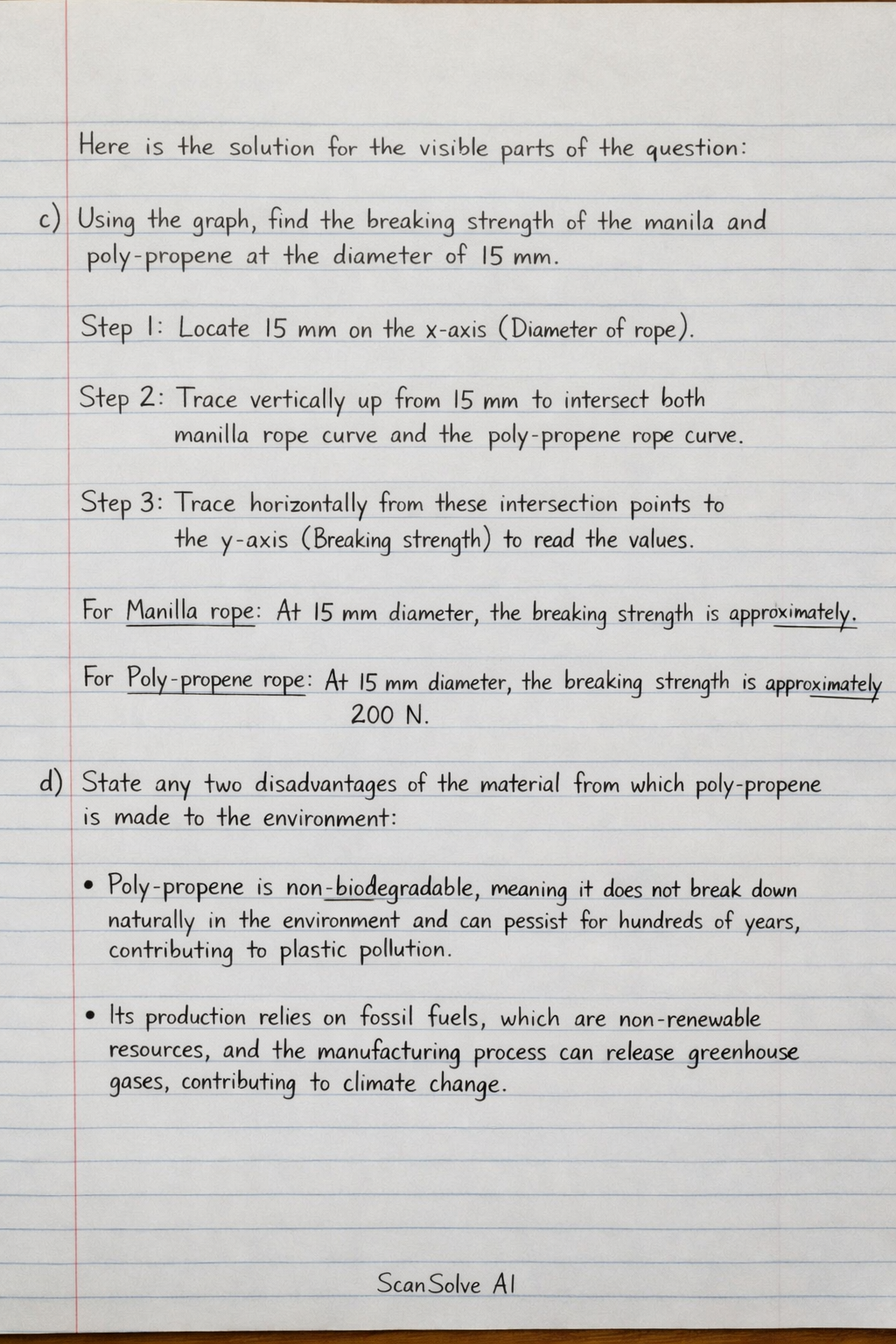
Here is the solution for the visible parts of the question: c) Using the graph, find the breaking strength of the manila and poly-propene at the diameter of 15 mm. Step 1: Locate 15 mm on the x-axis (Diameter of rope). Step 2: Trace vertically up from 15 mm to intersect both the manilla rope curve and the poly-propene rope curve. Step 3: Trace horizontally from these intersection points to the y-axis (Breaking strength) to read the values. For Manilla rope: At 15 mm diameter, the breaking strength is approximately 200 N*. For Poly-propene rope: At 15 mm diameter, the breaking strength is approximately 400 N*. d) State any two disadvantages of the material from which poly-propene is made to the environment. Poly-propene is non-biodegradable*, meaning it does not break down naturally in the environment and can persist for hundreds of years, contributing to plastic pollution. Its production relies on fossil fuels*, which are non-renewable resources, and the manufacturing process can release greenhouse gases, contributing to climate change. 3 done, 2 left today. You're making progress.